


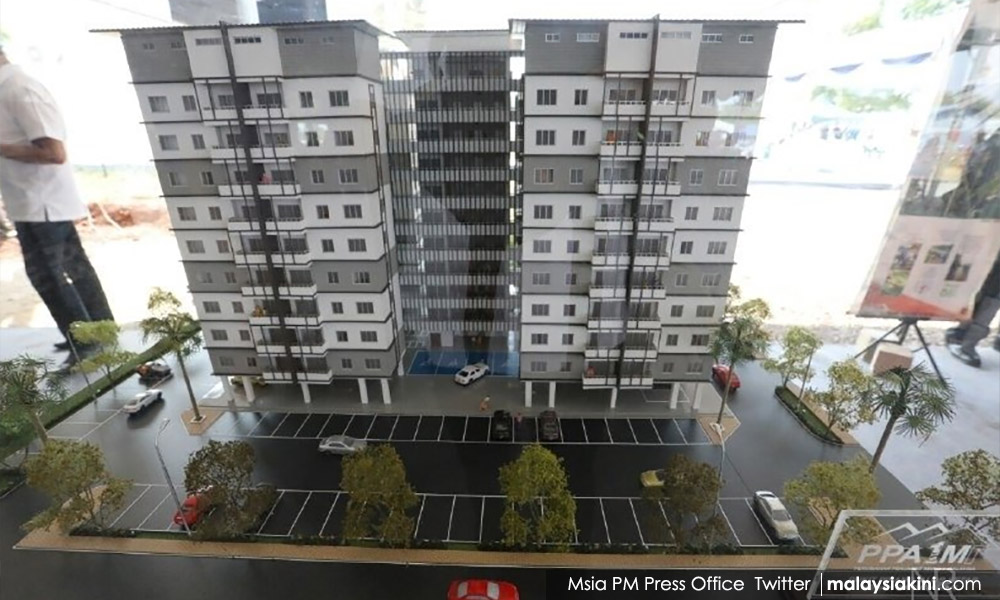

A house for everybody, especially the youngsters
LETTER | Yang Amat Berhormat Perdana Menteri,
I wonder whether you noticed that most local university students are only keen on participating in co-curriculum activities that award certificates or points and further on, after graduation, they prioritise getting new cars and high-end smartphones before acquiring other worldly assets.
These preferences have been subliminally implanted in them through unsatisfactory education policies and educationists, and further fortified by peer pressure as well as ingenious marketing.
To maintain their lifestyle, some even default on their PTPTN loan repayments until they are barred from travelling abroad. Very few bother to work towards buying their own homes chiefly because there is nothing much to save from the miserable wages they earn.
In the 2017 Budget, the previous regime provided a tax-deductible lifestyle allowance which I surmise to be giving young workers “fish for a day” instead of teaching them how to fish so that they can eat for the rest of their lives.
Meanwhile, state and local authorities impose guidelines on housing developers to build "affordable" homes which first-time buyers cannot qualify for financing.
Developers and bankers want their pound of flesh oblivious to helping to provide long-lasting solutions and this has culminated in an overhang of 24,738 residential units shown in the 2017 Property Report by the Valuation and Property Services Department (JPPH).
The Malay proverb "melentur buluh biar dari rebungnya" offers an insight on how important it is to inculcate the right values in our young. They should be taught how to live frugally and meaningfully.
This 2015 article is on how a non-profit organisation, Options-For-Homes helps immigrants with just 1,000 Canadian dollars to own a home rather renting one.
Options-For-Homes offers a co-ownership scheme by giving down payment loans equivalent to 10-15% of the selling price of a home and recoup their investment by taking 10-15% from the disposal price years later.
But legislation may prevent Malaysian developers from offering similar schemes. The Pakatan Harapan government in Penang has been exemplary in giving a 30% interest-free loan to buyers of affordable homes but this facility is limited to homes by the Penang Development Corporation.
Perhaps your cabinet should be inspired by Penang to consider setting up a revolving fund which can assist young workers nationwide to own rather than to rent homes near their workplaces.
In major towns, buying 450 sq ft shoebox units, euphemistically marketed as "studio" apartments costing RM200,000 will translate into a monthly mortgage slightly below RM1,000 if financed 70% on a loan of 30-year tenure by most banks.
Post-merdeka, all government lands were registered under the Federal Lands Commissioner (FLC) and a mechanism to emulate the FLC, tentatively named "Federal Affordable Homes Authority" (Faha).
The 30% Faha co-ownership can be reflected in the sale and purchase agreement (SAP) and land/strata titles.
To prevent abuse by borrowers, Faha co-ownership loans (Cool) should be disbursed via lawyers to banks and insurance companies financing the home loans while 30% of the disposal price can be repaid to Faha in the same manner.
The Faha-Cool revolving fund can spawn manifold benefits not limited to the following:-
(a) re-orientating the young from the present toxic lifestyle,
(b) building up their credit score,
(c) providing them with incidental insurance cover (via MRTA),
(d) expanding job opportunities to new townships near their folks where RM200,000 may be able to purchase a terrace house,
(e) assisting developers to address their overhang,
(f) reducing the risks of non-performing loans (NPLs) for financial institutions which may insist on auto-deductions from the borrowers' bank-in pay packets (akin to the Treasury's “arahan potong gaji” to the government department employing the borrower of its housing loan),
(g) encouraging insurance companies to foray beyond the MRTA business into the home loans industry,
(h) reducing speculative purchase of homes for rentals,
(i) increasing government coffers with stamping revenue, and most importantly
(j) alleviating the financial burden and mental anguish of old folks who worry whether their offspring have enough to live by.
To be honest, I am declaring my vested interest - that I am one of those old folks mentioned above.
I am sure formally trained economists can present more accelerator and multiplier benefits than the 10 listed by me.
Thank you.
The views expressed here are those of the author/contributor and do not necessarily represent the views of Malaysiakini.


Are you sure you want to delete this comment?
This action cannot be undone.