



SEN children - making preschool inclusion mandatory
Dear Yang Berhormat Dr Maszlee Malik,
LETTER | “Golongan kurang upaya (OKU) dan anak istimewa memiliki tempat yang kusus dalam hati saya [..] saya mahu memastikan mereka mendapat pendidikan yang berkualiti melalui persekolahan yang conducive dan juga inclusive.”
(An excerpt from Maszlee Malik’s initial speech as the education minister on May 22, 2018).
We welcome and embrace your appointment as Malaysia’s 19th education minister. Congratulations. Inspired and encouraged by your aspirations and sentiments regarding children with Special Educational Needs, we would like to put forward to your good self our proposal on “Making preschool inclusion mandatory.’’
We are teachers from both the early childhood and special education fields, currently pursuing a weekend diploma programme for special needs (early years). In line with our proposal in making it mandatory for all pre-schools in Malaysia to practice inclusive education, our suggestions are as follows:
Benefits of mandatory preschool inclusion
(1) As you are well aware, there are tremendous benefits in implementing inclusive education and this is also mentioned in the National Education Blue Print. In an inclusive preschool setting, children with SEN can be identified early and be given the necessary intervention at this critical, formative stage. This would provide the opportunities for SEN children to receive the specialised support and instruction which would impact their growth and development in positive ways.
Research has shown that early identification and intervention prevents and reduces challenges faced by children in schools in later years as opposed to children who are not identified as SEN in their early years.
(2) Making it mandatory for all preschools to be inclusive would make early intervention accessible and affordable to more children; including children from preschools in the rural areas as well. Currently, children with learning disabilities requiring additional support attend segregated Early Intervention Centres (EIP). These services are for the most part quite expensive and not all families can afford them.
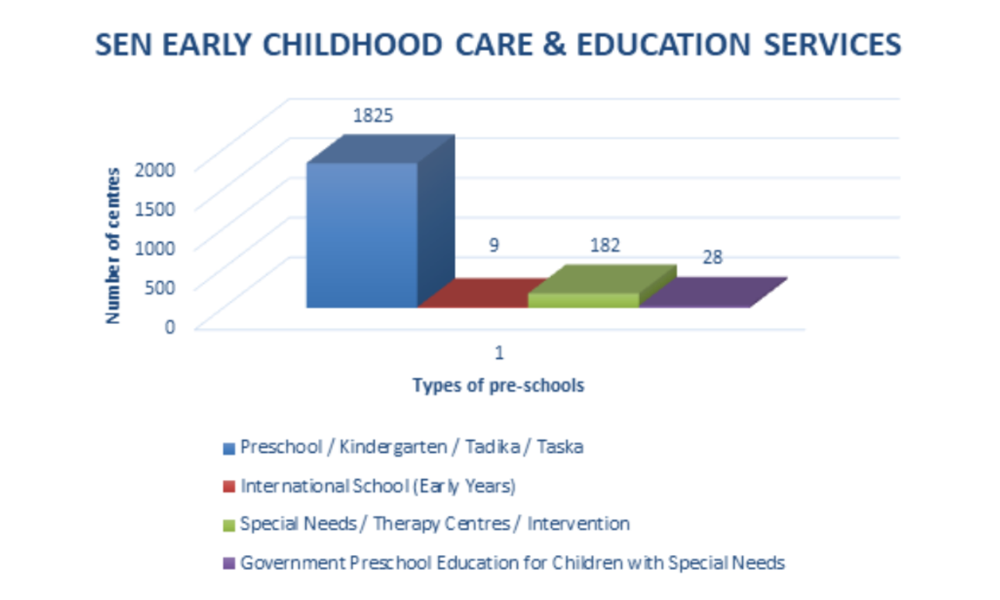
The government SEN (Special Education Needs) preschools, on the other hand, are far and few in between; whilst typical preschool institutions, may accept SEN but provide minimal assistance only. The diagram below shows the number of special Needs/therapy centres available in Malaysia as compared to conventional preschools/tadika.
Needless to say, the number of special needs/therapy centres is not able to cater to the needs of the society with respect to special needs education. In line with this, we would suggest that inclusive education is made mandatory for all preschools in Malaysia. This would not only make special needs education accessible to all levels of society in Malaysia but also make it affordable as well.
Currently, around one percent of special needs pupils are included in mainstream classes (MoE, 2013).
The three main obstacles to making inclusive education in pre-schools mandatory are
a) The lack of SEN teachers
b) The high cost of running an inclusive pre-school
c) Affordable and accessible pre-schools for special needs children
(3) To pave the way for an effective and sustainable Preschool inclusion we suggest that SEN teachers be stationed at each and every pre-school as curriculum specialists supporting the general education teacher with a variety of instructional strategies. Alternatively, they can also function as resource- room teachers who supplement the basic curriculum by providing specialised instruction for SEN children.
In order for this to materialise, the Special Education Department needs to invest in teacher training of SEN teachers. Currently, the number of qualified SEN teachers is limited and not sufficient to meet the needs of society. We recommend the government subsidise the cost of special education (pre-school/early years) or make more places available in public universities to enable and encourage more students to enrol in these courses.
The general education teacher, on the other hand, would also need some form of training and guidance in making inclusion successful in their classrooms. Mainstream teachers assume the responsibility towards special needs pupils rested solely on the shoulders of special education teachers.
Therefore, it is understandable that most mainstream teachers are not aware or even concerned about pupils with special needs. Comprehension among Malaysian mainstream teachers on LD is low while the success of a holistic IE program will require active involvement of mainstream teachers in tackling problems faced by special needs pupils in the classroom.
Studies also indicate pre-service and in-service courses taken by mainstream teachers in special education are not adequate for them to understand or even teach special needs pupils in the classroom. This resulted in the low acceptance of IE by mainstream teachers. The acceptance of mainstream teachers can be increased through training and education on the characteristics and behaviour of special need pupils.
(4) Another obstacle to the implementation of Inclusive education is the cost of running these schools. The cost of employing SEN teachers and professional support i.e. speech and occupational therapists, as well as capital expenditure when physical accommodations and adaptations are put in place to meet the specific needs of SEN children can be quite prohibitive to a majority of pre-schools which are already running on extremely tight budgets.
Extending subsidies or tax incentives to all privately operated pre-schools would help to reduce substantially both operational costs and capital expenditure and thereby help them be more receptive towards the mandatory inclusive setting.
Therefore we are hopeful Minister Maszlee Malik that our suggestions would merit due consideration from your good self. The nation stands to benefit from early intervention because research indicates that with early intervention children grow up to be self-sufficient citizens who are able to contribute fruitfully to the community.
Thank you for your kind attention.
This letter is also signed by Aw Jia Yi, Yap Pei Jee, Nithiya, Louisa Lim Siew Tian, Lim Keen Gaik and Yuen Mai Kiew.
The views expressed here are those of the author/contributor and do not necessarily represent the views of Malaysiakini.


