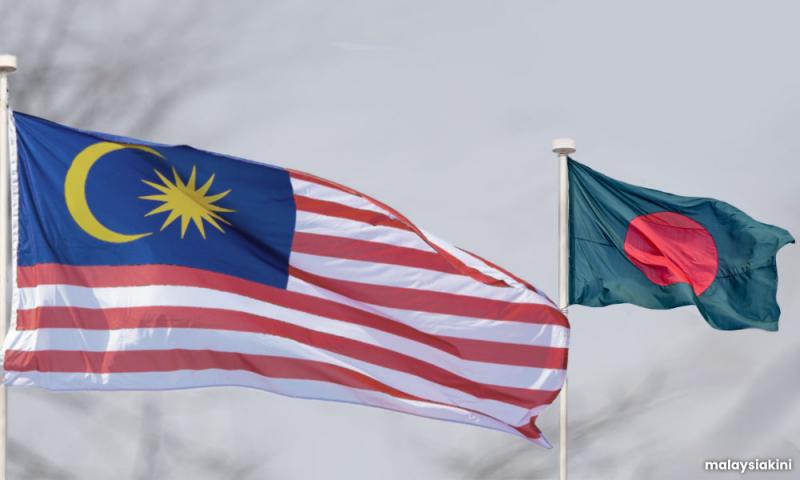

LETTER | The Global Human Rights Federation (GHRF) expresses its grave disappointment with the Madani government’s continued inaction in addressing the persecution and mass violence faced by Hindu minorities in Bangladesh, even on basic humanitarian grounds.
Malaysia and Bangladesh share long-standing diplomatic, economic, and people-to-people ties. Hundreds of thousands of Bangladeshi nationals live and work in Malaysia, contributing significantly to the country’s labour force and economy. These close connections mean that developments in Bangladesh are not distant concerns; they directly affect our region.
As Asean chair, Prime Minister Anwar Ibrahim carries a significant moral responsibility. When minority communities face sustained violence and lives are at imminent risk, silence does not preserve peace; it erodes moral leadership.
His silence on the atrocities in Bangladesh is deeply troubling, particularly when contrasted with the strong and vocal advocacy shown on the issue of Palestine. Such indifference stands in stark contrast to the way the Madani administration actively rallies for the plight of Palestinians.
When it comes to humanity, there are no borders, and selective empathy undermines our shared values. What is unfolding in Bangladesh should disturb every conscience.
In Mymensingh, a young Hindu man, Dipu Chandra Das, was brutally beaten to death by a mob over allegations of blasphemy, and his body was tied to a tree and set on fire. This was not spontaneous violence. It was a deliberate act of terror meant to intimidate an entire community.
The atrocities committed against the Hindu community include killings, arson, sexual violence, and targeted attacks, alongside the widespread vandalism, looting, and destruction of homes, businesses, and Hindu temples. These acts have caused profound devastation and lasting trauma.
Such violence is not new in Bangladesh; similar waves of violence occurred in August last year and in previous years and have also targeted the minority Buddhist community. This recurring pattern reflects decades of coordinated attacks by extremist elements and highlights a persistent failure to safeguard or protect the religious minorities.
When victims consistently come from minority communities, when women and children are harmed, and when accountability remains absent, it becomes increasingly difficult to deny that systematic persecution is taking place.
Malaysia cannot afford to remain silent.
As a country that hosts a large Bangladeshi migrant population and as a regional leader, Malaysia’s voice carries significant weight. Anwar should raise these concerns directly with Bangladesh’s interim prime minister, Nobel laureate Muhammad Yunus, and demand clarity on what concrete steps are being taken to protect minorities, women, and children and why such repeated incidents of violence are taking place.
Humanity does not wait for diplomatic convenience. When people are attacked for who they are, when women and children are harmed or displaced, these are not political inconveniences; they are moral emergencies.
There is also a conversation Malaysia must confront internally. Many Bangladeshis come to Malaysia seeking dignity and honest work. However, when people flee environments shaped by extreme violence and trauma, the consequences do not end at national borders. If violence against minorities continues unchecked in Bangladesh, what risks does this pose for Malaysia’s future social harmony and regional security?
The failure of the Madani government to condemn religiously or racially motivated violence sends the wrong impression and message about the country’s stance towards not only non-Muslim practitioners in Malaysia but also Malaysia being a multiracial, multireligious secular nation.
For those seeking to understand the scale of suffering faced by minorities in Bangladesh, visual documentation shared by civil society groups can be found on the Instagram pages Rescue Sindhi Hindus and Voice of Bangladeshi Hindus, where denial becomes increasingly difficult.
Can we afford to remain silent today and manage the consequences tomorrow?
We must choose empathy clearly, urgently, and without borders.
HEMA SUBRAMANIAM is vice-secretary, Global Human Rights Federation (GHRF).
The views expressed here are those of the author/contributor and do not necessarily represent the views of Malaysiakini.