




Overlapping claims a serious security threat
The Royal Malaysian Navy (RMN) feels the issue of overlapping claims remains the most significant maritime security threat faced by our country. Malaysia is a maritime nation, and its maritime border is overlapped by six neighboring countries.
The Royal Malaysian Navy (RMN) feels the issue of overlapping claims remains the most significant maritime security threat faced by our country. Malaysia is a maritime nation, and its maritime border is overlapped by six neighboring countries.
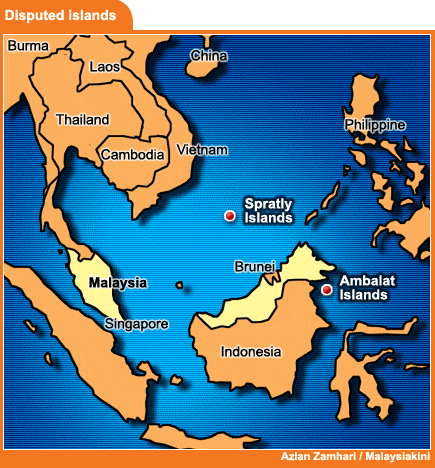
One of the most important overlapping issues includes the Spratly Islands in the South China Sea and Ambalat in the Sulawesi Sea.
These disputes, which are generally the legacy of colonial history as well as the enactment of the United Nations Conference on the Law of the Sea (UNCLOS) 1982, enable littoral states to lay claim to waters and features that they hitherto had not.
Consequently, the claimant countries are pushing their claim by having a military presence on their occupied territories or islets. The military presence in these areas indicates their willingness to resort to armed conflict, if required, to defend their claim. Such precarious situations can develop into crises if they are not addressed cautiously.
In fulfilling its tasks and role of safeguarding the Malaysian maritime interests, the RMN has taken various approaches to ensure the region remains stable and secure. Other than the political avenue taken by the government, the navy's efforts include intensifying and enhancing its relations with other regional navies. These interactions have always been given appropriate importance and consideration.
It is not limited to conducting regular inter-naval exercises but also conducting joint patrols in the disputed areas. In addition, the littoral-state navies of the Strait of Malacca - Malaysia, Singapore, Indonesia, and Thailand - have worked together and successfully reduced the piracy threat in the strait. Ultimately, such cooperation and understanding has created a mutual trust and develops confidence-building among the participants.
Avoiding unnecessary incidents
The RMN is also pleased to note that it has promulgated the Preventions of Sea Incidents Guidelines among the neighboring navies, particularly that of Indonesia. The agreement is non-binding between the navies, but serves to guide the commanders on the scene to help avoid unnecessary incidents. Such guidelines have managed to keep tensions from escalating.
Though some disputes have been resolved amicably through mutual agreement and the International Court of Justice, others remain unresolved. At the same time, no serious security disruptions are anticipated in the immediate future. This includes the South China Sea, where the Declaration on the Conduct of Parties in the South China Sea was agreed upon, as well as cordial relations among the disputing states that help maintain and sustain a peaceful situation.
Meanwhile, the RMN will continue to play its part by ensuring relations between the regional navies are kept harmonious, as we believe it is the best way to reduce the possibilities of conflict at sea.
(ADMIRAL ABDUL AZIZ JAAFAR is the Royal Malaysian Navy chief. The above commentary first appeared in the US Naval Institute’s publication Proceedings .)


Are you sure you want to delete this comment?
This action cannot be undone.