




Batang Ai: Art of 'randau ruai' key in campaign
A speaker’s ability to weave historical folklore, especially of Iban warriors, into a rhetorical style that subtly plays on emotions, renders political ideas in simple terms, employs references to Iban culture and lifestyle, while leavening the whole with humour makes one a skilled exponent of ‘randau ruai’.
A speaker’s ability to weave historical folklore, especially of Iban warriors, into a rhetorical style that subtly plays on emotions, renders political ideas in simple terms, employs references to Iban culture and lifestyle, while leavening the whole with humour makes one a skilled exponent of ‘randau ruai’.
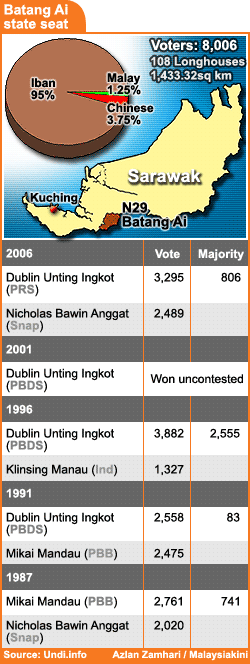
Batang Ai is a majority Iban constituency - up to 93% of the 8,129 voters - so the mastery of art of ‘randau ruai’, which translates as ‘verandah conversation’, will count in the battle between the contestants, likely to be Malcolm Mussen of Parti Rakyat Sarawak (PRS) and Jawah Gerang of PKR.
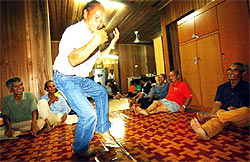 ‘Ruai’ refers to the verandah of the longhouses in which the Iban live, an open area, often lit by fluorescent lamps, where the folk spread their mats to sit and while away the night in conversation after dinner.
“You have to be good at ‘randau ruai’, especially if the contest between the candidates is going to be close,” said Edmund Langgu Saga, a widely acknowledged exponent of the art and at one time, the youngest MP in Malaysian parliamentary history.
 He was 25 when he became representative for Saratok in 1963, just after Sarawak merged with the Federation. That record was overtaken by Najib Abdul Razak when became MP for Pekan at 23 in January 1976.
“Iban are great talkers. They favour as their political representatives speakers who are skilled at ‘randau ruai’,” said Langgu, who was originally from Sarawak National Party (Snap) and later Parti Bansa Dayak Sarawak (PBDS) in his 23 years as MP (1963-86).
The retired former deputy minister of agriculture is currently in the final stages of compiling the first Iban dictionary.
Langgu was born in Saratok, in the middle reaches of the mighty Rajang river, the longest in Malaysia and of mythic significance to the Iban who populate its upper and middle reaches.
Before the Iban of the Saribas region, also located in the middle reaches of the Rajang but at a remove from Saratok, acquired a reputation in the mid-1900s as the best speakers of the mother tongue, it was ‘Saratok Iban’ that was the best spoken.
Using logic and humour to make a point
Langgu, 71, learned the tongue from his grandparents and uncles and was able to ascend to a level of exposition considered the highest of the ‘randau ruai’ arts. This is when your speech is larded with rhythmic couplets that blend references to historic Iban personages with current concerns.
“This is the ‘randau ruai’ of the bards,” said Langgu, regarded as the last of the exponents of this dying art, the building blocks of which are quarried in the depths of Iban folklore and lifestyle.
 According to Langgu, eloquent exponents of the prosaic version of ‘randau ruai’, as distinct to the lofty bardic style, are Dunstan Endawie, the former president of Snap, the late Edwin Tangkun and Leo Moggie, both originally from Snap but broke away to form PBDS, and James Masing, formerly PBDS and now PRS leader and state land development minister.
“A good exponent of the prosaic version of ‘randau ruai’ would be able to simplify political ideas, employ references to Iban folklore and lifestyle, and use logic and humour to make his points,” explained Langgu.
He would rate Jawah Gerang as a more skilled exponent of ‘randau ruai’ than Nicholas Bawin, the PKR election director for the Batang Ai by-election and until Jawah was announced as the PKR candidate last Monday, the leading candidate in pre-election speculation.
“Jawah’s ‘randau ruai’ is a bit rough but it is still good. As for Malcolm Mussen, nothing is known of his ability in the art. However, speaking ability is an important though not the decisive factor in elections,” offered Langgu.


Are you sure you want to delete this comment?
This action cannot be undone.