




Federal Court to rule on Borneo lawyers soon
Lawyers across both sides of the South China Sea are keeping their fingers crossed on whether the Federal Court will soon rule for or against them in the matter of two related “hot potato” issues before it.
Lawyers across both sides of the South China Sea are keeping their fingers crossed on whether the Federal Court will soon rule for or against them in the matter of two related “hot potato” issues before it.
First, is the issue of whether lawyers from the two states in Malaysian Borneo can appeal and argue cases in the Court of Appeal or the Federal Court when such courts sit outside the states of Sabah and Sarawak on cases which originate from the said states.
Specifically, it refers to the Court of Appeal and the Federal Court sitting in Putrajaya at the Palace of Justice.
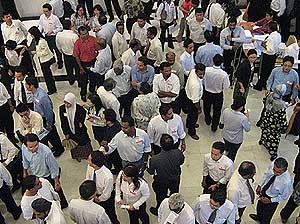 The related issue is whether lawyers from the Malayan Bar who have not been admitted either to the Sabah or Sarawak Bar can appear in the Court of Appeal or the Federal Court in cases which originate from the two states in Malaysian Borneo.
“We are pleased to say that these urgent questions will be answered soon by the Federal Court,” said Sabah Law Association president John Sikayun.
“These issues have been vexing the members of both the Sabah and Sarawak Bars for a long time. We hope we don’t have to wait for more than another month at the most. Cases are piling up.”
“The exclusive rights of counsel from Sabah and Sarawak to appear in the appellate courts in Putrajaya for cases originating from Sabah and Sarawak must be entrenched.”
'Proprietary rights'
Sikayun added that the issues involve constitutional safeguards granted to Sabah and Sarawak as contained in the Malaysia Agreement, the Inter-Governmental Committee Report, the Malaysia Act and the Federal Constitution.
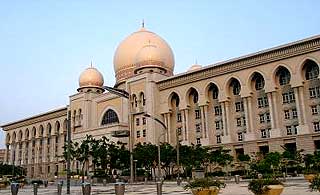 Apparently, the issue of the Appellate Court and Federal Court sitting in Putrajaya in Sabah/Sarawak-origin cases only arise in urgent matters.
Otherwise, the courts can convene at leisure in the Borneo territories in the matter of Sabah and Sarawak-origin cases.
One issue is whether the Malayan Bar Council has “proprietary rights” over the Federal Territories of Kuala Lumpur, Putrajaya and Labuan but this was not brought up during the Federal Court hearing on March 10 in Kuching, conceded Sikayun.
“We were more focused on Labuan, where lawyers from all over Malaysia and even Brunei appear in court.
“By right, the Federal Territories are a ‘legal no man’s land’ and members of the Borneo Bars should also be allowed to appear before the court.
"The Federal Territories should not be considered as being in the same league as one of the states in Peninsular Malaysia. Hopefully, this point would be considered by the Federal Court.”
Instead, the Federal Court heard other arguments and submissions from a number of interested parties on the two issues in Kuching on March 10.
The five-member Federal Court panel, after hearing submissions from all parties concerned, reserved judgment.
The panel consisted of Chief Justice Zaki Azmi, Chief Judge of Sabah and Sarawak Richard Malanjun, the Chief Judge of Malaya Ariffin Zakaria, Court of Appeal president Aluddin Mohd Shariff and Federal Court judge Zulkefli Ahmad Makinuddin.
Earlier, on Nov 7 last year, Court of Appeal Judge Gopal Sri Ram ruled that the right of counsel to appear in cases heard in the Appellate Court’s sitting in Putrajaya is governed by the Legal Profession Act 1976 and therefore only lawyers of the Malayan Bar could appear and argue in cases in Putrajaya notwithstanding that such cases originated from Sabah or Sarawak.
Legal Profession Act 1976
The Court of Appeal also said that the Sarawak Advocates Ordinance, as in the case of Sabah, has no extra territorial effect. The right of audience before the court sitting in Putrajaya was governed not by the Sarawak Ordinance, in this case, but by the Legal Profession Act 1976.
The Legal Profession Act 1976 has not been extended to Sabah and Sarawak. The legal profession in Sabah is governed by the Advocates Ordinance of Sabah, while in Sarawak, the legal profession is governed by the Advocates Ordinance of Sarawak.
The legal profession in the states of Sabah and Sarawak come under the purview of their respective regulatory bodies which are distinct from the Bar Council of Malaya.
Gopal Sri Ram also held that the Courts of Judicature Act 1964 (Coja) empowered the president of the Court of Appeal to direct an appeal against the decision of the High Court in Sabah and Sarawak (until recently known as the High Court of Borneo) to be heard by the court (Appellate Court) anywhere in the states of Malaya. The High Court of Malaya is the other High Court in Malaysia.
The two issues before the Federal Court arose from an appeal in a case brought by businessman Ting Cheuk Sii against another businessman Muhammad Tufail Mahmud, and eight others, which was heard in Putrajaya instead of Kuching last year.
The issue started from a Kuching High Court decision on July 26, 2007 against the dismissal of a petition presented under Section 181 of the Companies Act and against another petition to wind up Sibu-based Sanyan Holdings Sdn Bhd. Last year, Ting appealed against the High Court decision.
No right to appear
 Sim Hui Chuang, counsel for respondents, had argued against lawyer Tommy Thomas (
left
) appearing for Ting in the appeal case.
Sim Hui Chuang, counsel for respondents, had argued against lawyer Tommy Thomas (
left
) appearing for Ting in the appeal case.
The argument was that if the case had been heard in Kuching, Thomas would have no right to appear on behalf of his client as the Sarawak Advocates Ordinance was against it.
The Sabah Law Association (SLA) and the Advocates Association of Sarawak (AAS), in a joint statement called the Gopal Sri Ram ruling as a serious violation of the Malaysia Agreement.
“The decision eroded the sanctity and constitutional safeguards agreed between Malaya, Sabah and Sarawak (and Singapore) in the formation of Malaysia,” said SLA president, John Sikayun, and AAS president, Frank Tang in their statement.
“We are shocked and dismayed with the decision of the Court of Appeal which takes away the rights of lawyers in Sabah and Sarawak to appear in appeal cases originating from their states merely by the fixing of cases to be heard in West Malaysia.”
“The right, which is guaranteed by the Federal Constitution, cannot be taken away by a mere administrative act. AAS and SLA will bring up this matter to the relevant authorities. If the opportunity arises on an appeal to the Federal Court, AAS and SLA will ask to be heard on this issue.”
On Feb 22, the Federal Court granted leave to appeal and in doing so invited all parties to submit on the matter.
The Federal attorney-general, the Sarawak attorney-general, the Sabah attorney-general, the Sabah Law Association, the Sarawak Advocates Association and the Malayan Bar Council were invited to air their views as amicus curiae (friends of the court).
Main fear of lawyers in Sabah/Sarawak
Sim asked the Federal Court to decide on the two issues in Kuching since lawyers from Sarawak would be committing an offence if they appeared in courts in Putrajaya after the Court of Appeal on Nov 7 had ruled against such appearance.
Peninsular Malaysian lawyers are not welcome in Malaysian Borneo either.
The Bar Council has on numerous occasions raised the issue of Sabah and Sarawak opening their legal services to Peninsular lawyers with the Attorney-General's Chambers and the International Trade and Industry Ministry, but the main fear of lawyers in Malaysian Borneo is an influx of lawyers from the peninsula if they were to change this policy.
Peninsular Malaysian lawyers do not have an automatic right to practise in Sabah and Sarawak. An application for an ad-hoc admission licence must be made to the High Court in Sabah and Sarawak.
The Sabah Law Association or Advocates’ Association of Sarawak may choose to object to such an application. Even if an ad-hoc admission licence is granted by the court, the lawyer applying for the ad-hoc admission must then obtain a work permit from the Immigration Department there.
As regards the Industrial Court, the Bar Council has in the past written to the president of the Industrial Court with its views that the current prohibition in respect of appearances in court (in Sabah and Sarawak) does not extend to an Industrial Court as it is not a court of record.
A lawyer from Peninsular Malaysia seeking to appear in the Industrial Court sitting in Sabah or Sarawak should not be refused permission to do so even if there are objections by the Sabah and Sarawak law associations, according to the Bar Council.
Bar Council's four panels
The Malayan Bar Council thinks that the two issues before the Federal Court are linked with other issues which overall involve the liberalisation of the services market.
The Bar Council has four committees viz the Islamic finance, legal profession, human rights and GATS, looking into these various issues.
These issues include the right of Peninsular Malaysians to work in Sabah and Sarawak unhindered, Bank Negara’s request to the Bar Council to allow stand-alone foreign firms to enter Malaysia as part of the Malaysian International Islamic Financial Centre (MIFC) initiatives, Article 153 of the Federal Constitution and the government’s pro-bumiputera policy, and government procurement under the World Trade Organisation’s so-called “Singapore issues”.
The main complaint at the moment is that law firms in Sabah and Sarawak would rather welcome foreign firms than allow Peninsular Malaysian firms to set up shop there.
Several opinion pieces on the Bar Council website explore the quid pro quo elements inherent in the trade liberalisation issues.
The federal government, it appears, cannot move forward on any of the issues without either conceding somewhere, grudgingly or otherwise, or inviting a political backlash which it can’t handle.


Are you sure you want to delete this comment?
This action cannot be undone.