




Close fight in Batang Ai but BN likely to prevail
While most analysts would be comfortable in predicting that the by-elections in the two Bukits – Bukit Gantang and Bukit Selambau – will likely be won by Pakatan Rakyat, the contest in the state seat of Batang Ai in the Sri Aman administrative district in Sarawak will likely go down to the wire.
This contest will likely be decided by less than 300 votes either way but because of the resource advantage which the BN possesses, which will be especially crucial in the last few days of campaigning, my prediction is that the BN will eke out a victory in this by-election.
While most analysts would be comfortable in predicting that the by-elections in the two Bukits – Bukit Gantang and Bukit Selambau – will likely be won by Pakatan Rakyat, the contest in the state seat of Batang Ai in the Sri Aman administrative district in Sarawak will likely go down to the wire.
This contest will likely be decided by less than 300 votes either way but because of the resource advantage which the BN possesses, which will be especially crucial in the last few days of campaigning, my prediction is that the BN will eke out a victory in this by-election.
 A BN victory in this seat means that the attempts by PKR to make inroads into East Malaysia will hit somewhat of a roadblock. It takes some pressure of the Sarawak Chief Minister Abdul Taib Mahmud as well as the new Prime Minister Najib Abdul Razak.
A BN victory here is especially important for Najib given that the BN will likely lose the two by-elections in Peninsular Malaysia. It also means that Anwar and PKR has to ‘go back to the drawing board’, if you will, in terms of finding a strategy to break through to the Dayak voters in time for the next Sarawak state elections, which is due in 2011.
Expect small winning majority
In this state seat of approximately 8,000 voters, the margin of victory for the BN has never been very large, in absolute terms. In the most recent state elections, the BN candidate, Dublin Unting defeated Nicholas Bawin by a margin of only 806 votes.
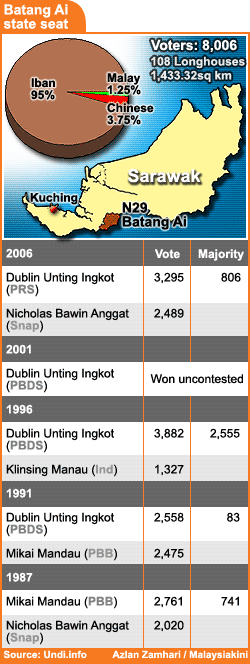 In the 2008 parliamentary elections in Lubok Antu, BN candidate William Nyalau defeated Bawin by 1,610 votes of which 744 came from the Batang Ai state seat (the remain majority coming from the Engkilili state seat).
Hence to win this seat, the PKR candidate, former Lubok Antu MP, Jawah Gerang, will need to swing over slightly more than 400 votes to his side.
On the surface, this should not be an insurmountable challenge given the following factors: the increasing unpopularity of Taib Mahmud, whom many say has ‘overstayed’ his welcome as the chief minister, the unresolved land issues, the lack of development and advancement, not just for the Dayaks in this seat but for the Dayak community in the entire state. (For the sake of brevity, I use Dayak as a general category with the caveat that one could easily point to different groups within the larger umbrella category).
But given the nature of campaigning in a rural, mostly Dayak seat that comprise of widely dispersed longhouses, where the tradition of last-minute vote buying is widely accepted as part of an election campaign, the resource advantage which the BN possesses can and most probably will prevent the underlying Dayak disgruntlement from manifesting itself into a PKR victory.
Politicians exploit Dayak disunity
I do not pretend to understand the intricacies of Dayak politics or the manner in which campaigning takes place in the context of a longhouse and the political alignment of different longhouses in Batang Ai. Here, I leave it to the experts on the ground such as Joseph Tawie, who is Broken Shield blogger and Professor Jayum Jawan, an expert in Dayak politics at Universiti Putra Malaysia.
Here, I will only echo the thoughts and observations of many others in regard to the apparent lack of unity among Dayak politicians which has resulted in the under representation of this community in the power structure that is Sarawak politics. This phenomenon has manifested itself in the selection of the PKR candidate for this by-election.
 Many had speculated that Bawin, who had campaigned in this area twice (once as a parliamentary candidate and once as a state candidate) would be selected as the candidate but in the end, five-term Lubok Antu MP Jawah, formerly of the PBDS, was selected instead. Rumours abound that Jawah was selected because a certain Chinese tycoon was willing to ‘bankroll’ his campaign.
Many thought that Bawin would have been the better opposition candidate given that he is spared from being ‘tainted’ by any association with the BN but at the end of the day, the costs of running a campaign in a seat like Batang Ai overwhelmed the benefits of putting Bawin as the opposition candidate.
While Bawin is still campaigning on behalf of the PKR candidate, if the opposition does lose this seat, the issue of candidate selection will inevitably be brought up in the post-mortem and fingers will be directed at the person most responsible for this decision at the end of the day – PKR leader Anwar Ibrahim.
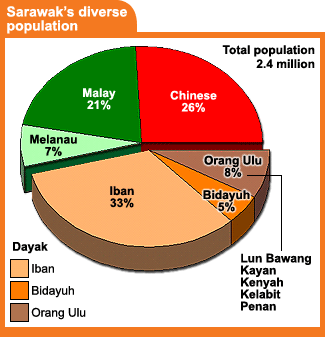 The incorporation of Dayak leaders into the non-Dayak parties of PBB and Supp and the incorporation of non-Dayak leaders into the ranks of Dayak parties such as the PBDS (before it was deregistered) and the splitting of the Dayak parties into different components and factions has been part and parcel of a larger narrative whereby Dayak disunity has been exploited to deprive this community of the political power that is commensurate with its share of the population in Sarawak.
Even if PKR manages to win this seat, this challenge will persist in the lead up to the next Sarawak state elections and into the next general election. There is no guarantee that PKR will be the opposition’s umbrella vehicle to channel all of the Dayak frustrations into.
The label of being a ‘Peninsular’ party will be no doubt exploited to the fullest by the BN component parties in Sarawak and questions still abound in regard to the allegiance of Snap as well as the viability of the still yet unregistered Malaysian Dayak’s Congress (MDC).
Money, money, money
Campaign and community issues aside, at the end of the day, the role of money politics will determine the final outcome of this by-election.
Sources which are familiar with the situation on the ground have told me that the night before polling day will see ‘bags of money’ literally flown into many of the longhouses where many of the tuai rumah , or longhouse headmen, will be paid off to deliver a certain number of votes from their respective longhouses.
The small number of voters in each polling station or longhouse will ensure that a stricter monitoring mechanism can be put in place and non-compliance on the part of certain voters ‘punished’ more effectively.
 Unlike in Peninsular Malaysia, where overt acts of vote buying are less acceptable and less commonly seen, this is a much more commonly accepted form of elections campaigning in the more rural areas in Sarawak.
And it is for this reason that most analysts, including myself, predict that this seat will remain in the hands of the BN, despite the fact that the issues seem to weigh heavily in the opposition’s favour.
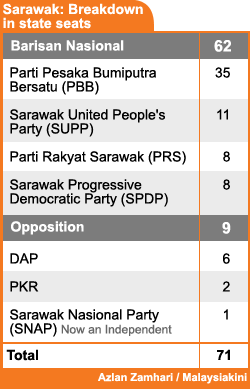
If PKR can manage to capture this seat, against the odds and against the persuasive power of money politics, then it will give a tremendous boost to its aspirations of winning this state from BN in the next state elections. (My own impression is that the opposition would do well to deny the BN a two-thirds majority in the state assembly).
If Batang Ai falls to the opposition, along with Bukit Selambau and Bukit Gantang, then one would not be too surprised to see a clampdown on opposition and pro-opposition activity in Sarawak as well as in Peninsular Malaysia.
Herein lies the silver lining for the opposition – that a loss here buys some breathing space for Najib and hence the opposition as well. It would also be a reminder for them to return to the drawing board in terms of deciding what their overall strategy would look like in the run-up to the Sarawak state elections, due in 2011.
ONG KIAN MING is a PhD candidate in political science at Duke University. He can be reached at im.ok.man@gmail.com.
Related analysis
Close fight in Batang Ai but BN likely to prevail
Bkt Selambau: PKR to win by 1,500-2,000
Bukit Gantang: PAS to thump Umno by 3,000


