




Bkt Gantang: Lessons for BN, Pakatan
It is almost a week since the conclusion of the tri-elections in Bukit Gantang, Bukit Selambau and Batang Ai. While the euphoria and disappointment on the part of Pakatan and BN supporters respectively are dying down by now, the lessons that can and should be drawn from these by-elections have not been fully fleshed out.
In this article, I want to examine what we can glean from the results in what was arguable the most important by-election out of the three – the parliamentary seat of Bukit Gantang.
It is almost a week since the conclusion of the tri-elections in Bukit Gantang, Bukit Selambau and Batang Ai. While the euphoria and disappointment on the part of Pakatan and BN supporters respectively are dying down by now, the lessons that can and should be drawn from these by-elections have not been fully fleshed out.
In this article, I want to examine what we can glean from the results in what was arguable the most important by-election out of the three – the parliamentary seat of Bukit Gantang.
 My own estimates show that BN managed to increase its support among the Malay voters in Bukit Gantang by 5% - from 53% in 2008 to 58% in this by-election.
However, this could not compensate for the sharp 13% drop in the level BN support among the non-Malays - from 35% in 2008 to 22% in this by-election. While the drop in the Malay support should worry PAS, the fact that Pakatan has now co-opted the BN ‘winning formula’ should most definitely worry the ruling coalition more.
The BN formula of vote pooling that used to guarantee it victory in almost all ethnically ‘mixed’ or heterogeneous seats worked as follows.
In Malay majority ‘mixed’ seats such as Bukit Gantang, the BN can afford to split the Malay vote and still win large majorities on the back of almost unanimous non-Malay support. In non-Malay majority ‘mixed’ seats, the BN can afford to split the non-Malay vote and win on the back of Malay support.
In the 2008 general election, the Bukit Gantang seat was won by PAS by reversing the BN winning formula in its favour. PAS lost out slightly on the Malay vote but gained from a huge swing against the BN among the non-Malays. This pattern was repeated again in the recent by-election but with a slight decrease in Malay support and a significant spike in non-Malay support.
What can account for the racial voting patterns which we observed in the recent by-election in Bukit Gantang?
5% 'new PM' bounce for BN
As I predicted earlier , I expected the Malay support for BN to register a small increase as a result of the post-Umno general assembly ‘bounce’ which Najib would benefit from. But I only predicted a 1% bounce for Najib while the actual results showed 5%.
 While PAS should certainly be concerned about the inability of its grassroots network and machinery to reach out to the Malay voters in Bukit Gantang (a problem that was apparent right from the start of the campaign period), the BN probably has more to worry about in the run-up to the next general election, due by 2013.
The reasons are not hard to fathom. BN cannot count on another ‘new PM’ bounce to lift its Malay support. If this by-election had been held a week before the Umno general assembly election and Najib’s swearing in as the 6th PM of Malaysia, the Malay support for the BN would have been closer to 50% rather than the 58% it eventually obtained.
BN also cannot count on PAS to be on the defensive as it was in Bukit Gantang in fending off attacks that Nizar is nothing but a DAP ‘puppet’.
 Nizar and PAS together with the DAP and PKR would have sufficient time to prepare for the next general election including building up the grassroots network to reach out more effectively to the Malay voters in Bukit Gantang and in other parts of Perak as well.
The fact that BN could not surpass the 60% Malay support mark in Bukit Gantang, despite the advantages accorded to it by virtue of the by-election date as well as a strong local machinery is not a good sign.
At the same time, PAS and Pakatan cannot rest on its laurels and declared the Malay vote ‘won’. Pakatan still has a long way to go before it can claim to have the support of half of the Malays, in Peninsular Malaysia at least.
Sharp fall in non-Malay support for BN
The fall in the level of BN support among non-Malays is not very surprising. I predicted a conservative drop of 5% (from 35% to 30%) in the level of BN support among non-Malays but the actual drop was actually a much larger 13% (from 35% to 22%).
This is clearly an indictment, among the non-Malays at least, on the BN takeover of the Perak state government. Unlike the small minority of Chinese voters in the by-election in Kuala Terengganu earlier in January who did not dare to buck the trend of voting for BN, the non-Malay voters in Bukit Gantang had no such reservations even after promises were made to them that their Temporary Occupancy License (TOL) problems would be resolved by the new BN Perak state government.
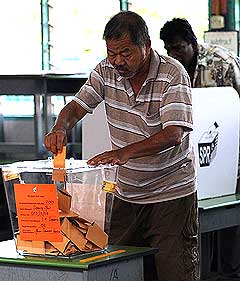 A stark example of this was seen in the Kuala Sepetang new village which is 97% Chinese where BN only managed to obtain 16% of the popular vote. (For comparison, the BN obtained 67% of the popular vote in this polling station in 2004).
This is an indication of the steep hill which the BN has to climb if it wants to recapture the non-Malay vote.
While Nizar is a unique PAS candidate in his ability to capture the imagination of the non-Malay voters in Perak and possibly elsewhere as well, more and more PAS leaders such as Husam Musa, Khalid Samad, Dr Dzulkelfy Ahmad and Yusuf Rawa are stepping up to the plate to not only defend the integrity of Islam (which is expected of PAS leaders) but also to square Islam with the necessity of treating all races in Malaysia as equals, and making concrete efforts to reach out to the non-Malay community in Peninsular Malaysia.
 In doing this, they are taking the lead of Tok Guru Nik Aziz who has been consistent in upholding the spirit of cooperation and moderation within Pakatan.
In contrast, it is difficult to point to a single Malay leader within Umno whom the non-Malays can genuinely point to as someone who is moderately acceptable to them. Even Najib’s first acts as PM which included the freeing of a few Hindraf detainees (though not the most prominent ones) and visiting Sin Chew Daily , a Chinese newspaper, did not make any difference in the two by-elections in Peninsular Malaysia, at least among the non-Malays.
For this, Najib can thank his predecessor for setting expectations too high and then failing to deliver on his promises. If Najib wants to reach out to the non-Malay community, he would have to deliver concrete results rather than the symbolic gestures which can no longer fool the non-Malay community.
Youth voters favour Pakatan
In addition to trying to claw back some of the non-Malay vote as well as to protect its hold on the majority of Malay voters, Najib and BN also have the unenviable task of trying to win back some of the youth vote.
BN has not yet arrested the trend where young voters (as indicated by the polling ‘streams’ or ‘salurans’) are more likely to vote for the opposition than older voters. An examination of the Malay majority and non-Malay majority streams from the Bukit Gantang by-election reveals the extent of this trend.
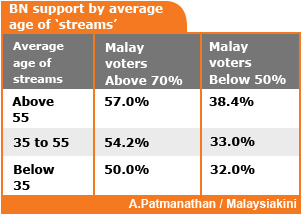 While the level of BN support in the Malay majority polling ‘streams’ (more than 70% Malay) is higher than that in the non-Malay majority polling ‘streams’ in every age category, BN managed only to split the vote in the Malay majority polling streams where the average age is under 35. [See chart]
This shows a lower willingness among younger Malay voters to buy into the campaign rhetoric which the BN used in the Bukit Gantang by-election.
 Given that these younger voters (and those not yet registered) will form a larger percentage of voters in the next by-election, one would expect that all things being equal, the opposition would be able to make electoral gains if the status quo is maintained, even if it does nothing to increase the registration rates among younger, eligible voters or campaigns using methods and messages which appeal more to the younger generation.
Someone once said that a week is a long time in politics. What more the four years or so until the next general election. But what the Bukit Gantang by-election has shown is that the voting patterns established in 2008 will be hard to overturn. The upside in terms of Malay support for BN is much lower than the potential downside for BN in terms of its non-Malay support.
Pakatan has its work cut out if it wants to split the Malay vote 50/50. But the BN has a much tougher task ahead if it hopes to win a respectable 35% to 40% of the non-Malay vote in Peninsular Malaysia in time for the next general election.
ONG KIAN MING is a PhD candidate in political science at Duke University. He can be reached at im.ok.man@gmail.com.


Are you sure you want to delete this comment?
This action cannot be undone.