




Tamil Tigers concede defeat, to lay down arms
Tamil Tiger rebels today said they would put down their weapons after a 37-year battle for an independent ethnic homeland, with their last remaining fighters encircled in the jungle.
Sri Lanka's Tamil Tiger rebels on Sunday said they would put down their weapons after a 37-year battle for an independent ethnic homeland, with their last remaining fighters encircled in the jungle.
In what could mark the end of Asia's longest running civil war - one that left more than 70,000 dead in pitched battles, suicide attacks, bomb strikes and assassinations - the rebels appeared to finally admit defeat.
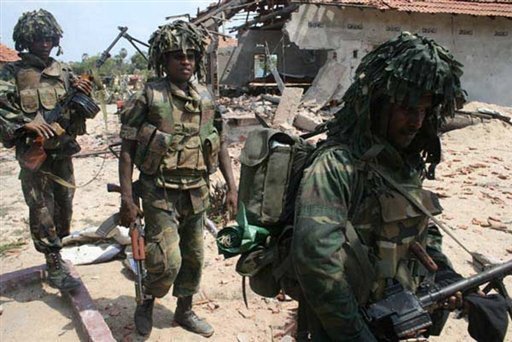
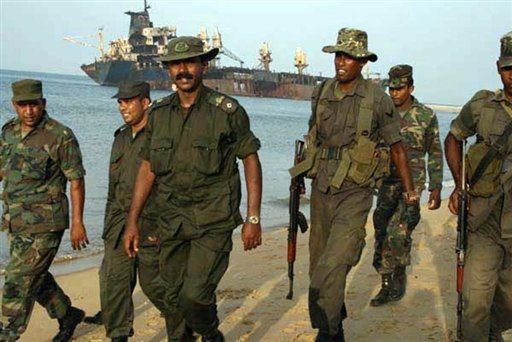
But the military refused to let up in their offensive, saying troops were pushing on to recapture "every inch of land" held by the rebels.
Selvarasa Pathmanathan, the Tigers' chief of international relations, said in a statement on the Tamilnet website that the fighting had reached "its bitter end."
"We remain with one last choice - to remove the last weak excuse of the enemy for killing our people," he said.
 "We have decided to silence our guns. Our only regrets are for the lives lost and that we could not hold out for longer."
Velupillai Prabhakaran, the Tigers' founder and leader, had been reported to be with his fighters as they made their last stand, though the defence ministry said it had no news of his whereabouts - or whether he was still alive.
Only two years ago, the Liberation Tigers of Tamil Eelam (LTTE) controlled nearly a third of the island nation and operated an effectively autonomous Tamil state with courts, schools and a civil service.
But the government of President Mahinda Rajapakse launched a military assault which drove the Tigers out of the east and then the north, before trapping the remaining guerrillas on the island's coast.
"They were actually defeated some time ago, but they have formally accepted defeat only now," military spokesman Brigadier Udaya Nanayakkara told AFP .
"They fought for an Eelam (separate state) that they could never win. It was only a waste of lives. They have caused massive death and destruction over the years. Finally they themselves have realised that it is all over."
He said the government soldiers were moving in on the 24-hectare (60-acre) patch of jungle still held by Tigers and would soon "take back every inch of land they have occupied."
Tigers may return to guerilla tactics
There was considerable doubt whether the defeat would bring peace to the island, however, as the Tigers were thought likely to return to the guerrilla tactics they used to devastating effect in the past.
The military's push for victory has come at the cost of thousands of innocent lives, according to the United Nations, and the government has faced international condemnation for its conduct of the war in recent months.
 Shortly before the LTTE's announcement, Sri Lanka's officials said all civilians held hostage by the Tigers had escaped the war zone.
Sri Lankan military leaders say they held back on their final assault to avoid civilian deaths, though thousands are still thought to have been killed in months of heavy fighting.
Rajapakse, who announced in Jordan on Saturday that his forces had finally defeated the rebels, was greeted by supporters waving flags and setting off firecrackers as he returned home earlier on Sunday.
"My government, with the total commitment of our armed forces, has in an unprecedented humanitarian operation finally defeated the LTTE militarily," he told a meeting of international leaders.
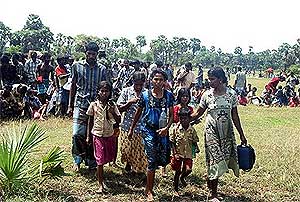 The president has faced fierce criticism for civilian casualties caused by army shelling and for the detention in state-run camps of more than 100,000 Tamils who fled the fighting.
Thousands of non-combatants had been held hostage by the Tigers, though the exact number has been a matter of dispute between the United Nations and Sri Lankan officials.
The government previously maintained that less than 20,000 civilians were being held by the rebels as human shields, while the United Nations said there could have been 50,000 people trapped.
The International Committee of the Red Cross, the only neutral organisation working in the war zone, described the situation as "an unimaginable humanitarian catastrophe."
Despite pleas for a ceasefire from the United Nations, the United States and many other countries, Sri Lanka had been determined to push on until it had secured a clear victory against the rebels.
With the Tigers facing total elimination, defence officials are predicting a "mass suicide" of the rebel leadership.
- AFP


Are you sure you want to delete this comment?
This action cannot be undone.