




Farmers want Bernas out of Sabah
Rice farmers in Sabah are calling for the end of Padiberas Nasional (Bernas) in the state as it is equated as a callous money-making monopoly that fails in its objectives to establish stable prices for locally-grown variety and helping the state to be self-sufficient in rice.
Rice farmers in Sabah are calling for the end of Padiberas Nasional (Bernas) in the state as it is equated as a callous money-making monopoly that fails in its objectives to establish stable prices for locally-grown variety and helping the state to be self-sufficient in rice.
The farmers, instead, wanted a revival of the Sabah Padi Board (SPB) which was closed down in 1982, on grounds that it failed to curb rice imports of 30 percent of the state's rice requirements.
However, Sabah today imports 72 percent of its rice requirements, forking out RM 700 million last year to secure 220,000 tonnes.
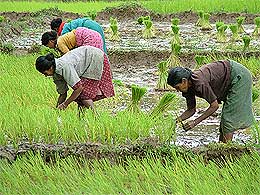 Claims of monopoly
Kota Kinabalu MP Hiew King Chew reckoned that Sabah's rice-planting sector is at least 50-years behind the rest of the rice-producing countries such as India, China, Vietnam, Cambodia and Indonesia.
Hiew, who has taken up the cause of the rice farmers in Kota Belud, the rice bowl of Sabah, said: "We see less and less paddy fields and higher imports of rice. Why has it become easier to import than grow our own rice?"
The role of Bernas in Sabah remains a thorny issue. "It plays two major roles - the sole importer and paymaster. It's in fact a money-making machine," said Jaujip Pangalin, Kota Belud-based Padikom president (Sabah Commercial Paddy Millers Association).
"Bernas has not helped the industry in Sabah. This is one of the conditions in its agreement with the state and the people. This matter should be seriously looked into."
PadiKom is confident that Sabah can be more than self-sufficient with 269,500 metric tonnes of rice a year. This is based on the current planted area of 49,000 hectares that give two yields a year.
Rice farmers are burdened by planting costs, estimated at RM2,910 per hectare. They get subsidies of RM140 per hectare for ploughing and RM200 per hectare for planting.
Claims to the state government are limited to a maximum of two hectares and must not exceed RM1,000 per annum. Farmers would be blacklisted if caught seeking excessive claims.
To add to the existing problem, the price of local rice has dropped in the market, allegedly because of intervention by Bernas.
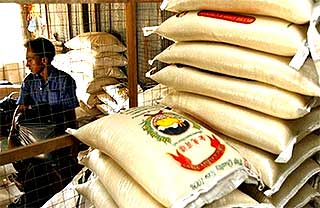 PadiKom presented a case last year to the Federal government when it decided to import rice from Thailand.
Apparently, it cost the government some RM700 million at RM3.50 per kilogram.
Wholesalers obtained the rice from Bernas at RM1.35 per kilogram and were allowed to sell at RM1.80 per kilogram to the consumer. The remainder RM2.15 per kilogram was subsidised by the government.
Imported rice cheaper than local
Not surprisingly, sales of the more expensive local rice plummeted. The impact was felt by paddy farmers and rice millers, driving them into abject poverty, as they were forced to compete with Bernas.
"It is alarming to note that Bernas is selling imported rice cheaper than local rice," claimed Sapp Youth Chief Edward Dagul. "This will force paddy farmers to stop planting and the rice mills will close down."
Production at local mills has been on the decline. From a high of 32 mills, including 16 in Kota Belud, half have closed down and moved into the planting of oil palm, according to Chu.
"Those who remain in business are only producing half of their previous production. Generally, a mill produces between 4,000 and 7,000 metric tonnes a year," he added.
Under the latest revision this month by the Federal government through Bernas, local millers and those in Sarawak will get a RM600 subsidy a month for six months. Rice millers have to sell the local variety, dubbed ST25, to Bernas through a company called Sazarice for RM2,300 per metric tonne.
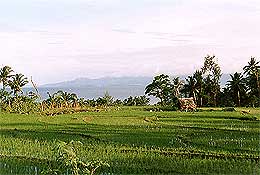 Bernas would claim the subsidy from the government and resell the rice to the wholesaler at RM1,700 per metric tonne. The retail price for consumers "will be floated at a reasonable price".
In the meantime, rice farmers have until September to improve their production. But they appear to be bogged down by drainage problems and water outlets in need of repair and face the prospects of flooding during bad weather.
Chu complaints that infrastructure such as connecting roads and bridges were also in need of urgent repair in Kota Belud and rice-growing areas elsewhere.
Plans are at foot for Bernas
Meanwhile, Bernas has finally sprung into action and has plans of its own in Sabah, according to Deputy Chief Minister Yahya Hussin whose portfolio covers agriculture and food.
"Some 3,000 padi farmers will work on 10,000 acres of land managed by Bernas in Kota Belud in Kota Marudu by the end of next year," said Yahya. "There are 1,814 farmers currently working on 6,336 acres of the 10,000 acres."
Half the 6,336 acres involve 704 farmers from 17 villages in Kota Marudu.
Industry expert Jerry Silek, who was against the closure of the Sabah Padi Board, estimated that Sabah would need to import 990,000 metric tonnes of rice by 2020 to feed a population of 4.5 million.
"We would need some 250,000 hectares of paddy fields, all under double cropping, to achieve the 990,000 metric tonnes of rice target," said Silek. "Our local paddy production now is only 3.7 metric tonnes per hectare."
He urged a revival of the Sabah Padi Board "provided it does not end up as a job centre for political cronies and supporters".


Are you sure you want to delete this comment?
This action cannot be undone.