




Moggie pushes for quick coal option in Sabah
Tenaga Nasional Berhad (TNB) chairperson Leo Moggie thinks that coal is the only practical option for an additional substantial power station proposed for the energy-short eastern seaboard in Sabah.
Tenaga Nasional Berhad (TNB) chairperson Leo Moggie thinks that coal is the only practical option for an additional substantial power station proposed for the energy-short eastern seaboard in Sabah.
He admits that coal is not a popular option and that it has not been easy for him to push for the option but he’s left with no other way out.
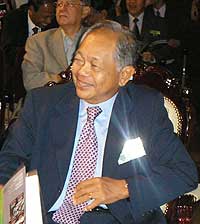 "The longer we wait, the longer the east coast of Sabah will be deprived of reliable electricity supply and the consumers’ suffering will be extended," said Moggie on the sidelines of a Sabah Electricity Sdn Bhd (SESB) board meeting in Kota Kinabalu yesterday.
"Our consultants have reaffirmed the very real and pressing power needs in the east coast. We are looking at a 300 MW plant, at the very least 200 MW.
"We have however not come to the stage of identifying and finalising the source of fuel to be used for power generation in the east coast," he said.
SESB is 80 percent owned by TNB and 20 percent by the state government.
Moggie's stand was echoed by TNB chief executive officer Che Khalib Mohamad Noh.
"If we want to develop the east coast, we will need more power and the only option at the moment is a coal-fired power plant," said Khalib.
"Remedial solutions now can be likened to band aid. How long can band aid work? We can try to plug the problem for one or two years but it cannot be a permanent solution," he added.
Power shortage issue needs to be resolved
Moggie urged NGOs in particular to take note that the power shortage issue needs to be resolved as soon as possible.
NGOs have been in the forefront against the siting of any coal-fired power plant in Sabah, citing environmental concerns.
They are not impressed with explanations by TNB and SESB that coal is a viable option with the advent of clean coal technology on the basis that "there's no such thing as clean coal. Coal is the dirtiest fuel source available."
The NGOs also fear that the coal option being pushed by TNB/SESB is part of a bigger agenda to import increasingly expensive coal from Kalimantan and later use the higher price as an excuse to mine cheaper coal locally from the substantial reserves in Maliau Basin, the off-limits 'Lost World'.
There have also been reports cited by NGOs that various Malaysian companies have invested in coal mining operations in Kalimantan with an eye on the Malaysian power market.
Moggie refutes all such talk and efforts to establish linkages between the various developments in the emerging coal scenario in the region which worry NGOs in Sabah.
Newspaper reports in Sabah have cited some of these Malaysian-owned companies in Kalimantan as saying that they would be shipping their coal to Sabah for use in power-generation, dismissed by TNB/SESB as a bid to talk up the market.
Moggie added that TNB/SESB had taken note of the various comments and objections from NGOs in Sabah on the coal option "and so, we are of course looking at other options and alternatives but up to now we have not identified anything that can substitute coal."
"We are however prepared to look at the possibility of engaging outside advice and we are engaging a consultant to assist us in doing this," said Moggie.
"However, while we are open to the idea of what else is available, we are not dropping the coal-fired power plant proposal. Our preliminary findings have not changed our thinking on the coal option.
"Our thinking and our observation now is that there are no other alternative, practical options. I have to be very honest with you. If there are other practical options that can be presented, workable, sure why not? Why shouldn't we look at them?" he added.
Paints a difficult scenario
Moggie has set a target of sometime next year for the proposed additional power plant in the east coast to be operational. In the meantime, the consumers have to put up with mobile generating sets "which are not really very efficient or reliable."
SESB has 20 mobile generating sets which cost the utility company RM24 million. These sets can generate one MW each and have been parked at the Tanjung Aru and Melawa power stations.
Moggie paints a difficult scenario along the east coast of Sabah given the existing, old and unreliable diesel-fuelled power generation plants.
He gave an assurance that renewable energy like bio-fuels will continue to be among the comprehensive configurations that TNB/SESB will include in the future "although it is not likely to play any significant part in any power system development for the next five to 10 years."
Bio-fuels, for example, are said to be able to supply power only on a small scale of one to five MWs, leaving conventional fuels as the only practical, viable and large-scale option for the immediate future.
Both Moggie and Khalib also ruled out the prospects of Sabah importing any power from Bakun and warned against being misled by the press on the matter.
The TNB CEO disclosed that power from Bakun has already been committed in Sarawak itself and for export to Peninsular Malaysia.
He also ruled out Sabah importing any of Sarawak’s estimated 28,000 MW power potential which includes Bakun’s 2400 MW.
"Except for Murun's 900 MW and Bakun, the rest of the 28,000 MW is yet to be developed," said Moggie.
Expensive to build a line
Khalib trots out technical reasons and the enormous distance which stand in the way of Sabah importing excess power from Sarawak.
"It would be very expensive to build a line from Bakun to the east coast of Sabah. It would cost more than building a new power plant. We will have to invest billions of ringgit to do it. One must not forget that the line is not for free.
"Therefore, no economic benefit would be attained from the project," he said.
"Then, there's also the state's topography to consider when implementing the project. My personal opinion is that the line would be less reliable because it would have to go through very difficult terrain and the distance between Sabah and Sarawak compounds the difficulties," he added.
Nearer home, TNB/SESB are examining the two hydropower potentials in Sabah viz the Upper Padas and Liwagu rivers.
The federal government yesterday approved a RM50 million additional funding for power supply projects in Tenom and Melawa. Also along the west coast, independent power producer Rainhill Powertron’s project unit with a 65MW capacity would be ready by November this year and another 65MW early next year.
Moggie disclosed that TNB is talking with Petronas and relevant government agencies to initiate the development of a 300 MW gas-powered power plant in Kimanis for the west coast using the state's own reserves of the commodity which has been largely earmarked for the Malaysian Liquefied Natural Gas plant in Bintulu, Sarawak.


Are you sure you want to delete this comment?
This action cannot be undone.