




RPK faces certain deportation from 'exile'
Controversial blogger Raja Petra Kamarudin faces immediate arrest and deportation by Australian immigration if it is established that he has indeed been living in Brisbane to escape the law in Malaysia.
Controversial blogger Raja Petra Kamarudin faces immediate arrest and deportation by Australian immigration if it is established that he has indeed been living in Brisbane to escape the law in Malaysia.
This is the legal opinion from Brisbane-based senior lawyer Quintin Rozario, who left Klang nearly 30 years ago. The police have reportedly said that Raja Petra had fled to Brisbane.
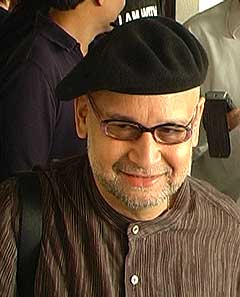 “If he (Raja Petra) has been convicted of an offence in Malaysia, he probably did not declare it on arrival in Australia,” said Rozario.
“If he failed to make such a declaration, then depending on the nature of the offence he was charged with and where a conviction was recorded, he could have his visa cancelled and he would be deported.
“Failing to declare a conviction is in itself an offence under the Immigration Act of Australia.”
However, while Raja Petra has been charged in Malaysia for a number of offences, he has yet been convicted by the court.
Likely asked to leave Australia
Moreover, the Malaysian government could also request Australia to facilitate his return on specific grounds.
However, it appears that Raja Petra, who is popularly known as RPK, could in return claim persecution in Malaysia and the Australian authorities would be bound by the UN Convention relating to the Status of Refugees to consider his claims. Australia is a signatory to the convention.
 “If RPK claims persecution and Australia is satisfied that there is indeed a basis for such claims, he would be eligible for a protection visa,” said Rozario.
“Getting a protection visa is a process in itself determined more by the applicant. The question is how does one establish ‘real and well-founded’ fear of prosecution by the authorities in Malaysia?
“The process would be made easier by the fact that it would not be the Australian authorities who would establish ‘real and well-founded’ fear of persecution.”
Rozario thinks that Australia would be seen as making a political statement if it does indeed accept Raja Petra’s arguments.
Alternatively, Raja Petra could be extradited back to Malaysia. Malaysian police are already planning to seek Interpol's help to trace the fugitive.
Extradition, under normal circumstances, would mean placing Raja Petra in detention in Australia pending the arrival of Malaysian police officers to escort him home. However, this is unlikely to happen.
“Generally, what they may do is ask him to leave Australia (for another country) if Malaysia asks for his extradition,” said Rozario.
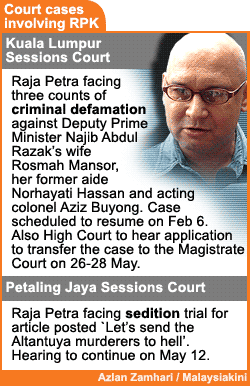
Raja Petra faces two arrest warrants for failing to turn up in court for his sedition and criminal defamation trial, while there are other charges pending.
In addition, his wife Marina Lee Abdullah faces a show-cause letter from the courts in connection with bail for her husband in both cases.
How did he leave the country?
Most of Raja Petra’s troubles with the law and the authorities stem from his ownership of Malaysia Today , a controversial blog.
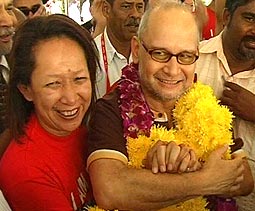 The man himself has confessed that he is no journalist and has no pretensions that his blog is a serious news portal in the same league as the established sites which employ an army of trained and experienced journalists.
It is not known how Raja Petra left the country given that he is an undischarged bankrupt.
As the result of earlier ex-parte claims against him and judgments in default, he was bound by law to surrender his passport to the immigration authorities in Malaysia. He is not allowed to leave the country without permission.
In a website posting explaining his self-imposed exile, he made the ingenious claim that he was actually punishing himself.
The punishment that he meted out to himself was over allegations that he hurt the feelings of the Perak royal household in the wake of a constitutional and political crisis in the state and had reportedly refused to apologise as commanded by the Selangor sultan.
By the same token, he inadvertently also referred to numerous pending charges against him. He vowed that he would not be taken that easily next time under the Internal Security Act, which allows detention without trial.
Raja Petra had been detained twice under the ISA in the past 10 years.
He pointed out that he had many good years left ahead of him and wanted as much as anybody else to enjoy the remaining years of his life as a free man.


Are you sure you want to delete this comment?
This action cannot be undone.