




GE results: Bad for BN, good for democracy
Umno Youth leader and Rembau parliamentarian Khairy Jamaluddin has admitted frankly that he was happy with the outcome of the last general election as it reflected the maturity of Malaysians.
But he was quick to point out that as an Umno politician, he felt disappointed.
He said that the defeat inflicted by the voters on BN showed that Malaysians were not afraid of making changes.
Umno Youth leader and Rembau parliamentarian Khairy Jamaluddin has admitted frankly that he was happy with the outcome of the last general election as it reflected the maturity of Malaysians.
But he was quick to point out that as an Umno politician, he felt disappointed.
He said that the defeat inflicted by the voters on BN showed that Malaysians were not afraid of making changes.
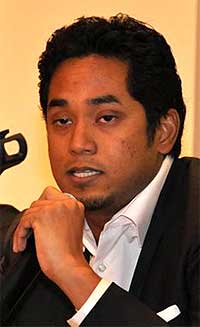 "I am disappointed as a politician, but happy as a Malaysian as it (the results) showed a maturing democracy," he said at a forum last night.
"One key aspect of Barack Obama's campaign in the US was the challenging of political axioms.
"In 2008, we also challenged these axioms, that you can vote for another party (other than BN) and the country won't crumble. As a Malaysian, this is good for democracy," he added.
Khairy then went on to say that the next general election will be very interesting as he believed that for the first time people will vote according to whose policies they actually supported and not according to who their ethnicity traditionally voted for.
The forum - New America, One Malaysia - was a prelude to the Asia 21 Young Leaders Summit to be hosted by Asia Society in November.
The other speakers were DAP's Petaling Jaya Utara MP Tony Pua, Malaysiakini chief executive officer Premesh Chandran, editor of the Nut Graph Jacqueline Ann Surin, and executive vice-president of Asia Society Jamie Metzl.
In the March 2008 general election, BN was handed its worst ever defeat by the opposition who won five states and denied the BN's two-thirds in Parliament.
Khairy accepts the challenge
While Suryani Senja, who was the moderator for the event, did her best to contain the focus of debate on the issues of the summit, both Khairy and Pua's comments occasionally trailed off into campaign-like speeches and rhetoric, taking polite and humorous jabs at each other.
 "There is a strong socio-cultural aspect to politics in Malaysia. I hope no longer will this country be focused on race, but on how much one can contribute to this country," said Pua.
"Khairy has been accused of wanting to become prime minister by the age of 40 which he denies, but no one will believe him," he quipped.
Later Chandran revisited the issue by stating: "Who's to say this man (Khairy) can't become prime minister by the age of 40?
"Our goal should be to create a common future for Malaysians, and I hope that you can realise this common future," he said.
"Leadership is important, but what else? And when we are talking about leadership are we talking hegemony or self-organising society? We need to look deeper into society and understand the underlying causes that are driving this process," he added.
In reply, Khairy, now 33, said he accepted the challenge to look into the underlying causes.
"This challenge is one that I can't ignore, therefore I accept this challenge. Leadership is not so easy; there is never a perfect answer to these issues.
"Often there is a serious disconnect between what leadership wants and the bureaucracy," he said.
At one point during the Q&A session, a man who identified himself as an 'independent' remarked:
"What is your response to what people say about you being arrogant and being where you are because you're the son-in-law to the former PM?"
And Khairy was quick to respond.
"I cannot change the way you think about me right now. I hope that in the future people will judge me for the decisions and changes I made," he said.
Argument over US' role
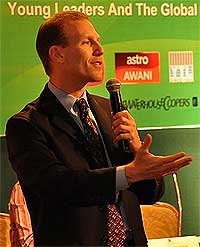 Metzl, who previously worked on the US Security Council during the Bill Clinton administration and also campaigned for Obama, was the first speaker on the night.
"Over the past century, we've seen the world's centre of gravity shift from Europe to the US, then very quickly to somewhere over the Pacific.
"We are facing unprecedented financial, environmental, and food crisis, but unfortunately the level of creativity to address these issues has not risen to the challenge.
"For the past 60 years or so, the US has had a disproportionately huge role in global issues. Now it seems the system is weakening and we're hoping someone will fill this void. What will be the role of China and India? The question is how do we find these people?"
However, Khairy and Pua joined forces in countering Metzl on the issue of US' leadership role.
Khairy argued that the majority of Americans still distrust the Muslim world. Specifically he mentioned the US handling of the Palestine-Israel conflict.
Pua broadened the statement by stating that the Palestinian issue was not only a Muslim concern.
"I'm of the opinion that in the past, US foreign policy has been a complete failure, and is only being used to protect its own right," he said.
 Both Pua and Khairy also cited previous conflicts in Bosnia, Rwanda, Somalia, Darfur, and Iraq where US foreign policy had failed.
Metzl countered their arguments by stating:
"Where were the nations of Islam during these crises, specifically in Darfur where we have one group of Muslims carrying out genocide on another group of Muslims?
"Where was Asean during the Myanmar crisis? If the US is stepping back someone else needs to step up," he said.
Some 150 people attended the forum.


