




Promises denounced as 'dam' lies
"We think they will cheat us. They said they will pay us, but actually we are kicked out from our land without compensation. And at the new place, we have to be in debt (for) our house. No food... and from where would we get our money?" said Jamis John, a woman from Kampung Bojong Pain.
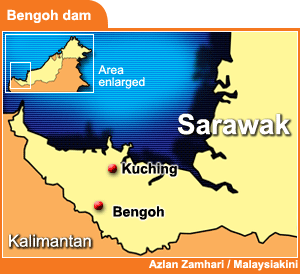
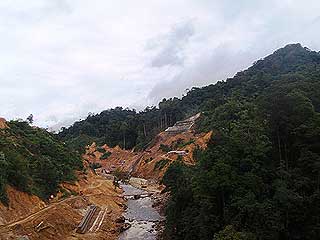
Kampung Bojong Pain, Kampung Rejoi and Kampung Sait, 42km from Kuching, Sarawak, are to be submerged by the proposed giant Bengoh Dam, across the upper reaches of the Sarawak River.
 People from Kampung Semban, another village two hours' hike upriver, have also been told to move too, even though Semban will not be inundated by the dam. Semban's eviction has been linked to a feasibility study, already conducted, for a tourist resort overlooking the dam.
The Sarawak government is trying to evict 1,300 people from 199 families in these four villages. These communities will lose their ancestral native customary rights (NCR) lands. The authorities have promised to move them to a "development-oriented area" 10km away, called Medan Tun Razak.
"We think they will cheat us. They said they will pay us, but actually we are kicked out from our land without compensation. And at the new place, we have to be in debt (for) our house. No food... and from where would we get our money?" said Jamis John, a woman from Kampung Bojong Pain.
Kampung Bojong Pain, Kampung Rejoi and Kampung Sait, 42km from Kuching, Sarawak, are to be submerged by the proposed giant Bengoh Dam, across the upper reaches of the Sarawak River.
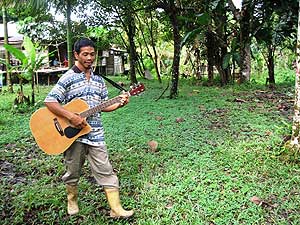 People from Kampung Semban, another village two hours' hike upriver, have also been told to move too, even though Semban will not be inundated by the dam. Semban's eviction has been linked to a feasibility study, already conducted, for a tourist resort overlooking the dam.
The Sarawak government is trying to evict 1,300 people from 199 families in these four villages. These communities will lose their ancestral native customary rights (NCR) lands. The authorities have promised to move them to a "development-oriented area" 10km away, called Medan Tun Razak.
Peter Chin, the federal minister for energy, green technology and water, announced on July 7 that he had "had a discussion with the Sarawak government for each family to own a house".
Villagers say promises hold no water
"The government said that we, in this village, are fortunate, because we receive a big project like this. That's what James Dawos Mamit (local MP for Mambong) said," Duyap Rimon, from Kampung Bojoi Pain, related.
 "He also told us that we don't have to actually move out. All of us were asked to move to higher ground... (we) just have to move a few meters above the water. We were promised that the government will make roads and clear the area for us... build a clinic, football field, community hall. That is what the government promised us when they first came here.
"We were promised we don't have to move to another area…I don't want to hear about them telling us (about) moving to a new place called Tun Abdul Razak. I don't want. Because if they tell us that, they are breaking their own promises, then what is the meaning of politics?" he asked.
"They are not humans if they constantly change their promises, or if they do not follow their own words that they promised us previously," Duyap said.
The villagers have good reasons to be skeptical.
 "They said that they will give us three acres of land to plant rubber and cultivate rice, but I don't know if they will pay for my house," said Jamis.
"If we have to move to the new place, if we have to pay for our houses, there's no point to be in debt. How do we pay these if there are no jobs there?" she asked.
Duyap frowned. "Do we need to pay for the electricity and water at this new site?
"We've been here since 1893," he recounted. "Our great grandparents by the name of Saang and Sandung cleared Bung Jogong for their first settlement after they came down from Bung Kiding. From the beginning, since we lived here, we farm, we got enough to eat."
 Jamis explained: "What we Bidayuh here usually do is to cultivate rice and farm to earn cash income and buy food even to the extent that we can send our children to university."
Duyap decried that the compensation offered would not be sufficient.
"As a farmer, each family of two persons, husband and wife, needs at least about six acres of land for farming a year.
“I heard about the government's promise to give us three acres if we were to be resettled. What will happen to us as farmers, since the rotation period for hill padi farming takes about 15 years?" asked Duyap.
"Where are we going to plant our rubber? Where can we plant our pepper? Where can we farm? How can we live as farmers?"
Dam will help mitigate Kuching floods
The construction of the controversial dam, expected to cover 1,600 hectares, began last year. The government wants the dam to be in operation by the end of 2010.
Chin has said the dam could provide Kuching's water supply "until 2030". Deputy Sarawak Chief Minister Dr George Chan has claimed the dam would help mitigate floods in Kuching by controlling the water in the upper reaches of Sarawak River.
However, previous claims that mammoth projects, such as the Kuching barrage across the lower Sarawak River, could improve annual flood woes in the state capital, have been proved false.
There are other unanswered questions on the construction of the dam.
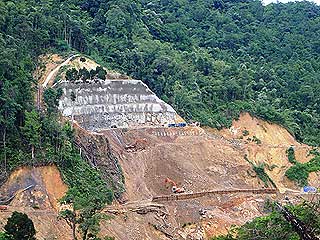 The government awarded the RM310 million Bengoh contract without a transparent tender process to construction mammoth Naim Cendera. The chairman of Naim Cendera, Abdul Hamid Sepawi, is Chief Minister Abdul Taib Mahmud's first cousin. Hamid has been reported to be
worth more than RM500 million
.
Naim Cendera subcontracted the project to Sinohydro from China for RM145 million. The RM165 million discrepancy has never been explained to taxpayers.
The Times of London has labeled the forced evictions "legal coercion with the familiar echo of 'crony capitalism'."
It quoted See Chee How, lawyer for the Bengoh communities, as saying, "(The local communities) don't know that this thing is coming until they hear the sound of bulldozers."
‘There's nothing to live for’
Some Bengoh villagers have shown courage by filing legal action to halt the dam’s construction. They say Naim Cendera intruded into their NCR land to extract building materials, then urged them to sign contracts to give up their land.
Thirty families from Kampung Bojong Pain, Kampung Semban and Kampung Rejoi have rejected cash handouts. According to Malaysiakini , many local families refused to surrender their ancestors' - and descendants' - land, when the state government held a ceremony last year to give out cash to evicted communities.
The compensation for the NCR land worked out to an average of only RM3,000 per acre, including crops and fruit trees. Villagers also allege that the compensation appears arbitrary.
"We will lose our culture, our ‘kampung’, when they change the name of our village to Tun Abdul Razak," Jamis said.
"We will lose our rights to the forests and land. There's nothing to live for. We cannot live if they tell us to move to the resettlement site."
Duyap Rimon's name has been changed.
KERUAH USIT is a human rights activist - anak Sarawak, bangsa Malaysia. His 'The Antidote' column, which appears in Malaysiakini every Wednesday, is an attempt to allow the voices of marginalised people to be heard all over Malaysia. The writer can be contacted at keruah_usit@yahoo.com


Report this comment
Are you sure you want to delete this comment?
This action cannot be undone.