




Najib brings 'same old, same old' to office
comment Najib Abdul Razak’ s first 100 days in office as prime minister of Malaysia have been similar to the first 100 days of his predecessors - long on form, short on substance.
His policies thus far do not address the root causes of problems and continue to reflect patronage, religion and race-based politics with the overarching ideology of Ketuanan Melayu (Malay supremacy) firmly entrenched.
comment Najib Abdul Razak’ s first 100 days in office as prime minister of Malaysia have been similar to the first 100 days of his predecessors - long on form, short on substance.
His policies thus far do not address the root causes of problems and continue to reflect patronage, religion and race-based politics with the overarching ideology of Ketuanan Melayu (Malay supremacy) firmly entrenched.
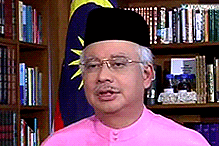 Najib, who took office on April 3, came to power in at the worst of times. Real GDP contracted by 6.2 percent year on year in the first quarter of 2009. This was Malaysia’s worst performance since the fourth quarter of 1998, when the economy shrank by 11.2 percent during the height of the Asian financial crisis.
Last year also recorded the weakest growth in six years and there is no sign of improvement for this year, confirming the long-term trends that Malaysia is fast losing its competitiveness. Najib also came in as the most unpopular premier in Malaysian history.
His economic measures (11 gifts to the people and liberalisation measures) were driven purely by the need to please a clearly discontented electorate and to contain long-term economic decline.
The 11 gifts may address short-term issues relating to the poor provided it is implemented graft-free and is race-blind. For example, the plan to sell 44,000 low-cost houses to current tenants may solve severe housing problems faced by the poor.
However, similar programmes in the past were implemented through political parties in the Barisan Nasional (BN) which then allocated to the highest bidder or friends or relatives, leaving those targeted beneficiaries homeless. This strategy only serves to perpetuate patronage and race-based politics.
 The liberalisation measures that reverse outdated affirmative action policies are steps in the right direction. It has been long recognised that race-based investment restrictions have not benefitted the larger Malay community and have in fact contributed to Malaysia’s long term economic decline.
The liberalisation measures were narrowly defined and avoided areas that affected the Malay political base and strategic sectors which are dominated by government-linked companies. The fine print of these measures has yet to be revealed. Furthermore, in the creation of Ekuinas, another government agency to protect the interest of bumiputeras through equity ownership, Najib has opened yet another door to crony capitalism.
Deliver promises
Economic liberalisation must be balanced with social and political liberalisation, yet thus far Najib has shown no sign of pushing for reform in these areas. Instead, he has promoted a series of populist measures which do not address the root causes of Malaysia’s social, political and economic problems. For instance, the media has paid much attention to Najib’s ‘1Malaysia’ policy.
Although aimed at uniting Malaysians of every race - an admirable goal given Malaysia’s ethnic divisions - the actual policy content remains unclear.
While Najib has been promoting the ‘1Malaysia’ policy through songs, TV and radio advertisements, and a choreographed ‘cultural workout’ dance routine, the people have been left wondering what the policy actually means, and how it differs from the bangsa Malaysia envisioned by former premier Dr Mahathir Mohamad. Furthermore, his support for Malay unity talks with erstwhile enemies flies in the face of 1Malaysia.
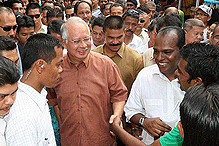 Najib’s ‘walkabouts’- during which he converses with ordinary Malaysians at political events - are another indicator of his unwillingness to implement genuine civil and political reforms.
Indeed a ‘walkabout’ would be unnecessary if he opened the political system to public scrutiny, legitimate evaluation and appraisal. Media investigations have revealed that such outings are usually surprise visits which only the national news agency Bernama is invited to cover.
The release of detainees held under the Internal Security Act also fits with this analysis. Najib’s motives in releasing the detainees appear directed towards gaining political capital rather than a genuine expansion of civil liberties.
 A telling indicator of the mettle of his administration is Najib’s inaction on the issues which led to the downfall of predecessor Abdullah Ahmad Badawi. No reforms have been made to reduce corruption or improve governance.
A recent poll by the Merdeka Centre for Opinion Research showed that the majority of Malaysians are not confident of Najib’s ability to reform the Anti-Corruption Agency (now Malaysian Anti-Corruption Commission) or the judiciary, or to implement government projects in a timely fashion.
Najib’s overall approval rating also remains low when compared to Abdullah’s tenure over the same timeframe. While Najib is enjoying an early surge in popularity from a very low base, with this poll giving him a 65 percent approval rating, Badawi scored 91 percent support when he first took power in 2004. If Abdullah was ousted for his weak reforms in these key areas, what can Najib expect?
Najib’s first 100 days have included an array of measures which signify ‘business as usual’ in Malaysian politics. Given ongoing concerns about the role of race-based politics, corruption, breakdown in the rule of law and a weak domestic and global economy, Najib faces pressures above and beyond those faced by Abdullah.
In response, Najib will have to deliver on Umno’s long-promised economic, political, and civil reforms.
SIAAN ANSORI and GREG LOPEZ are postgraduate students in the College of Asia and the Pacific at the Australian National University. This article first appeared on East Asia Forum .


Are you sure you want to delete this comment?
This action cannot be undone.