




Yasmin: Truly Malaysian to the end
obituary How do I describe the hole that film maker Yasmin Ahmad’s sudden demise has left in the Malaysian heart, soul and consciousness? Where do I even begin to explain the phenomenon and personality of Yasmin and her work?
Yasmin, fondly known as Kak Min to young fans, passed away on July 25 following a stroke and brain haemorrhage. She was 51.
obituary How do I describe the hole that film maker Yasmin Ahmad’s sudden demise has left in the Malaysian heart, soul and consciousness? Where do I even begin to explain the phenomenon and personality of Yasmin and her work?
 Yasmin, fondly known as Kak Min to young fans, passed away on July 25 following a stroke and brain haemorrhage. She was 51.
She shot to fame with her first feature film Sepet (2004), an inter-racial teenage romance between 17-year-old Orked, a Malay girl from a liberal, loving family; and Jason, an 18-year-old seller of pirated DVDs, from a Chinese working class family. She followed up the film with Gubra (2006), Mukhsin (2006), Muallaf (2008) and Talentime (2008).
Prior to Sepet , Yasmin had ‘trialed’ her talent with a teledrama Rabun based on the story of her parents. She was motivated by her father’s collapse and felt she needed to pay a tribute to her parents’ loving relationship: indeed she portrayed them as a couple who continued to bathe together and who teased one another even in their 70s.
The characters of Mak Inom, Pak Atan and their daughter Orked were to appear as main characters in the Orked trilogy ( Sepet, Gubra and Mukhsin) . At the time of her death, Yasmin was working on two film projects, Wasurenagusa (Forget-Me-Not) and Go Thaddeus .
Her award-winning films, much like her Petronas commercials, conveyed the universal message of love and compassion underlined by humour and sometimes pathos. Who could forget Mukhsin’s pain of rejection and isolation as he stands outside Orked’s house looking in to see the family embraced in a slow dance to Nina Simone’s ‘Ne Me Quitte Pas’?
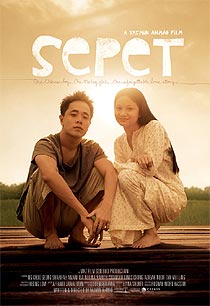 Or when Jason’s Peranakan mother tells him she welcomes his Malay girlfriend and wanted to meet her without knowing that they had just broken up (and Jason responds by laying his head on her lap wordlessly)?
In fact, the recent commercial she made for the Singapore Ministry of Community Development, Youth and Sports about the importance of family - entitled Funeral - might be said to be an apt eulogy that we can express for her: it is a message about acceptance of human imperfection and inter-racial love.
Her works touched us and reminded Malaysians that diversity and difference are our strengths and not the liability that ethno-nationalist purists and racist bigots wanted us to believe it is. One could say that her films, in detailing the impossible, were idealistic and maybe even a tad naïve.
For our 50th anniversary of Merdeka which most Malaysians found little to celebrate under Pak Lah’s troubled leadership, she gave us the gift of Tan Hong Ming in Love to remind us that despite the racialised politicking, our children are colour-blind.
‘Please wake me up’
Only a naïve person would write as she did on her blog a week before she collapsed: “Someone please wake me from this nightmare and tell me that this did not happen in my country and that Teoh Beng Hock is safe at home with his family.” (July 16, 2009).
Only the naïve or the very sheltered would believe there was any substance behind our national slogans like ‘1Malaysia’. Yet, where would we anak-anak bangsa Malaysia be without the shared dreams and hopes of cosmopolitan togetherness her films envisioned for us, both in the past, present and future?
Before Yasmin came along, there was only Malay cinema. She represented a multicultural Malaysian society on screen and unlike her other independent film making cohorts, was arguably the most successful in projecting her indie ‘Malaysian Malaysia’ sensibilities onto the local mainstream film industry.
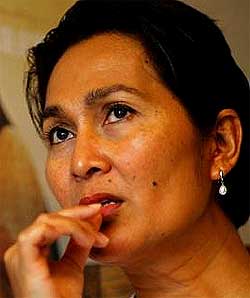 In a 2007 panel discussion about the controversy over Namewee’s rap,
Negarakuku,
Yasmin said she didn’t know anything about politics; yet she spoke nothing but the politics and philosophy of love, not realising that it was love that is perhaps the hardest dream (though the simplest in her mind) for her critics and naysayers to overcome: hard and impossible for those who beat up others and abuse their authority, hard for those whose corrupt souls no longer have room for compassion.
In a 2007 panel discussion about the controversy over Namewee’s rap,
Negarakuku,
Yasmin said she didn’t know anything about politics; yet she spoke nothing but the politics and philosophy of love, not realising that it was love that is perhaps the hardest dream (though the simplest in her mind) for her critics and naysayers to overcome: hard and impossible for those who beat up others and abuse their authority, hard for those whose corrupt souls no longer have room for compassion.
Hard for those who have forgotten what it means to be a humble human being and merely one of many of God’s creatures. After all, an advertisement she created for SPCA about an autistic child who could not be drawn out into the world except by a dog was banned by the censors.
Yasmin made loving seem so easy: enough to dissolve the bitter kernel in most cynics. Yet only narrow-minded repressed bigots could make that love so impossible and so dirty. Only bigots would perceive the instances of acceptance of diversity, her embrace of hybridity and human imperfections (the bilal and his wife who are friendly to the two sex workers in their neighbourhood in Gubra ) as ‘culturally polluting’ and ‘morally lost and corruptive’.
So today it is my turn to say: Someone please wake me from this nightmare and tell me that this did not happen in my country and that Yasmin Ahmad is safe at home with her family.
Go in grace, rest in peace, Yasmin. You are sorely missed.
KHOO GAIK CHENG is lecturer in Gender, Sexuality and Culture at the Australian National University.


