




Perak Pakatan gov't was the prototype
Shah Alam MP Khalid Samad believes that the creation of a decision-making mechanism within Pakatan Rakyat is the principal milestone in the quest for a two-coalition system in Malaysia.
Shah Alam MP Khalid Samad believes that the creation of a decision-making mechanism within Pakatan Rakyat is the principal milestone in the quest for a two-coalition system in Malaysia.
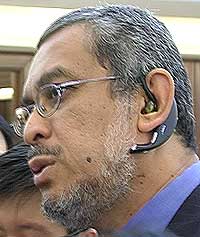 In remarks made at a seminar organized by the Institute of Southeast Asian Studies in Singapore earlier this week, the PAS legislator said such a mechanism was created by the Pakatan government that ruled Perak from March 2008 until it was ousted by the Barisan Nasional last February.
Khalid ( right ), one of the Malaysian Parliament's least partisan voices, credited the DAP, which held the overall majority in the Perak State Assembly, for the success of the concept of consensual government whereby no policy would be passed if coalition partners were not in agreement.
He claimed the Pakatan governments of Selangor and Kedah have yet to emulate the mechanism successfully wrought by the Perak Pakatan government led by Nizar Jamaluddin, the PAS assemblyman who became menteri besar.
Khalid, a resolute believer in persuasion through reasoned argument, said the mechanism was necessary to obviate the impact of differing ideologies of Pakatan partners on decision making.
Overriding political ideologies
He explained that Pakatan coalition partners were propelled by a desire to provide responsible and transparent government in the five states where they were enthroned.
 He said this motivation was sufficiently potent to override ideological differences among coalition partners such that the immediate policies that were being implemented were not held hostage to fundamental differences.
He added that the Pakatan desire to provide government that moves the "country away from racial politics that has been the defining character of politics under BN" overrode the centrifugal pull of clashing ideologies.
Khalid said the "fear of one race being sidelined" and the fear of another race coming into power "has always been the bogeyman that has been projected by Umno-BN in order for them to stay in power".
He said the Pakatan faced the challenge of educating the public that this "racial politics" was a tool employed by the BN to extend their hold on power rather than an actual danger posed by Malaysian society.
Caution ary note to Pakatan
According to Khalid, another challenge faced by Pakatan was how to manage change. He held that change would be better managed if Pakatan partners correctly identified the reasons why the public supported Pakatan in the last general election.
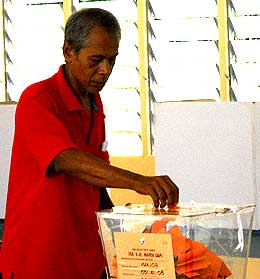 He said he personally believed the main reason why Pakatan did well was that the people were tired of BN's corruption and racial politics.
He said attributions by PAS for their success to increasing Islamic consciousness and of PKR and DAP to their attractiveness to voters, were not necessarily correct.
Khalid cautioned that incorrect attributions for their success would lead Pakatan coalition partners to "bring about changes which probably society at large is not completely ready to accept".
He said the management of change would be better effected if Pakatan emphasised the need for political socialisation and reconstruction of social values which were warped by Umno-BN's domination of access to Malay society through mosque, and surau, and through the positions of village chiefs and security committees.
Khalid said the values perpetuated by Umno-BN were based on fear, suspicion and racialist policies. He added that Pakatan should counter this politics of fear and race with a "more positive political philosophy where issues of social justice, economic justice and the role of government in ensuring national unity" is emphasised.
He said this philosophy must be imparted and explained to Malay society "in a more Islamic perspective".


