Air quality improves slightly but worsens in S'wak
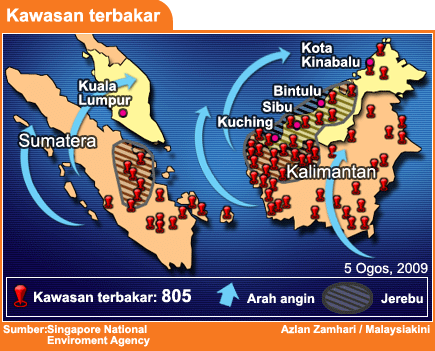
There has been a slight improvement in the air pollution levels today with only one ‘unhealthy’ area in Peninsular Malaysia, but the situation has significantly worsened in Sarawak.
There has been a slight improvement in the air pollution levels today with only one ‘unhealthy’ area in Peninsular Malaysia, but the situation has significantly worsened in Sarawak.
Yesterday, Malaysia recorded its worst haze levels this year as smoke from forest fires caused 'unhealthy' levels of pollution in six areas - three in Peninsular Malaysia and three in Sarawak.
The Air Pollution Index readings taken at 5pm yesterday by the Department of Environment show Cheras (104), Malacca (109), Kuantan (103), Bintulu (107), Sibu (103) and Samarahan (117) in the ‘unhealthy’ category.
At 5pm today, only one area in the Peninsular fall into the ‘unhealthy’ category - Malacca (104) - while Sarawak has three areas with ‘unhealthy’ readings - Miri (115), Samarahan (148) and Sibu (122).
Meanwhile, Kuching and Bintulu are both two points below ‘unhealthy’ at 99, and Sri Aman is at 95.
Air quality is deemed 'unhealthy' at readings of 101-200, 'very unhealthy' from 201-300 and 'hazardous' if above 300. A reading of 0-50 is deemed 'good' and from 51-100 as 'moderate'.
Only 11 out of 49 areas where API readings were taken nationwide have registered 'good' air quality. They were mostly in the northern part of Peninsular Malaysia - Penang, Kedah, Perak, Perlis and Kelantan.
Increase in hot spots
Environment Department director-general Rosnani Ibarahim said hundreds of forest fires were blazing in the Indonesian provinces of Kalimantan and Sumatra, and in Sarawak.
"Malaysia started to record an increase in hotspot numbers since Sunday due to the dry weather and open burning activities which spread very fast," she told APF earlier this week.
Farmers burn forests every year to clear land for agriculture, sending plumes of smoke across neighbouring countries.
The haze was at its worst in 1997-1998, costing the Southeast Asian region an estimated US$9 billion by disrupting air travel and other business activities.
Health Minister Liow Tiong Lai has expressed fears that the haze would worsen the A(H1N1) flu situation by causing more respiratory illnesses.