




MCA - President vs Deputy
William Shakespeare's saying, "Uneasy lies the head that wears the crown," has a ring of truth for Transport Minister and MCA president Ong Tee Keat.
The president of the second largest component party in Barisan Nasional (BN) coalition, is being besieged within his party.
William Shakespeare's saying, "Uneasy lies the head that wears the crown," has a ring of truth for Transport Minister and MCA president Ong Tee Keat.
The president of the second largest component party in the Barisan Nasional (BN) coalition is being besieged within his party.
In recent weeks, the decibels of the drumbeats of war within Ong's party seemed to be getting louder. Party insiders say both Ong and his deputy Chua Soi Lek's supporters are eyeing each other for signs of an open confrontation that might unfold in the coming weeks.
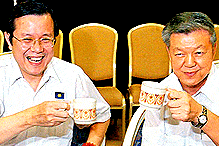 It has led some observers to speculate that an Extraordinary General Meeting (EGM) would be held to address the issue but this rumour had been circulating for the past several months.
Things have come to such a stage that non-partisan party rank and file leaders are getting frustrated and bitter that the leadership had learnt little from the party's history.
Chua's recent denial in May that he is contemplating jumping ship with his son, Tee Young, who is Labis MP (joining an opposition party), are indications that a battle is looming.
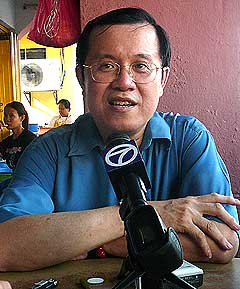
Stanley Koh, formerly with MCA's Research and Planning Department shares some of his thoughts with Malaysiakini on the leadership crisis and what to expect in the coming weeks.
Koh was with Malaysiakini for a year under its Digital Library project in 2008. He left to join online news portal Malaysian Mirror before resigning in July last month .
Malaysiakini: How serious is the personality clashes between Ong and his deputy Chua? What is the likelihood of an open confrontation which will seriously affect MCA’s already poor image?
Koh: According to a recent NST report, a silent war is already on in the electronic media dubbed 'cyber brickbats' or tactical character assassination initiated by some party members.
The fact that this in-fighting is being waged in cyberspace reveals that rising emotional temperatures can be quite pervasive, particularly among hardcore supporters of both camps.
But the question whether an open confrontation of a volcanic proportion can take place largely depends on the Ong-led presidential council's verdict on Chua's case.
The party's disciplinary board headed by former secretary-general Ng Cheng Kiat had just completed its hearing where Chua had presented his case.
As I see it, the decision of the presidential council chaired by Ong will be a major factor as to whether another political hurricane will take place within the 60-year old party.
How long will the party grassroots have to wait for the final decision on Chua's case?
I gathered from party sources that the disciplinary board will in all likelihood take one to two weeks to deliberate and submit its recommendations to the presidential council, which will make a decision at one of its weekly meetings.
How soon the council decides is anybody's guess as the president fixes the date for the meetings. If the decision goes against Chua, he has 14 days to file an appeal to the central committee.
Under normal circumstances, it could take more than a month for the outcome to be made known.
Do you think the negative developments were a surprise and a repeat of MCA's history?
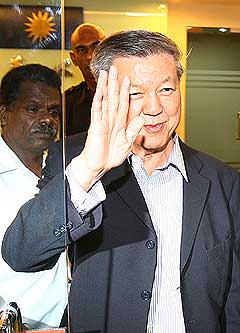 With the benefit of hindsight, there was little surprise despite Ong and Chua giving open assurances of their cooperation immediately after their victories in last October's party elections. Most non-party members do not really pay much attention to the squabblings and side-shows.
The Chinese community views the MCA leadership crisis as nothing new, being part and parcel of the party's history of rivalry between the top two.
There are also those who are quite convinced that since the last general elections, the party has lost its relevance. It looks like history is repeating itself.
I gathered from a reliable source that certain quarters are mulling the possibility of getting someone like a corporate leader to mediate between Ong and Chua.
We still remember that Lim Kok Wing mediated during the Ling-Lim leadership crisis.
Has the popularity of the MCA president been affected, especially on issues with his deputy and PKFZ?
Within the MCA, there is a general realisation that the Ong (Ka Ting) and Chan (Kong Choy) era of close rapport and good working relationship was the "golden age".
This was the result of the compromise that ended the leadership dispute between Ling Liong Sik and Lim Ah Lek - leaders of Team A and B respectively.
So when Ka Ting and Kong Choy stepped down, expectations were high within the party that the party leaders would redeem MCA's image in the wake of the "308 political tsunami".
 According to a Merdeka Centre Opinion Research survey of last September, 76% of the 1,002 respondents favoured Ong Tee Keat over Chua Soi Lek who scored 46%.
More than two-thirds were against a tainted leader holding a government post.
But at the October 2008 party elections, central delegates surprised themselves by voting in the Ong-Chua combination.
The message it would seem was for the two to bury the hatchet and concentrate on guiding the party along the road to recovery.
It has been almost 10 months since last October when Ong took over the reins of leadership and I doubt these delegates can accept any more excuses for their failure to work together.
I would not be surprised if Ong's popularity rating has taken a dip although there was no follow-up to the poll taken in September.
Chua's conciliatory tone, professing his willingness to cooperate for the sake of the party had won him sympathy and goodwill from ordinary party members.
In contrast Ong's image has taken a beating with many members accusing him of taking cheap shots at Chua for the sake of publicity, and marginalising Chua.
Were there any major incidents which led to this worsening relationship between the two?
In fact, there were just too many incidents or contributing factors which in one way or other aggravated their personal and working relationships.
Marginalising Chua was one of the main factors. A Chinese proverb says, " bing dong san chi, fei yi ri zhi ." Literally it means, "a single day of sub-zero temperature is insufficient to create three-feet of ice."
The gradual building up of grievances and frustrations on both their parts over a 10-month period may make reconciliation more difficult.
It may reach the point where "the straw that broke the camel's back" may apply.
Chua's supporters recently submitting a memorandum to the party's disciplinary board provides an illustration.
In that document they claimed that Ong as president had tarnished MCA's image by supporting the setting up of the Integrity Watch Group (IWG) in 2008, whose hidden agenda was to only find fault with Chua.
In May, according to the Sun daily, Ong dismissed the allegation that the IWG comprised exclusively of his men with the agenda to topple his deputy.
Chua remained unconvinced. In claiming Ong's link with the IWG, he mentioned its head, one Dr Daphne Loke who was from Segi University, owned by Clement Hii, who was appointed The Star Publications' deputy executive chairperson by Ong.
This prompted Ong to publicly deny that IWG was set up with the express purpose of getting rid of his deputy as reported by some mainstream newspapers.
The Chinese press had been turned into a battleground on two conflicting lists of Adun appointments in Johor MCA.
Chua's appointment as BN chief coordinator by the prime minister (which some had perceived as by-passing the MCA leadership) also added to the dissatisfaction among the president's men.
All these incidents, I think, have contributed to the worsening of the Ong-Chua relationship.
But the final straw was when Chua was summoned by the MCA disciplinary board to defend himself on Aug 4 over the sex tape scandal.
Do you think Chua has been successful in striking a new consensus within the party on his political future?
Chua himself in his latest blog posting cited five reasons why there was no justification for the disciplinary committee to hear the sex-tape case.
One of the reasons was that the complainant, a party leader from Simpang Renggam, had withdrawn his complaint filed more than a year ago.
Of course, many agreed with him (Chua) that he had suffered enough punishment by resigning as health minister and from all party posts last year.
The central delegates gave him a new lease of political life when they voted him as deputy. I think the support for him is gaining momentum within the party but I'm not sure whether its coming from the central delegates.
Being popular and garnering the hard votes is something else. Even Chua has admitted that as incumbent, the president is very powerful and influential. Only a battle at the EGM can provide the answers.
Why has the PKFZ been drawn into the leadership dispute ?
I think it's all gamesmanship. I might be wrong on this count. Gaining sympathy and whipping up support when one is facing a politically threatening scenario. It happens all the time.
Chua had openly criticised Ong who is also transport minister for "play-acting" over the PKFZ issue by claiming that he was threatened by both "internal and external" forces.
Some supporters of Chua had interpreted the "internal forces" as referring to the deputy president who had been suspected of orchestrating the effort to call an extraordinary general meeting aimed at removing Ong as president.
Although the rumours of an EGM had been circulating for the past few months, there's nothing solid to indicate the truth of the matter or whether the event would take place at all in the near future.
"Ong should make a police report if it (threat) was a genuine one," said Chua. He was referring to Ong having openly claimed that certain people had tried to stop him from revealing more about the PKFZ, a project overseen by his transport ministry. Ong finally did lodge a police report.
What are your views on the leadership qualities that would help to bring an end to this feuding situation?
Ong was a member of the gang of 8 who had fought bitterly in Team B and had incurred the wrath of former president Ling Liong Sik.
Many years later Ong recalled that he had stood his ground on many issues during the Ling-Lim party crisis "guided by his conscience."
This realisation should give Ong more reasons to avoid repeating the same mistakes of former presidents who were blinded by the same power he has today.


Are you sure you want to delete this comment?
This action cannot be undone.