




Rains, Typhoon Morakot clear haze
While Sabah and Sarawak has joined the rest of Malaysia in recording better air quality yesterday, both states are now experiencing a lengthy dry spell which started about three weeks ago.
While Sabah and Sarawak has joined the rest of Malaysia in recording better air quality yesterday, both states are now experiencing a lengthy dry spell which started about three weeks ago.
 Sarawak Deputy Chief Minister Dr George Chan informed
Bernama
yesterday that "residents (chief administrative officers) of all the 11 divisions were asked to be on high alert (despite) a respite from the dry spell and haze due to cloud-seeding operations and the aftermath of Typhoon Morakot."
Sarawak Deputy Chief Minister Dr George Chan informed
Bernama
yesterday that "residents (chief administrative officers) of all the 11 divisions were asked to be on high alert (despite) a respite from the dry spell and haze due to cloud-seeding operations and the aftermath of Typhoon Morakot."
The state "government might consider water rationing for a few hours if no rain, including from cloud-seeding operations, occurred in the water catchment areas."
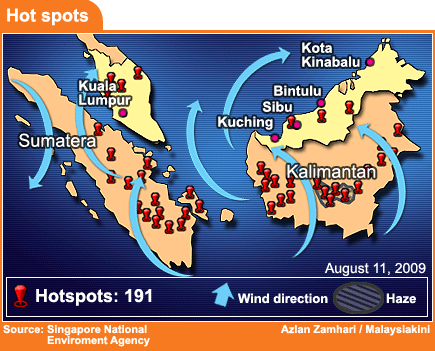
The situation is serious enough for Chan, who is also state disaster and relief management committee chief, to tell residents “to ensure that our people who need water get their supply as soon as possible”.
He urged the residents to “enlist the help of the private sector and other agencies, including the army and navy, for transportation besides the Public Works Department” in transporting water into areas worst hit by the dry spell.
Rains, Thypoon Morakat provide respite
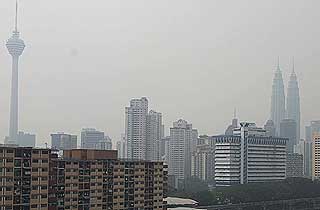
Overall, the heavy rainfall and strong winds from the after effects of Typhoon Morakot brings the blessing-in-disguise of lifting the veil of haze over most parts of Malaysia yesterday.
Last weekend, AP reported that the typhoon formed in the storm-breeding waters of the South China Sea, wreaked havoc in Taiwan and China.
 Early estimates put the damage caused by the tropical weather system to be in the billions. The typhoon also caused strong winds, heavy rainfall and mud slides which accounted for most of the damage to agriculture and local infrastructure.
Since last weekend and throughout early this week Malaysia has been experiencing the after-effects of Morakot. This is mainly seen in a slight rise in rainfall and windy conditions.
Reports on the ground from Miri told of strong winds which according to locals, blew away some of the haze.
In general, the Air Pollution Index (API) shows a general reduction from both the 11am and 5pm readings yesterday. This shows an easing of the API from the highs of the day before.
As at 5pm yesterday, the API readings remained at an average of 60 and lower for the peninsula with only Cheras and Shah Alam recording 81 and 80 respectively. Universiti Sains Malaysia continued to record the best reading with 27.
In Sabah and Sarawak, the air quality in three areas - Limbang, Sandakan and Kota Kinabalu - was rated below 50 or ‘good’, while other areas averaged readings in the 70s. However, Sibu at 104 and Miri at 185 continued to exhibit the highest readings.
Air quality is deemed 'unhealthy' at readings of 101-200, 'very unhealthy' from 201-300 and 'hazardous' if above 300. A reading of 0-50 is deemed 'good' and is 'moderate' from 51-100.


