




Airlines in tussle for lucrative KK-Sibu route
Air Asia may get to keep the lucrative Kota Kinabalu-Sibu sector beyond the Oct 25 deadline if intense lobbying by the low-cost carrier, various associations in Sabah and Sarawak and the respective state governments pays off.
Air Asia may get to keep the lucrative Kota Kinabalu-Sibu sector beyond the Oct 25 deadline if intense lobbying by the low-cost carrier, various associations in Sabah and Sarawak and the respective state governments pays off.
Also, this offers a ray of hope for passengers who are holding tickets beyond the deadline, many until next April.
 Air Asia head Tony Fernandes, it is learnt, has sent Transport Minister Ong Tee Keat a letter urging the government to open rural routes to commercial airlines.
He has also held out a carrot, with plans to make KK the transit point between Foo Chow in China and Sibu. A direct flight between Sibu and Foo Chow has been ruled out as unrealistic.
Ong disclosed this to two groups, the Foo Chow Association (FCA) in Kota Kinabalu and the Chinese Chamber of Commerce in Sibu, who met him over the weekend in Kota Kinabalu to discuss the matter.
Sibu is a ‘Foo Chow’ city and many members of this Chinese community are involved in business in Sabah. They travel home regularly.
“Ong said that it (KK-Sibu sector) involved an agreement between the government and MASwings before he became transport minister,” said FCA chairperson Lee Su Kwong.
“He has to look into the delicate points contained in the agreement because that might involve, perhaps, not just one sector.”
“The government should allow Air Asia to continue providing direct daily flights between KK and Sibu for the sake of the passengers. The route is popular among passengers. MASwings is more expensive than Air Asia.”
Jackson Lau, the Air Asia station manager in Kota Kinabalu, said the airline’s lowest fare for KK-Sibu is RM100 return and the highest RM170. MASwings charges as high as RM285 while its lowest fare is RM247.
Air Asia started its daily KK-Sibu flights in April and operates with its Airbus A380 which has a capacity of 180 passengers. It has a load factor of 80 percent.
When it sent in its proposed flight schedules for this year to the Transport Ministry late last year for approval, its KK-Sibu route had received the go-ahead.
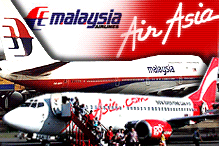 Last Thursday, Fernandes said he was told leave the sector to MASwings, a Malaysia Airlines subsidiary, by Oct 25. This followed complaints by the national carrier which has a monopoly of rural air routes in Sabah and Sarawak.
Apparently, a 10-year contract signed between Malaysia Airlines and the Transport Ministry in October 2007 gives the national carrier the rights to all seven ‘rural’ routes in the two states, some of these being exclusive to it.
Growing support
The Federation of United Chinese Associations of Sarawak is among the latest to lobby for Air Asia to keep the KK-Sibu sector.
“Frequent travelers between KK and Sibu are very happy with the current service by Air Asia due to its affordability and reliability,” said secretary-general Kong Sieng King.
“Deputy Transport Minister Robert Lau Hoi Chew assured us that he personally discussed the matter with Ong.”
Lau, according to Kong, will also push for an open skies policy in Sabah and Sarawak “in order to enhance the tourism and investment sectors”.
Robert Tan, managing director of the Sibu-based Equatorial Tours and Travel Sdn Bhd, is also actively lobbying the Sarawak government to support Air Asia.
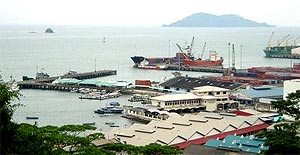 “KK is the second biggest hub and transit point after Kuala Lumpur for flying from Malaysia to the places like Seoul, Manila, Jakarta, Hong Kong and Macau. KK is also the most important and cheapest stopover,” he said.
However, the Air Transport Workers Union of Sabah (ATWUS) and the Air Transport Workers Union of Sarawak are against the KK-Sibu sector reverting to Air Asia or even the airline sharing the route with MASwings.
“The government should not bend the existing agreement to accommodate Air Asia’s demand,” said both unions in a joint statement.
“Air Asia’s request to operate the KK-Sibu route may affect the business of MASwings and also indirectly the staff as well as the public.”
Added ATWUS president Mohd Alfreedo Mohd Yahya: “Allowing Air Asia to fly the KK-Sibu sector would mean the government adding to the profits of the airline. Besides, MASwings would not be able to optimise its seating capacity for the sector.”
MAS: No such thing
Malaysia Airlines has denied that it is forcing Air Asia out of the KK-Sibu route.
“The KK-Sibu route is exclusive to the Rural Air Service (RAS) operator. Air Asia had this right when it operated FAX,” said MASwings managing director Mohd Salleh Tabrani.
 “Air Asia quickly realised that the RAS was not profitable and surrendered the routes although it has more subsidies than Malaysia Airlines. Now that we are running the RAS, it wants to cherry pick and cut in on the profitable routes.”
Mohd Salleh claimed that when Malaysia Airlines handed over the RAS to FAX on 2006, the airline had to retrench hundreds of long-serving staff in Sabah and Sarawak under a mutual separation scheme.
It also handed over seven Fokker 50 and five Twin Otter aircraft to FAX in good flying condition.
When MASwings resumed the RAS from FAX on Oct 1, 2007, 50 percent of the Fokkers and Twin Otters were not airworthy, claimed Mohd Salleh.
“We had to spend RM 36 million to restore these aircraft to make them airworthy again.”


