




Immigration warns bosses as amnesty deadline looms
Immigration authorities in Sabah have warned employers that they will move against them and their illegal workers with the full force of the law after the current amnesty offer period - the second within a year - ends its four-month run on Oct 31.
Immigration authorities in Sabah have warned employers that they will move against them and their illegal workers with the full force of the law after the current amnesty offer period - the second within a year - ends its four-month run on Oct 31.
The warning comes in the wake of a joint memorandum submitted by employers to the federal government on Monday through the state government on the legalisation of their illegal workers.
The employers are appealing for even more incentives citing the current economic uncertainties. Immigration authorities however feel, given past experience, that this approach is just a lame excuse to pressure the government to cave in to their various demands.
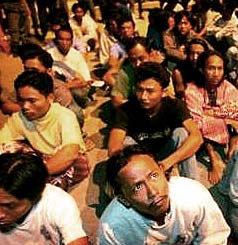 “Employers should not blame the government after Oct 31. Those who fail to pay the levies for their workers or register them will face the music,” said Sabah Immigration director Baharom Talib.
“Our men are monitoring all main entry points in the state closely, with every movement recorded and thumb prints taken using the biometric system. We are getting assistance from other agencies like the police, marine and Malaysian Maritime Enforcement Agency.”
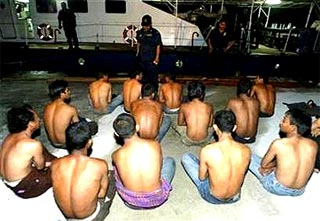
Immigration will also take action after Oct 31 against locals renting out their premises and land to illegal immigrants besides roping in those employing illegal immigrants, according to Baharom.
The Immigration chief expressed disappointment over the poor response to the second amnesty offer which began on July 1. He’s wringing his hands over the fact that only 931 registered foreign workers have paid their levies so far.
Drastic reduction in registration
It is not known how many failed to register but they are believed to be in the hundreds of thousands.
Under the current amnesty period, the Immigration Department has only collected RM513,000 in levies from registered illegal workers compared with RM81 million during the first period from Aug 1 to Oct 31 last year.
“Out of 312,000 immigrant workers and their dependents who registered with Immigration during the first amnesty offer period, only half paid their levies,” sighed Baharom.
“Just for the second amnesty offer period, we are offering a 50 percent reduction (for some workers) in the levies. But still there are very few takers.”
 Plantation workers, under the second amnesty offer, have to fork out RM270 for their levy and maids RM180. Other categories are not affected.
Aside from the palm oil sector, the timber industry employs the most number of foreign workers followed by construction, services and others. Generally, the levies have to be paid by employers. In practice, employers deduct payment for levies from the salaries of their employees.
“Employers who register their foreign workers and pay their levies will also get their passports (from their missions) immediately. Previously, the workers had to pay for their levies first and then wait quite some time for their passports.”
The Immigration Department has also extended its operating hours by working throughout the week to accommodate those who cannot come during the weekdays to do their transactions. On weekends, immigration offices are open from 8am to 1pm.
Why the poor response to amnesty?
The poor response to the second amnesty offer is seen as linked with the joint memorandum by the employers and an advisory from the Indonesian Consulate in Kota Kinabalu that levies should be paid by employers and not their workers.
Already, Indonesian workers in Sabah have to fork out between RM833 and RM1,388 for transport costs from their area of origin to Nunukan, off Tawau, for processing by labour agents.
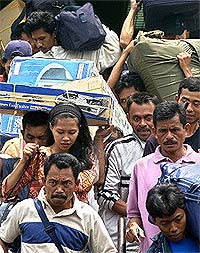 In addition, they have to pay for the cost of their stay in Nunukan and travel to their places of work. Many sell their belongings such as land and livestock while others borrow from family, relatives, neighbours and friends at an interest.
Apparently, the Indonesian Consulate in Kota Kinabalu has received many complaints about employers deducting the levies in installments from their workers’ salaries.
“By right, the employers should be the ones bearing the cost of the levy. They are not supposed to pass on the cost to their workers,” said Indonesian consul-general Rudhito Widagdo.
Surprisingly, the consul-general revealed that there are only 2,000 maids in Sabah registered with his office. This is based on the number of passports issued so far in the past year.
In actual fact, there are several hundred thousand maids in Sabah from Indonesia and the Philippines. Figures from the Philippines Embassy, which does not have a consulate in Kota Kinabalu because of the Sabah claim, were not available.
“Our requirements for the issuance of the passports are that employers or applicants must make sure their levy is paid, a contract in Malay between the employer and, for example, the maid is prepared to be endorsed by us and that the employers buy insurance to safeguard the safety of maids,” said Widagdo underlining the difficulties that illegal immigrants face in getting a passport.
“There was one case where a maid was not paid for seven years by her employer.”
Employers seek more relief from gov’t
Employers in Sabah are meanwhile seeking even more relief from the federal government for the recruitment of foreign labour as part of a “cost-reduction package to relieve the burden of major labour-orientated industries in particular”.
The employers feel that “drastic changes must be undertaken to address the concerns of the industries”.
“We appeal to the state government to emphasise our plight to the federal government and highlight our opinion if thegGovernment is unable to work out a relief package in terms of the employment of foreign workers,” reads the Joint Memorandum of Associations submitted to Chief Minister Musa Aman.
“It must at least come out with a cost-reduction package to relieve the burden of industries.”
 Among the appeals in the joint memorandum is a call for the standardisation of the levy for each foreign worker at RM360 in all sectors, subject to any discount for the second amnesty offer period.
Employers also want pro-rata payment in installments to provide flexibility in case of workers who abscond.
Employers also want across the board reduction in all supplementary expenditure, levy reimbursement of at least 50 percent for genuine cases of workers laid off, misconduct and other disciplinary matters.
They also want more holding centres for the health assessment of foreign workers to be established, the health assessment fees be reduced from RM95 per worker to RM50 and overall medical examination fees be reduced to RM60 per male worker and RM75 for females.
“The government should introduce approaches that are an inducement and provide incentives in nature. Don’t dangle the carrot and show the whip at the same time,” said Sabah Timber Industries Association (STIA) president James Hwong who submitted the joint memorandum on behalf of various chambers of commerce, and associations representing manufacturers, planters and builders.
“We hope the government will understand our predicament and not increase cost of operations, especially during these difficult times.”
The submission of the joint memorandum, however, is not expected to give employers in Sabah any respite from the Oct 31 deadline and crackdown against illegal immigrants.
Immigration officials say the joint memorandum cannot be used as an excuse to push the deadline further.
Employers, privately, are hoping the deadline under the second amnesty offer can be extended to the end of the year pending a decision on the joint memorandum.
It is unlikely that any extension would involve a third amnesty offer since this would seriously compromise the credibility of efforts by the federal government against illegal immigrants in the state.


