




Batang Kali and other emergency secrets
The recently announced decision by the British authorities that they will not carry out an inquiry into the Batang Kali massacre of 1948 because it happened 60 ago is "damn poor show, if you ask me." As someone has already commented, it is as if justice has an expiry date!
The recently announced decision by the British authorities that they will not carry out an inquiry into the Batang Kali massacre of 1948 because it happened 60 ago is "damn poor show, if you ask me." As someone has already commented, it is as if justice has an expiry date!
I remember a British QC once saying this in our Malaysian court: "Let justice be done though the sky fall down."
The ancient Romans said it first - "Fiat justitia ruat caelum" - because it sounded more profound in Latin.
Will the sky fall down if a case of grave injustice - the massacre of 24 innocent Malayans at Batang Kali in 1948 - is once and for all brought to a closure?
Why have the purveyors of "British justice" suddenly become such fuddy duddies? Are they worried about paying huge amounts of reparation to the victims if they are found to be liable?
First of all, "time is an ocean but it isn't the shore..." I think Bob Dylan said that. Sixty years? What's 60 years?
Didn't the Japanese pay compensation to the Korean "comfort women" for what they did 70 years ago? Then consider the Africans asking for reparation for slavery which happened more than three hundred years ago!
 No, the credit crunched British authorities should not be looking at reparation in such materialistic terms. Reparation is about justice. It is about atonement.
It is also about reconciliation, helping the victims and their families to come to terms with the past and to face the future after an acknowledgement of wrong-doing by the perpetrators.
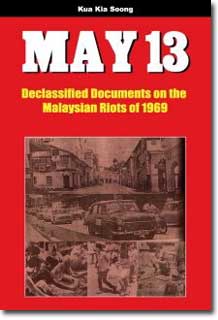
I brought up this point also in my book on May 13: Declassified Documents on the Malaysian Riots of 1969.
One of the surviving family members of Batang Kali, Madame Tham Yong is terminally ill. She has had to live through these 60 years without seeing the truth and justice prevail, and only when it has been fully established how these 24 Batang Kali men were killed, will she be able to rest in peace.
For the youth of today and for those who are not familiar with this and other Emergency secrets, 45 years after the event, I wrote an article "Batang Kali and other atrocities" which was published in The Sun on Aug 9, 1993.
In this article, I also held the Malaysian government partly responsible for covering up these dark Emergency secrets.
Here's why. The most complete record yet compiled on the Emergency (1948-60) was written by Anthony Short. He joined the University of Malaya in 1960 and was commissioned by the Malayan government to write the history of the communist insurrection in Malaya.
Confidential and secret papers
He was given full assistance by the government, including full access to confidential and secret papers. When his finished manuscript was handed over to the Malaysian government in October 1968, Short had to wait three years before being told that it was not to be published.
Poor Short had been too much the rigorous and honest academic and apparently, his work couldn't represent "the official history of the Emergency".
Nevertheless, The Communist Insurrection in Malaya , 1948-60 was eventually published in 1975 by Frederick Muller Ltd while he was senior lecturer at Aberdeen University.
For many years, this book was banned in Malaysia. Maybe it is time we had an official explanation of why Anthony Short's commissioned history of the Emergency was rejected by the government.
This is Short's conclusion after examining the records on the Batang Kali incident:
" That 24 guerrillas should have been killed in combat was in itself remarkable but the reticence shown by the army in acclaiming what should have been a considerable victory made it even more so.
"For 10 days there was no further statement. Two days later after the incident a police inquiry began but for 10 days no statement was issued although it soon became obvious that the 24 had been killed in what were at least unusual circumstances...There were no photographs, no names and no evidence that they were suspected guerrillas...
"What emerges from the villagers' accounts is a far more complex story which begins with the earlier ambush and killing of a lieutenant and a special constable, the arrest of a guerrilla supplier, and his arrival on the Sungai Remok estate with a combined army and police patrol.
"They encountered two young Chinese carrying padi who were accused of supplying the guerrillas, denied it, and were shot on the spot. The following morning, a lorry carrying tappers and rice arrived at these remote labour lines. The detained guerrilla supporter picked out a woman guerrilla supplier and the women were divided into two groups, some returning to the village, but the families of the men staying on.
"Troops then proceeded to burn down the labour lines and in so doing a number of detonators which were stored there, illegally no doubt but used for fishing purposes, exploded. The troops, outnumbered and thinking they had been ambushed, panicked and began shooting. The Chinese started running but at such close quarters, all of them were killed by rifle and automatic fire."
After the expose of the My Lai massacre during the Vietnam War in 1970, one of the Scots guardsman who was at Batang Kali swore statements under oath to the effect that the 24 men had been massacred and they were not attempting to escape.
Short believed that:
" Most of the evidence today is probably in the files of Scotland Yard, whose investigations were conducted by a Detective Chief Superintendent...Batang Kali remains the gravest, not least because it is the most exceptional, suspicion on the conduct of the British Army in Malaya."
Batang Kali not an isolated incident
With the change in leadership in Britain, in June 1970 the new Conservative government announced that the matter had been dropped. No reasons given. Was 22 years too long after the event to warrant an inquiry?
Batang Kali was not an isolated incident. Batang Kali was by no means the only atrocity committed by the government forces during the Emergency.
Short also found:
" In the series of actions in which large numbers of homes were burnt - Jalong, Kachau, Lintang, and Tronoh being particular examples of concern - the Kachau case, while it may not have been entirely representative, affords some insight into the despotic nature of certain operations ."
When the 30-year secrecy rule in Britain lifted the lid on the early years of the Emergency, it was discovered that the British Army had used a herbicide identical to Agent Orange in their operations in the rural areas of Malaya.
This appeared in the New Scientist in January 1984. But at least four years before that, when the Soviet Union was accused of using chemical warfare against the Afghan people, 'Le Monde Diplomatique' had already revealed this Emergency secret.
The question that environmentally conscious Malaysians today should ask is: What is the full extent of the spraying since, up to 1952, it was revealed that at least 20 sites in West Pahang and tracts of jungle had been sprayed.
Based on studies done in Vietnam, it has been found that the long-term effects of Agent Orange on health are horrific to say the least, giving rise to cancer, infertility as well as deformities.
Those who lived in the affected areas during the time should hold the authorities responsible and ask for compensation. The Malaysian health and environmental ministries have a responsibility to these victims and to ascertain the exact extent of such spraying during the Emergency.
Dr Kua Kia Soong is the director of Suaram.


Are you sure you want to delete this comment?
This action cannot be undone.