




US says welcomes 'independent' Japan
The United States said it welcomed a more "independent" role for Japan but stood firm that it would not back some of the new centre-left leadership's ideas on security.
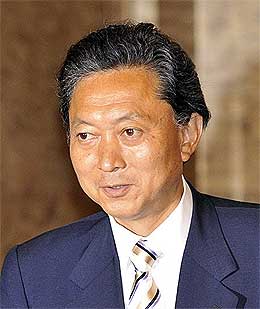
President Barack Obama offered congratulations in a telephone call to Japan's incoming prime minister Yukio Hatoyama, whose Democratic Party on Sunday trounced the conservatives who had led Japan almost uninterrupted since 1955.
The United States said it welcomed a more "independent" role for Japan but stood firm that it would not back some of the new centre-left leadership's ideas on security.
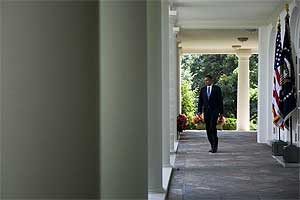 President Barack Obama offered congratulations in a telephone call to Japan's incoming prime minister Yukio Hatoyama, whose Democratic Party on Sunday trounced the conservatives who had led Japan almost uninterrupted since 1955.
The White House said the two spoke on the economic recovery, North Korea and climate change and "stressed the importance of a strong US-Japan alliance and their desire to build an even more effective partnership."
Hatoyama, a Stanford-educated engineer, has vowed to build a more "equal" relationship with the United States, which has stationed troops in Japan since World War II and has traditionally counted Tokyo among its staunchest allies.
Kurt Campbell, the assistant secretary of state for East Asia, said that the United States welcomed, rather than resented, a more independent Japan.
"I actually think that for the alliance to maintain its relevance and its influence over the course of the first part of this century, a degree of independence and of confidence is absolutely essential on the part of Japan," Campbell said.
"The United States supports that. We don't see any contradiction," he said at a forum at the Center for Strategic and International Studies, a Washington think-tank.
"Will there be challenges? Undoubtedly there will be, but the truth is that we've faced challenges over the decades and we've surmounted them," he said.
American air base issue
But the Obama administration, while pledging to work with the new administration, made clear it had red lines.
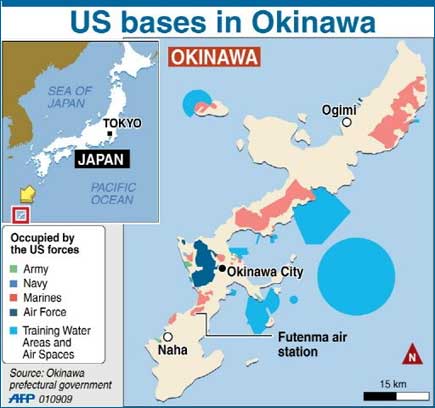
 Hatoyama's Democrats has called for a review on the nature of the 47,000-strong US troop presence in Japan, particularly in the subtropical island of Okinawa which is home to more than half the forces.
Hatoyama in the past supported calls to remove Futenma air base - long a source of friction as it lies in a crowded urban area - out of Okinawa. A plan between the two countries would shift the Marine base's facilities to reclaimed land on a quiet part of the island.
Kevin Maher, who heads the Japan desk at the State Department, said that a realignment deal reached with a previous government on Okinawa - under which 8,000 Marines would head to the US territory of Guam by 2014 - was final.
"It's an agreement between nations; it's not an agreement between parties," Maher said at the American Enterprise Institute, another Washington think-tank.
Maher said the realignment deal "does really drastically reduce the burden on Okinawa" but that Futenma was crucial in Okinawa.
"For the United States to be operationally able to meet our commitments for the defense of Japan and the maintenance of peace and stability in the Far East, we need to maintain the capabilities of Futenma," Maher said.
Naval mission opposed
On another hot-button issue, the Democrats have opposed Japan's naval mission on the Indian Ocean refueling US forces operating in Afghanistan.
Hatoyama has agreed not to end the mission before it expires in January, setting the stage for a potentially bruising foreign policy debate within the party.
On the campaign trail, Hatoyama also pledged to make Obama promise not to let US forces bring nuclear arms into Japan, the only nation to have suffered nuclear attack.
Hatoyama said he suspected the United States had a secret pact with Japan to bring in the weapons.
"Our position has been very clear - if you get down to the specific aircrafts and ships, we neither confirm nor deny" the nuclear nature of US forces worldwide, Maher said.
"With respect to Japan specifically, we are very much aware and respect the sensitivities," he said.
- AFP


Are you sure you want to delete this comment?
This action cannot be undone.