




MTUC asked to look after unorganised labour force
A former Malaysian Trade Union Congress (MTUC) general officer wants the union to look after the interests of the 90 percent unorganised labour force in the country, who are often short-changed by employers in the country.
A former Malaysian Trade Union Congress (MTUC) general officer from Perak wants the union to look after the interests of the 90 percent unorganised labour force in the country who are often short-changed by employers in the country.
K Kunasekaran, who volunteered at the MTUC for six years from 2002 to 2008, wants the union to recruit more Industrial Relation Officers (IRO) to cope with the increase in cases of terminated workers especially with the recent downturn in the country's economy.
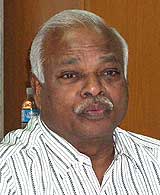 MTUC secretary-general G Rajasegaran
(left)
stated that only 10 percent of the country's 11.2 million workforce are unionised as the current Malaysian labour laws are unfriendly towards the formation of unions in the country.
MTUC secretary-general G Rajasegaran
(left)
stated that only 10 percent of the country's 11.2 million workforce are unionised as the current Malaysian labour laws are unfriendly towards the formation of unions in the country.
The unionist also further explained that there are 2 million legalised foreign workers in the country.
Kunasekaran said "As an umbrella body for the workers at large, MTUC must recruit more Industrial Relation Officers to represent these non-unionised workers who are mostly ignorant of their labour rights".
He stated that the current workforce of the 60 volunteer IROs of MTUC is insufficient to even meet the demands of the 10 percent of the union members.
So, there is a need to recruit more volunteers to efficiently solve the grouses of the non-unionised workers he opined.
"There are many social workers who have studied law and want to contribute towards society and MTUC can recruit such volunteer workers as Industrial Relation Officers to cope with the high work-load of wrongfully terminated non-unionised workers", he pointed out.
Resort to retrenchment as means of cutting costs
He said a lot of factories in Malaysia have reduced their workforce and have resorted to cutting costs by retrenching their workers and some workers face wrongful dismissal by their employers.
According to Kunasekaran the industrial court statistics between 2001 and 2008 showed a total of 12,447 types of termination cases of which 10,210 cases are for misconduct, 840 for retrenchment, 422 for constructive dismissal and 975 cases due to other factors.
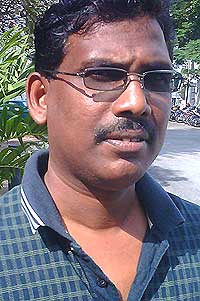 Kunasekaran
(right),
who is also Parti Sosialis Malaysia (PSM) central committee member, claimed that his PSM office (situated in the Tasek Industrial area of Ipoh) received a total of about 100 complaints from retrenched workers in Tasek from January to September this year.
Kunasekaran
(right),
who is also Parti Sosialis Malaysia (PSM) central committee member, claimed that his PSM office (situated in the Tasek Industrial area of Ipoh) received a total of about 100 complaints from retrenched workers in Tasek from January to September this year.
Kunasekaran stated since they did not have the authorisation letters from MTUC to represent these retrenched workers in the Industrial Relations Department (IRD), they could only advise them on the process of fighting for their rights. However, 60 of them had cold feet and withdrew while the remaining affected workers went through the legal process.
Under Section 20 of the Industrial Relations (IRA) Act 1967, workers who feel that they have been dismissed without just cause by his employer can state their case by writing in to the IRD within 60 days of their dismissal.
Section 20(6) of the IRA further states that a workman may represent himself or where he is a member of a trade union of workmen, he can be represented by an officer of the union.
MTUC IROs are given letters of authorisation by the union to represent the workers at the IRD or the industrial court.
However, Section 20 (7) of the act prohibits either the workman or employer from being represented by an advocate, adviser, consultant or any other person whatsoever.
The intention of Section 20(7) is to protect the workers from misuse and abuse and to encourage them to join unions.
Ignorant of labour laws
"However, the problem is that most of these workers are not educated and do not know the labour laws procedure when presenting their cases to the IRD. As a result they loose out in what they are legally entitled to like reinstatement and other benefits," he reasoned.
The first step in the procedures for going to the Industrial Court is the reconciliation process by IRD officers between the employer and worker.
If no settlement is reached then the matter is referred to the Human Resources Ministry for a final decision as to whether the case can be referred to the industrial court.
Kunasekaran pointed out that during the process of reconciliation if the worker fails to get legal advice from the MTUC IROs or is unable to put his facts correctly in seeking a reinstatement then he will lose his case if he goes to the industrial court as the minister will reject his case.
He argued that the whole purpose of the IRA is to reinstate the retrenched workers to their former work place and not to offer compensation to settle the matter out of the industrial court.
IRD officers offer bad advice
He alleged that some IRD officers advice retrenched workers against going back to their former place of work giving reasons such as that they may be victimised by the management and the work place will no longer be conducive for them to work in.
He further alleged that these officers will encourage the retrenched workers to opt for compensation offered by the employers.
These actions carried out by such unscrupulous officers go against the principles of natural justice and the labour laws of this country, alleged the PSM social worker.


Are you sure you want to delete this comment?
This action cannot be undone.