




Brother not eyeing PBS presidency after Pairin
PKR vice-president Jeffrey Kitingan has dismissed intense public and media speculation that he is the heir apparent in an elaborate succession plan put together by Parti Bersatu Sabah (PBS), currently helmed by his ‘ailing’ elder brother Joseph Pairin Kitingan.
“It is not true that I can simply walk into PBS tomorrow and take over as the party president as media reports seem to imply,” said Jeffrey on his former party of which he has been a member twice and turned down when he made a third attempt.
PKR vice-president Jeffrey Kitingan has dismissed intense public and media speculation that he is the heir apparent in an elaborate succession plan put together by Parti Bersatu Sabah (PBS), currently helmed by his ‘ailing’ elder brother Joseph Pairin Kitingan.
“It is not true that I can simply walk into PBS tomorrow and take over as the party president as media reports seem to imply,” said Jeffrey on his former party of which he has been a member twice and turned down when he made a third attempt.
“PBS, like other political parties, has constitutional provisions on who can or cannot be the party president.”
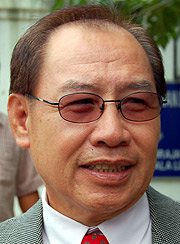 Jeffrey pointed out that it would be the members who will, in the final analysis, decide who will be the PBS president. In short, his elder brother cannot just simply ride roughshod over the members and decide on his own who should succeed him, even if he wanted to make that decision.
The PKR veep noted that some media have even quoted him as saying that his return to PBS was imminent because the party was having problems with its succession plans. He denied that he had ever made any statement along these lines to the media and suspects that “some people are again trying to fish in troubled waters at my expense and that of PKR”.
However, he agrees that it would not be surprising if PBS is having great difficulties in putting together a succession plan to prepare for a future without Pairin.
 Jeffrey was recently invited twice, indirectly, by Pairin to abandon the opposition and return to PBS, a party he co-founded together with the latter in 1985.
The invite
, according to the grapevine, is linked with the party’s search for a new leader to replace Pairin.
Jeffrey was recently invited twice, indirectly, by Pairin to abandon the opposition and return to PBS, a party he co-founded together with the latter in 1985.
The invite
, according to the grapevine, is linked with the party’s search for a new leader to replace Pairin.
Talk of the succession plan intensified after Pairin disappeared from public view for a month recently after his 69th birthday celebrations. He emerged to squash rumours, amidst feverish succession talk, that he was either suffering from cancer or had cardiac problems.
Falling out with PBS leadership
Underlining the difficulties of a future for him in PBS, Jeffrey stressed that there has been no love lost between the PBS leadership and him ever since his release from Internal Security Act (ISA) detention in 1994 on the eve of the state elections.
“The PBS leadership was not very welcoming after I was released. Many of them were even openly suspicious if not hostile,” said Jeffrey. “This was a marked contrast with the time when I was in detention and hailed as a hero fighting for Sabah rights.”
The initial suspicions against Jeffrey, according to him, was that he had been “brainwashed” while in detention and had been released to be a sort of Trojan horse for the ruling BN government.
Matters worsened, said Jeffrey, when a newspaper in Kuala Lumpur reported him as saying in 1994 that “Pairin was willing to step down as chief minister and accept the post of high commissioner to Australia and go into political exile”.
“I never said such a thing but the damage was done,” recalled Jeffrey. “What Pairin told me, and I repeated, was that he was willing to step down if it would help resolve a simmering political crisis then in Sabah. But this was never reported in full and instead what came out was completely different.”
Jeffrey acknowledged that he is still being blamed by PBS leaders for the exodus of state assemblypersons, dubbed the Frog Revolution, which followed his purported statement in Kuala Lumpur.
The PBS state government collapsed and the BN took over when the governor denied knowledge of an undated state assembly dissolution he had pre-signed.
Six state assemblypersons broke away to form Parti Bersatu Rakyat Sabah (PBRS) under secretary-general Joseph Kurup who left first. A week later, the same six followed Jeffrey himself to set up their own party but were unsuccessful. They returned to PBRS but left again when Jeffrey could not clinch the presidency.
Jeffrey’s group joined Angkatan Keadilan Rakyat (Akar), a PBS breakaway led by one-time deputy chief minister Mark Koding.
Subsequently, the seven including Jeffrey pulled out from Akar when he too failed to wrest the presidency from Pandikar Amin Mulia, now speaker of the Dewan Rakyat. Akar subsequently dissolved itself and its members, including the Chinese, joined Umno en bloc.
Meanwhile, another bigger group of state assemblypersons from PBS left, purportedly with Pairin’s blessings, to form Parti Democratic Sabah (PDS) under deputy president Bernard Dompok and join the BN.
PDS subsequently changed its name to United PasokMomogun KadazanDusunMurut Organisation (Upko) after PBS members began openly taunting the party as ‘Parti Dompok Sendiri’ (Dompok’s own party).
PBS deputy president Yong Teck Lee had earlier pulled out from the PBS on the eve of the 1994 state election and formed the Sabah Peoples Progressive Party (SAPP) to join BN. SAPP pulled out from the BN on Sept 17 last year citing loss of confidence in the federal leadership and listing a host of unresolved local grievances.
Jeffrey wants to lead his own party
“PBS today is basically Pairin and Pairin is PBS after the formation of so many breakaway parties,” said Jeffrey who does not rule out the demise of the mother party itself after the elder Kitingan leaves the scene.
“There are many in PBS who are worried about this and fear that PKR would step into the vacuum left by a party without Pairin.”
The demise of PBS would not necessarily be a bad thing, points out Jeffrey, since the party has already deviated from its original struggle for Sabah rights.
The Tambunan Declaration, which was abandoned by PBS upon its re-admission to the BN, has already been adopted by PKR as its Sabah manifesto, points out Jeffrey, “reducing PBS to irrelevance.”
The Tambunan Declaration incorporates the ‘20 Points Formula’ which was the basis for Sabah to agree to form Malaysia together with neighbours Sarawak and Brunei, Singapore and Malaya on Sept 16, 1963. Brunei stayed out at the 11th hour and Singapore left two years later.
Many politicians in Sabah think that it would be highly unlikely that Jeffrey would ever return to the PBS if he had no chance of emerging as the party’s leader after Pairin.
Jeffrey, it is noted, had always wanted to helm his own party - “not wishing to play second fiddle to anyone” - “and it remains to be seen whether he will stay with PKR if he doesn’t emerge as the party’s Sabah chief during party elections slated for May next year”.
In the case of Jeffrey’s failure to wrest the Sabah PKR leadership in May, it is predicted that he would either set up his own political party or return to PBS provided it re-adopts the Tambunan Declaration and he’s assured of succeeding Pairin as the party president.
Jeffrey’s departure from PKR, if it materialises, is likely to be a great setback for the party’s plans in Sabah.


Are you sure you want to delete this comment?
This action cannot be undone.