




Forget 'futile' complaints, take battle to the people
About two weeks after the conclusion of the MIC elections, seven candidates who contested and lost alleged that the elections was riddled with irregularities. They demanded for fresh polls to be held.
About two weeks after the conclusion of the MIC elections, seven candidates who contested and lost alleged that the elections was riddled with irregularities. They demanded for fresh polls to be held.
They also announced the formation of a pro-tem committee to pursue their grouses with the relevant authorities.
However, looking at the MIC constitution and the legal environment in the country, this could be a futile attempt.
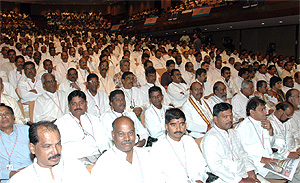 In the first place, there is no provision in the MIC constitution which provides for disgruntled candidates to file complaints or appeals with the election committee once the election results are announced.
This is because once the election committee conducts the elections and announces the results, it becomes ' functus officio ' which means that the committee is no longer functional and does not have the powers.
Therefore, complaints would have to be forwarded to the central working committee (CWC).
Assuming the CWC is going to consider the complaints on election irregularities, it must be remembered that the meeting would be chaired by MIC president S Samy Vellu himself and therefore he is not going to entertain these complaints as the bulk of them are against him.
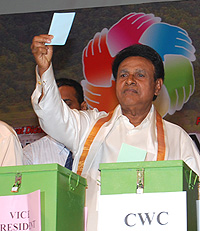 Even if Samy Vellu chooses to stay out of the CWC meeting deliberating these election irregularities just to show that the he is not influencing the CWC in arriving at a decision, it is unlikely that the CWC would favour a re-election even in his absence. They would still reject these complaints as the present CWC is made up of members who managed to win in the recent elections and none of them would be interested in going through another re-election.
In past MIC elections, there had never been an occasion where a complaint on the MIC polls at the federal or state level has been entertained nor was there any decision calling for a re-election just because of a complaint filed by a contestant.
Challenging the CWC's decision
So, once the CWC rejects all the complaints on the conduct of the election, is there any other avenue?
Article 91 of the MIC constitution makes it clear that a member who goes to court against a decision of the CWC shall cease to be a member of the party. The relevant provision reads as follows:-
"....If he resorts to court proceedings in respect of his rights, obligations, duties and privileges or on behalf of any other member or in respect of the rendering or meaning of the provisions of this constitution without first referring to the central working committee or in violation of any decision or directive of the central working committee he shall ipso facto (by the fact itself) cease to be a member of the congress and shall not be entitled to exercise any of the rights of a member."
Therefore, if the CWC rejects these complaints on election irregularities and the disgruntled candidates take the matter to court, they would only end up losing their membership in MIC.
One other avenue available for the pro-tem committee is to file a complaint with the Registrar of Societies (ROS). Again the ROS, in the past, has never interfered in an election process of a political party in this country. The ROS has also never gone against a decision made by the supreme council of a political party. The decision on T Murugiah during the recent PPP controversy is testimony of this.
Knowing the outcome of the ROS' decision, the only other option left for the pro-tem committee or the disgruntled contestants is to file a civil suit against MIC to nullify the elections. Here again, they would come to a dead-end as the provisions of the Societies Act clearly forbids court proceedings against the decisions of a supreme body of a political party which is the CWC in the case of MIC.
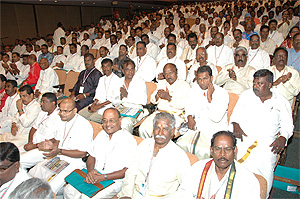 Even if the courts are prepared to look at the grouses of the disgruntled contestants, one of the cardinal principles always followed by the judges in deciding petitions for nullity of an election is that the appellant must prove that he could have won the election if not for the alleged irregularities. It means that the contestant must have lost by a narrow margin of votes.
Looking at the disgruntled contestants who have come forward to report about the election irregularities none of them appear to have lost by a narrow margin. Even if a re-election is held whether any of these candidates would be able to win back their respective positions for which they contested remains doubtful.
Therefore, even if a legal suit by the disgruntled contestants’ is considered by the courts the contestants would not get a favourable judgment because the court would only be interested to see whether the aggrieved contestant could have won the election if not for the irregularities.
Take battle to the people
Finally, among those complaining about the election irregularities, there is only one vice- presidential candidate and the rest are CWC candidates. So even if the complaints of these aggrieved contestants are accepted by the CWC or by the courts, there could only be a re-election for the CWC or the vice-presidents.
The CWC or the courts cannot order a re-election for deputy president because both S Subramaniam and S Sothinathan have not officially filed any complaints on election irregularities.
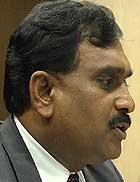 We should not overlook the fact that despite all these alleged irregularities there were several candidates outside the official line-up of Samy Vellu who managed to clinch a seat in the CWC. For example, KP Samy (
left
), a well-known critic of Samy Vellu managed to win a seat in the CWC with a comfortable majority despite all the odds.
We should not overlook the fact that despite all these alleged irregularities there were several candidates outside the official line-up of Samy Vellu who managed to clinch a seat in the CWC. For example, KP Samy (
left
), a well-known critic of Samy Vellu managed to win a seat in the CWC with a comfortable majority despite all the odds.
The noble intention and struggle of the all the contestants who fought against the official line-up of Samy Vellu to bring about changes and reforms in MIC must be commended and appreciated. However, these failed contestants including Subramaniam and Sothinathan should realise that the MIC general assembly is not the final forum for their battle cry.
Since MIC delegates are not prepared for changes, the struggle for change must now be taken to the people directly. There are thousands of MIC members who are not with the present leadership. There are thousands of people outside MIC. There are also large political groups outside MIC.
So what the vanquished should do now is to take their battle to the people and the Indian community to prove that the decisions of the MIC leadership and the MIC delegates were wrong.
They should not waste their energy and time in taking up complaints on election irregularities to the CWC, ROS or the Courts knowing very well that it is an exercise in futility.
R Mutharasan is an observer and writer on Malaysian politics and has been particularly following political developments within the Malaysian Indian community. He is the web-master of www.indiantoday.net and has also authored the book "Winning Strategies of Anwar Ibrahim".


Are you sure you want to delete this comment?
This action cannot be undone.