




Making sense of postal votes in Bagan Pinang
With three army camps and eight army outfits in the Bagan Pinang state constituency, postal votes play a crucial role in the by-election on Oct 11.
With three army camps and eight army outfits in the Bagan Pinang state constituency, postal votes play a crucial role in the by-election on Oct 11.
Political observers believe that votes from the soldiers which accounted for 4,571 of 4,604 postal votes in the constituency are critical for contending candidates. Bagan Pinang has 13,664 voters.
The Barisan Nasional wants to retain the seat with a bigger majority and postal votes were perceived as its safety net.
 PAS president Abdul Hadi Awang admitted that it would be an uphill task for the party to win the seat due to the sizeable number of postal votes and urged for transparency in postal voting process.
Does Hadi's apprehension has any merit or is it merely a ploy to send the BN into complacency and to create a victory through surprise?
An observer feels that not all postal votes will be in BN's favour.
"They (postal voters) are flexible and not rigid. They are open," political analyst Wan Abdul Rahman Wan Abdul Latiff told Bernama .
Wan Abdul, who was former Universiti Kebangsaan Malaysia (UKM) lecturer, said as such, postal votes would not give BN the upper hand.
In the 2008 general election, BN's Azman Mohammad Noor obtained about 3,000 postal votes against about 1,000 postal votes polled by PAS' Ramli Ismail. Azman won the seat with 2,333-vote majority.
Since Azman's death on Sept 4, which necessitated the by-election, the opposition had been harping on the BN's unfair advantage over postal votes to gain the sympathy of the constituents.
Non-Malay votes
Assoc Prof Mohamad Agus Yusoff of UKM said a change in the status quo of the postal votes would have a far-reaching impact to the political landscape - whether the soldiers would continue to back BN or otherwise.
Deputy Prime Minister Muhyiddin Yassin said he wanted BN to win with a bigger majority and as it would be the yardstick that the BN was regaining the support of the people.
 However, the BN and Umno deputy chief, reminded the coalition campaigners not to be overconfident although BN candidate Isa Samad was a popular figure in the constituency and they should not overlook the non-Malay votes.
According to Wan Abdul, his recent analysis showed that the majority of non-Malays were still supporting the opposition while the Malay voters were in favour of BN.
In the last general election, the opposition garnered 80 percent of the Indian votes, 65 percent of the Chinese votes and merely between 10 and 15 percent of the Malay votes, he added.
The Bagan Pinang state constituency, which is the Teluk Kemang parliamentary constituency, has 30 percent non-Malay votes.
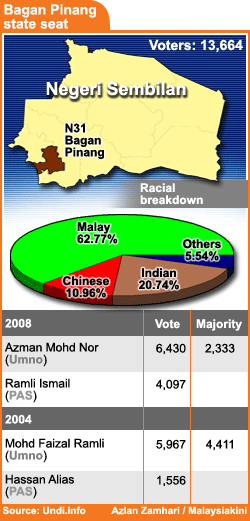 Twenty percent or 2,834 of the voters are Indians in four estates and 10 percent or 1,498 are Chinese scattered in the constituency.
The Malays accounted for 62 percent or about 8,500 of the voters, including postal voters.
Isa, who was former Negeri Sembilan menteri besar, grew up in Bagan Pinang and this is his trump card against his contender, PAS state commissioner Zulkefly Mohamad Omar, who admitted that he is an outsider.
While Isa is very popular in the Bagan Pinang polling district, his popularity in seven more polling districts - Atherton estate, Pekan Siliau, Bradwall Estate, Sua Betong, Taman Eastern, Si Rusa and Teluk Kemang - is about 70 percent, said Wan Abdul.
The BN election drumbeat to retain the seat with a bigger majority will pay dividends if the coalition continues to enjoy the support of the Malays, including the postal voters, as well regaining the confidence of the non-Malays.
- Bernama


Are you sure you want to delete this comment?
This action cannot be undone.