




Murdoch says media must charge for online content
Media mogul Rupert Murdoch has again repeated his stand that news content produced by news organisations on the Internet should not be free of charge.
Media mogul Rupert Murdoch has again repeated his stand that news content produced by news organisations on the Internet should not be free of charge.
This time he has taken his clarion call to the inaugural World Media Summit, of which he is also co-chairman, in a gathering in Beijing comprising more than 400 media publishers and editors from all over the world.
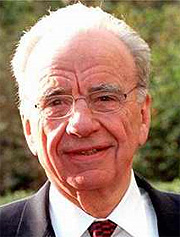 Murdoch, the chairman and managing director of News Corp, said that if news organisations and content creators did not take advantage of the current movement towards paid-for content on the Internet, then they would pay the ultimate price while the content kleptomaniacs would triumph.
He said the Philistine or negative phase of the digital age was almost over.
Murdoch said content aggregators and plagiarists would soon have to pay a price for the co-opting of content from news organisations.
He said there were many Internet readers who believed that they were paying for content when they signed up with an Internet service provider, presuming that they had bought a ticket to a content buffet.
That misconception, he said, had thrived on the silence or inarticulate institutions which were unable to challenge the fallacies and humbug of the e-establishment who were against paid content on the Internet.
Sharing the same view was Tom Curley, president and CEO of the Associated Press, who said that the market place for news content was growing but yet news organisations did not get paid for their hard work as well as the risks they took.
"Free riders and pirates are claiming they are entitled to our property," he said.
News Registry
To counter this, Curley said AP had decided to turn the tide by creating a News Registry, a rights management and tracking system.
The Rights Registry, he said, would discourage the unauthorised exploitation of news content by third parties as it promoted the use of news content that benefited participating news organisations.
Saying that this effort was known as AP3P for Protect, Point and Pay, he said step one was aimed at protecting against unauthorised exploitation, two, was to aggregate and index news content so that aggregators could point their users to the published news content, and three, to have a payment model which individual publishers might adopt.
Meanwhile, David Schlesinger, editor-in-chief of Reuters, called on the Chinese government to accord greater recognition and acceptance to the role of foreign financial journalists in China.
Speaking on "Transparency and the role of media in China", he said they too had a role in China's economic goals of maximising foreign investment in China.
Schlesinger, who was Reuters bureau chief in China from 1991-94, also expressed the hope that there would be more Chinese nationals having full careers in foreign news organisations and that the Reuters financial news editor in China would be a Chinese national, a step that could make that person to becoming its global editor-in-chief one day.
- Bernama


Are you sure you want to delete this comment?
This action cannot be undone.