




Villagers sue top cop for abuse of power
Kampung Bulud Batu (KBB) in Montuyon, Pitas District, will haul district police chief Haris Amroh to court on Monday for a whole list of offences.
These include wanton destruction of their crops and property, confiscation of planting tools, abuse of power and acting beyond his jurisdiction.
Kampung Bulud Batu (KBB) in Montuyon, Pitas District, will haul district police chief Haris Amroh to court on Monday for a whole list of offences.
These include wanton destruction of their crops and property, confiscation of planting tools, abuse of power and acting beyond his jurisdiction.
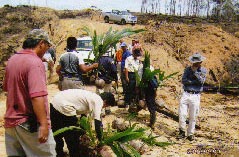 Pitas has the dubious distinction of being the poorest place in Malaysia.
The KBB folks are led by one Rodiah Aling, a Dusun, whose late father initiated action to win recognition for the NCR (native customary rights) status of their village land.
The court action comes a month after the villagers of KBB lodged police reports against Haris at the Kota Marudu police station on Sept 3 and at the Kepayan Sabah Police Headquarters in Kota Kinabalu on Sept 8.
There has been no response so far from the police, according to senior Kota Kinabalu lawyer Kong Hong Ming who has agreed to represent the villagers 'pro bono publico' (for the public good) in a civil suit: "Not a single person has been interviewed by the police so far."
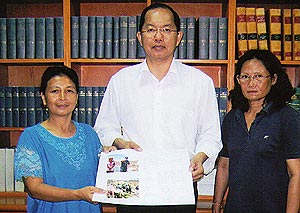 Kong (
right, centre
), also a green activist and presently Sabah PKR Deputy Chief, is a former Barisan Nasional state cabinet minister. An ex-civil engineer, Kong is a leading pro bono lawyer in the state.
Kong (
right, centre
), also a green activist and presently Sabah PKR Deputy Chief, is a former Barisan Nasional state cabinet minister. An ex-civil engineer, Kong is a leading pro bono lawyer in the state.
"Since there has been no response from the police on possible criminal proceedings against Haris and disciplinary action, the villagers want to take the matter to court in a civil action suit," confirmed Kong when quizzed on the police reports.
"The villagers are suing Haris in his personal capacity. The government and the police are not being mentioned in the case. If he wants to later drag them in or others to save him, it would further bolster the case of the villagers."
Cop guilty of abusing power
Explaining the merits of the case, Kong reiterated that "the facts outlined will prove beyond a shadow of doubt that Haris is guilty of abusing his power, acting beyond his jurisdiction and had criminal intent".
"The police have no business meddling in a civil matter. Neither is there any criminal element involved," continued Kong.
"What we will prove in court is that there was not even an aggrieved party in this matter when Haris took the law into his own hands."
Even if there was an aggrieved party in the matter, stressed Kong, "Haris' actions on Sept 3 in KBB are still inexcusable."
According to the facts of the case, Haris and his men in seven vehicles entered 250 acres of KBB land on Sept 3 and destroyed hundreds of young coconut trees planted by the villagers.
The villagers had no prior notice from any government authority, nor was there any order from any court of law. Haris did not show them any authorisation papers either, according to the villagers in their police reports.
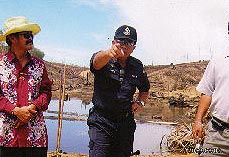 The two police reports, photographs taken (one showing Haris pointing a finger at Rodiah,
right
), a summary of the villagers' conversation with Haris and other supporting documents will be filed in court together with the facts of the case.
The two police reports, photographs taken (one showing Haris pointing a finger at Rodiah,
right
), a summary of the villagers' conversation with Haris and other supporting documents will be filed in court together with the facts of the case.
Interestingly, the KBB villagers alleged in their police reports that at least a couple of Land and Survey Department (LSD) and Safoda (Sabah Forestry Development Authority) staff were present with Haris when he and his men went on a rampage in the village.
Land gazetted as NCR
According to Rodiah, Safoda excised the 250 acres to the villagers from land allotted to the authority when it realised that the state government had inadvertently given it the NCR (Native Customary Rights) land.
The excise action, followed by degazetting, was confirmed vide a Safoda letter dated March 3 this year to Rodiah. The action followed an 11 year wait after Safoda confirmed through another letter dated Feb 4, 1998 that it had no objections to the villagers of KBB applying for the 250 acres.
The letter, addressed to Rodiah's father Aling, was also copied to the assistant collector of land revenue in Pitas. However, Safoda claimed the right to harvest the acacia trees it had already planted on the plant, a point which was apparently not opposed by the villagers.
Safoda's subsequent harvesting of the acacia trees is now the subject of a pending court action by the villagers for the damage it did to their crops in the process.
The villagers are awaiting an independent estimation from the Agriculture Department of the total damage done to their rubber, coconut and fruit trees and other crops.
Kong has noted that in similar cases, "usually a company will quickly apply for such land which is deemed to be state land until the NCR process is completed either via the issue of a Communal Native Title or individual Native Titles".
In KBB's case, Kong is not certain whether there is any private party behind Haris "to erase the fait accompli on the ground before applying for the land for themselves". Neither could he hazard a guess as to why LSD and Safoda staff were present when Haris and his men destroyed the crops of the KBB villagers on Sept 3.
"It would be interesting to see whether Haris mentions the LSD and Safoda in his statement of defence," said Kong. "Then, the cat will be out of the bag. Otherwise, how is he going to account for his actions on Sept 3 in KBB?"
Kong said KBB was another typical, sad story of the infringement of ancestral land of the natives of Sabah. "Based on the presence of the old longhouse and dwelling houses, water well, graveyard and old fruit trees on the land which are still visible, there is no doubt that this is a village community existing within the land in question," said Kong in reference to 'adat' (native law), NCR and common law.
Kong called it disgraceful when the protector (the police) becomes the oppressor.
The police for whatever reason known to them, he added, unnecessarily interfered with native land rights which is a civil matter and completely outside their jurisdiction.
"There was no criminal activity taking place on the KBB land," said Kong.
"The villagers of KBB, as natives, have a right to even enter state land without having to ask permission from anyone to do so. This has been established by justice Ian's Chin's ruling in 2007 in the Rambilin case."


Are you sure you want to delete this comment?
This action cannot be undone.