




Bagan Pinang: More than majority at stake
In this sleepy state constituency of Bagan Pinang near Port Dickson, voters will go to the polls tomorrow. All indications are that the results will be about Umno's majority, rather than an opposition upset.
In this sleepy state constituency of Bagan Pinang near Port Dickson, voters will go to the polls tomorrow. All indications are that the results will be about Umno's majority, rather than an opposition upset.
The pattern
 of incumbents holding onto their own that has followed in the eight by-elections since March 2008 will likely continue.
Umno is likely to hold onto the seat, given the high number of postal votes, the stream of "electoral" resources invested and the stronger Umno machinery in the area compared to that of PAS.
The focus will be on the amount of majority - this will be an indicator for both Umno and Pakatan Rakyat of their shortcomings and strengths.
The sad reality is that this by-election appears to me more about the former than the latter and raises real concerns about both the opposition and Umno long-term.
Important swing territory
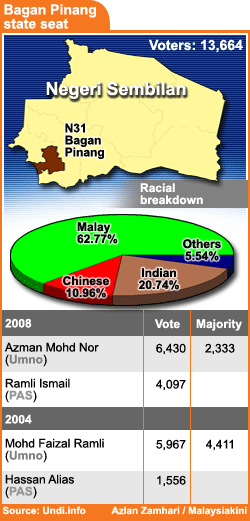
Bagan Pinang is a multi-ethnic seat, with a majority of Malays at 62 percent. Indians double the number of Chinese, but combined non-Malays comprise a healthy share of voters, particularly when one factors in the large share of Malay postal voters.
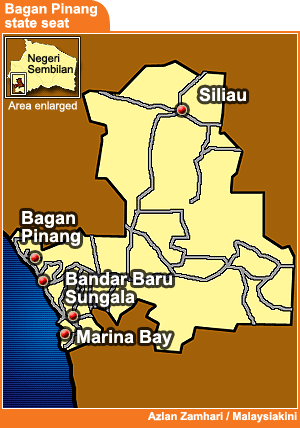 It is a semi-urban seat, located near a neglected (but formerly bustling) town of Port Dickson with a laid-back political outlook that shows its distance to the national capital.
Despite a façade of carefreeness, voters in Bagan Pinang are keenly connected into national events and deeply concerned about the future.
The issues of national leadership, jobs, development, crime, ethnic tensions, rights, fairness, and corruption are all on voter's minds, even as the flow of electoral goodies stream in.
What makes this seat politically significant is its unique position as in a "swing state".
Negri Sembilan was on the end of the national wave electorally in March 2008, as the opposition gained significant state and parliament seats and broke into the traditional secure base of the government, multi-ethnic constituencies.
The fact is that if the opposition wants to win nationally, it must win in these types of seats, particularly in light of the increasingly difficult terrain to win votes in East Malaysia. Similarly, a BN recovery must come from decisively and whole-heartedly winning back seats such as these.
The stakes are not just about the nature of the seat itself. The timing of the poll is also important. Coming on the eve of the Umno general assembly, the election will provide Najib Razak and his team with a vote of electoral legitimacy that it desperately needs. Najib has yet to win any poll as premier in West Malaysia (although he won a seat in East Malaysia).
Given the decline in Najib's popularity according to recent polls, this election is especially important.
Najib's political power and legitimacy comes from Umno and he needs to return to the general assembly in a position of strength in order to continue to use this power base to implement his policies, strengthen his position nationally and win over the Malaysian public.
A loss or even a significant reduction in the BN majority will be seen as a loss for Najib and Umno broadly. The hope is that the Bagan Pinang results will help rally a demoralised Umno.
For the opposition, this is a contest on their periphery. None of the parties have a strong base in Bagan Pinang. Short term, a loss in this seat will have minimal impact on the opposition's fortunes.
Attention continues to be on governing the states they lead and consolidating the opposition nationally. This by-election serves as another venue to forge cooperation and build capacity in electoral contests.
Long term, however, the results point to the weaknesses of the opposition to gain ground. If they can't win in new seats, they are likely to have a more difficult time during a national election when the stakes are higher. No matter how local, every contest is a marker of strength and weakness.
Weaknesses on both sides
The weaknesses on both sides are standing out.
While admittedly there is by-election fatigue and coffers are low, this contest has brought to the surface areas where both BN and Pakatan are failing the Malaysian electorate, especially long-term.
For the opposition, particularly PAS, the focal point has been on postal votes and the fairness of the electoral process. These issues are important, and often prove decisive in close contests.
Electoral reform remains a pressing concern for those interested in bringing about accountability and assuring that all Malaysian voters are counted, yet it is not enough to win over votes. Blaming the system only goes so far.
In fact, a campaign concentrating on these issues could be seen as a crutch. Voters want alternatives and choices. Sophisticated Malaysian voters want to be shown how people the opposition will govern and make their lives better.
Sadly, the Pakatan campaign in Bagan Pinang has yet to show how the opposition is moving beyond the promises of change in March 2008. Pakatan faces a major challenge in translating the tsunami into a sustained wave of support.
Three
 issues regarding the opposition's electoral identity in particular are pressing. First of all, there isn't a clear common platform of post-March 2008 issues.
Consider the handling of religious issues. PAS appears torn on how to present its agenda on religious issues - which bits it against its Pakatan partners.
Rather than embrace concerns of justice or common concerns of social problems that unite all of Pakatan, the party is floundering and fragmenting internally and this spills over to weakness the opposition as a whole.
A second dimension that is undercutting opposition campaigning is consistency on multi-racial inclusiveness.
The environment has not been easy to push this agenda since March 2008, as Umno has systematically portrayed multi-ethnic cooperation as betraying the Malay community and heightened racial discourse in its defensive bid to win back power.
Pakatan has been largely on the defensive on racial issues. Pakatan faces a difficult choice to continue piecemeal ethnic-specific campaigning or moving toward a more holistic Malaysian approach.
Finally, and perhaps most significant of all, is the task of building viable opposition governance into Pakatan's campaigning. Malaysians - pragmatic and thoughtful - want to know what the future will bring in terms of how they will fare.
The opposition needs to show it can deliver and govern - especially in the economy. It has been over a year since the opposition has been in government at the state level, yet little is being showcased in terms of deliverables.
Reaching a consensus on a campaign platform that highlights strengths and commonalities rather than focusing on postal voters who aren't from the area is essential for future opposition success, not just for tomorrow.
The campaign messages to date are not substantively bringing in new voters. October 2009 is not March 2008.
The Bagan Pinang campaign shows how vital it is for the opposition to redefine itself electorally if it is to maintain its support and win new votes. Pakatan has to stop blaming the system and forge a clear post-March 2008 platform for voters to connect to.
Umno returns to old games
Simultaneously, the Bagan Pinang campaign foreshadows real BN weaknesses. These are ironic given Umno's likely victory, but critical nevertheless.
In this vital contest for Najib, Umno is turning to old candidates and old techniques for victory and failing to understand how the political environment nationally is moving beyond outmoded BN techniques.
Bagan Pinang raises serious questions about Malaysia's future, with Umno now squarely dominating government without electorally viable BN partners. This contest points to persistent problems that Umno is not willing to address.
 Foremost is the inability of Umno to select a candidate that is not tainted by corruption.
Najib's choice of Isa Samad who was pushed out of the leadership by Umno leaders and an Umno disciplinary process for money politics reaffirms the impression that his administration is unlikely to reform and effectively address the issue of corruption.
It is important to note that this is the second candidate slated of this ilk in a row. Voters are asking whether Umno can field a clean candidate.
Then the question emerges whether Umno is bringing in new leadership. The candidate shows that the party is not rejuvenating. The reliance on the seasoned state warlord to win a small state seat shows that the party appears unwilling to bring in new blood.
Fundamentally, the Umno candidate raises questions about whether the party will allow younger Malaysians - who make up the majority of the country - to have a voice.
Choice raises questions
Moreover, the candidate choice also raises the issue of future internal Umno factionalism at the state level.
Why bring back someone that will fracture party dynamics? The political terrain in Terengganu recently shows how hard this issue is to manage.
It is generally accepted that bringing back Isa Samad will fuel dissent and division in Umno within the state. This pattern of pitting state leaders against each other to check challengers was common during Mahathir.
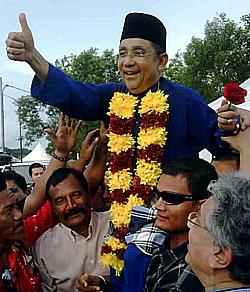 The choice of Isa Samad raises questions of whether Najib is returning to the game of using internal party factionalism to his advantage and to strengthen his power.
Is Najib stronger while others in the party fight each other? The persistence of factionalism undermines effective governance and puts issue of personality rather than policy implementation center stage.
The use of old techniques is also troubling. There have been reports of Umno thuggery.
Violence has no place in elections and the attack on a PAS party worker only reinforces the impression that Umno will use any measure to win. Even more central, the pattern of using race-based attacks on the opposition is also unsettling for voters in a multi-ethnic constituency.
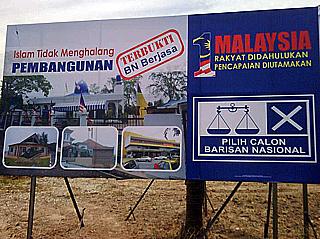
As Umno now the de facto governing party, given the weakness of the BN partners, the use of race-based campaigning is alienating voters nationally. 1Malaysia continues to lack substance as it is being undercut by the circulation of race-based campaign paraphernalia. Race-based campaigning only feeds ethnic insecurities and promotes uncertainty.
Finally, in keeping with the traditional mode of Umno by-elections, the goodies are coming. Money will not be enough nationally, however. It may prove decisive in a small seat such as Bagan Pinang, but coupled with the other Umno shortcomings noted above, it will create a false sense of security for Umno.
In this difficult economic climate, the party will not have the resources to win voters nationwide through patronage and a reliance on the stalwart state warlord.
The Bagan Pinang contest will likely be a wash. With the postal votes, it was never a real competitive contest. The incumbent party Umno will likely win. Short term, the issue will be how much and from which communities. Voters can make a difference in shaping the majority.
Longer term, however, the shortcomings of both sides in the campaign are more important for Malaysian voters than any majority. Bagan Pinang may be a sleepy constituency, but it is eye opening to those who look beyond the surface to what the campaigning is pointing to for future national choices at the polls.
BRIDGET WELSH is associate professor of political science at Singapore Management University. She can be contacted at bwelsh@smu.edu.sg .


Are you sure you want to delete this comment?
This action cannot be undone.