




Samy's iron grip turns 30 today
October 12th will forever be etched in the memory of S Samy Vellu. It was on this day in 1979 that he ascended to the position of president of MIC after the sudden demise of his predecessor V Manickavasagam.
October 12 will forever be etched in the memory of S Samy Vellu. It was on this day in 1979 that he ascended to the position of president of MIC after the sudden demise of his predecessor V Manickavasagam.
Today he completes an exceptional 30 years at the helm, probably unmatched by any other political party leader in Malaysia.
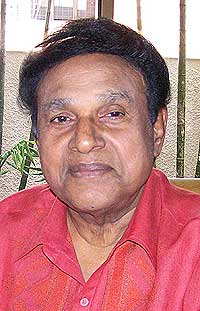 In 1979 many in MIC did not expect Samy Vellu to become party president that early in his career. He had won the deputy president's post two years earlier in a bitter battle against then secretary general S Subramaniam.
Furthermore, Manickavasagam was only 52 and had served just six years as MIC president. Samy Vellu, it seemed, was destined to be swiftly in the driver's seat.
He had been active in politics for a long time but between 1976 and 1979, the deaths of two stalwarts of the MIC played a pivotal role in his meteoric rise.
Athi Nahappan ....
When Manicakavasagam became president of MIC in 1973, succeeding VT Sambanthan, Athi Nahappan was appointed deputy president. He was made a senator and appointed law minister - one of two full ministerships accorded the MIC.
Athi Nahappan was in his early 50s and well accepted by the rank and file of the party. He was a noted lawyer with a sharp legal mind. He formulated the Law Reform (Marriage and Divorce Act) for non-Muslims which became law in 1976 while he was still law minister.
At that time the understanding was that Manickavasagam and Athi Nahappan would lead the party for a long time because of their age and calibre. But Athi Nahappan's sudden death in 1976 plunged the party into a leadership crisis.
Samy Vellu was then a vice-president. Having been elected with the highest number of votes in the party elections in 1975, he staked a claim for the deputy presidency.
Manickavasagam had a choice of appointing an acting deputy president or leaving the post vacant till the next party elections in 1977. (MIC elections were then held every two years).
For reasons best known to him, he chose not to appoint an acting deputy president, leaving the final decision to the 1977 party general assembly.
It was a clear message that he did not want Samy Vellu to succeed him and knowing that the ambitious Samy Vellu would mount a challenge for the deputy presidency, Manickavasagam had to pick a strong candidate from his team to take on the potential contender for his post.
A senior MIC leader recollected a private meeting called by Manickavasagam to decide on Samy Vellu's challeger.
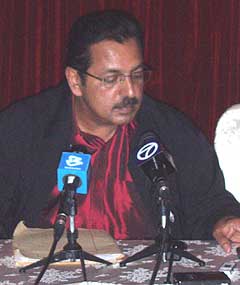 Manickavasagam, having weighed the strengths and weaknesses of Subramaniam(
left),
K Pathmanaban, G Vadivelu and VL Kandan (Manickavasagam's brother), declared: "Subra! it is you whom I have chosen to challenge Samy Vellu.
Manickavasagam, having weighed the strengths and weaknesses of Subramaniam(
left),
K Pathmanaban, G Vadivelu and VL Kandan (Manickavasagam's brother), declared: "Subra! it is you whom I have chosen to challenge Samy Vellu.
"Samy Vellu is a fighter and I know you are also a fighter. Only a fighter can take on Samy Vellu and I don't see anyone else capable of fighting Samy Vellu."
The fight between the two continues to this day. Some say that their political animosity started as early as 1973.
Samy Vellu who had fought alongside Manickavasagam to oust Sambanthan, expected to be appointed secretary-general. Manickavasagam chose a young 29-year-old Subramaniam instead.
Subramaniam was then serving as the executive secretary without any formal position in the party. Samy Vellu was livid as he had always viewed Subramaniam as his political opponent.
Battle for deputy president
In 1977, Subramaniam was a deputy minister and the party secretary-general when his opponent was the vice-president and MP for Sungai Siput.
The same year, Samy Vellu took the Selangor MIC chairmanship, defeating VL Kandan, a Selangor state assemblyperson and exco member of the state government.
In the contest for deputy president in 1977, Subramaniam was pipped to the post by his foe by 26 votes. Despite that Manickavasagam retained his as deputy minister while the victor went unrecognised.
Since Subramaniam was only 33 then, many anticipated another round between the two at the 1979 party elections.
However, the 1978 general election results changed the party's political equation. Subramaniam fell to the DAP's V David in the Damansara parliamentary constituency while Samy Vellu retained his Sungai Siput seat.
This time, Manickavasagam had no choice but to accommodate Samy Vellu as a deputy minister because only three MPs were left to fill the four parliamentary seats allocated to the party.
Furthermore, Samy Vellu was already the duly elected deputy president of MIC and Manickavasagam did not want to make it obvious that he was sidelining him again.
1979 party elections...
In the June 1979 party elections Subramaniam realised that it would be futile to mount a challenge against Samy Vellu for the deputy presidency again since the latter was now a deputy minister.
Subramaniam was only a senator then, having been appointed after the loss of his MP's seat.
So he went for a vice-presidency, winning the post with the highest number of votes.
Then on Oct 12 fate intervened - Manickavasagam died and Samy Vellu became acting president at the young age of 43.
A debate on how the leadership of MIC would have been shaped up if both Manickavasagam and Athi Nahappan had not died within a short interval of three years can lead to a host of interesting predictions.
Since his elevation as president, Samy Vellu has weathered countless political battles and challenges within the party but his tight grip had prevailed all these years.
It took 2008 general election to finally strike him down where he lost his Sungai Siput seat which he had been ensconced comfortably for the last 34 years.
Despite that loss Samy Vellu out-manoeuvered his political opponents to retain his presidency again in 2009, declaring he would only step down in 2012 after completing his term of three years in full.
Samy Vellu's personal life...
His leadership style and his decisions have come under severe attack in respect of the party and Indian community but none deny that his personal life is a lesson in tenacity.
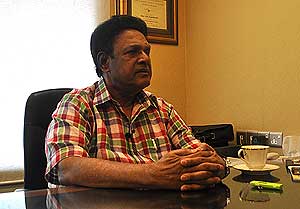 He started his working life as an office boy without completing his formal secondary education, but through sheer hard work and determination became a qualified architect.
Uncowed by the odds, he fought bitter battles against his political opponents. In the 1960s, as branch chairperson of Batu Caves MIC, he challenged VJ Balasundram for the Selangor MIC state secretary's post.
Samy Vellu fell six times in as many attempts but after every defeat, he would apparently say to his opponent: "Mr Bala I will see you at the next elections!"
Only on his seventh attempt did Samy Vellu succeed in winning the post - by three votes. Since then he had never tasted the ashes of defeat in party elections.
Samy Vellu also never feared standing up to the leadership whenever he felt it was necessary. During the Manickavasagam and Sambanthan leadership crisis, he threw his weight behind Manickavasagam although the latter was president.
Later when Manickavasagam decided to sideline him, he fought him tooth and nail as an underdog.
Making his debut as MP in 1974, he had a poor command of the English language and Bahasa Malaysia but realising the importance of oratory, he mastered both quickly. Needless to say his oratory skill in the Tamil language is unmatched in the country.
His concern for his personal health and appearance is also legendary. Even at 73, he shows no sign of slowing down and has always remained hale and hearty. He has admitted in interviews to waking up at 5.30am for his routine exercises and, time permitting, a swim.
Even now, when he is no longer a minister, Samy Vellu is at the MIC headquarters as early as 8am and many leaders have received phone calls from him at 1am or as early 6am on party matters.
What next for Samy Vellu?
There is a popular saying in Tamil, Muppathu varudam valnthavanum illai; muppathu varudam thalnthavanum illai which, loosely translated means, 'No one can lead a glorious life for more than 30 years and no one would suffer for more than 30 years'.
It simply means that according to the Hindu astrology no one's life would be as glorious as ever for more than 30 years.
Whether the saying holds true is another matter, but as Samy Vellu completes his 30 years of MIC presidency today, the writing on the wall is clear that it is time for him to bow out.
A majority look at him as an albatross round the BN's neck. Umno attempted to shun him in Bagan Pinang and did not want him to accompany them in their campaign rounds.
Maika Holdings Bhd stands tall as a monument of his failed leadership. The diversion of nine million Telekom shares meant for Maika Holdings is still debated by the Indian community and remains a stain on his political career.
With the disastrous March 2008 outing, and the "fixing" of unpopular leaders to lead MIC after him, the relevance and future of the MIC has come increasingly under question.
Many Indian parties have emerged outside MIC, indicating lack of trust and confidence in the party and his leadership. The Hindraf rally in 2007 was the peak of the Indian community's dissatisfaction and opposition to Samy Vellu's leadership.
Just days ago, BN chairperson and Prime Minister Najib Abdul Razak made an unprecedented move in the face of Samy Vellu to launch another Indian-based political party, Malaysian Makkal Sakti Party.
BN leaders have attended general assemblies of other parties supporting BN but this is the first time an Indian party had been launched by a prime minister, while having another as a component party.
Above all, Samy Vellu's recent statement that he set up the Aimst University and MIED in his personal capacity and that they do not belong to the party provoked an uproar in the community and earned their wrath.
With all these factors piling up against him on this 30th anniversary of his ascending to MIC presidency, two interesting questions loom.
The first is whether Samy Vellu will succumb to mounting pressure and give up his presidency, thereby endorsing the adage that 'no one can have a glorious life for more than 30 years'.
Or, will he, despite mounting criticism, adamantly continue as MIC president until 2012 to add another three more years to his already record-breaking tenure?
R Mutharasan is an observer and writer on Malaysian politics. He is the web-master of www.indiantoday.net and has also authored the book "Winning Strategies of Anwar Ibrahim".


Are you sure you want to delete this comment?
This action cannot be undone.