




Sabah's bird festival attracts global bird-watcher crowd
Sabah will have a dedicated place on the world bird-watchers map by the time the ongoing first of its kind Borneo Bird Festival (BBF) ends tomorrow in Sepilok, Sandakan.
Sabah will have a dedicated place on the world bird-watchers map by the time the ongoing first of its kind Borneo Bird Festival (BBF) ends tomorrow in Sepilok, Sandakan.
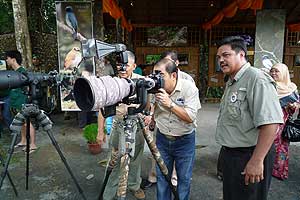 Sepilok, more noted for its orangutan sanctuary, has drawn hundreds of bird-watchers from all over the world.
Minister for Tourism, Culture and Environment Masidi Manjun thinks that Sabah will attract the bird-watchers of the world, and with good reason too. He claims to have discovered their weakness.
"Bird-watchers will fly across the world just to see one special bird," said Masidi who watched the World Bird Festival in the United Kingdom last year to get some idea of the market.
"They chase after endemic birds above all and they can get very passionate and determined. It's a craze, an addiction."
Masidi obtained some idea of the bird watchers market from the UK bird-watchers association. members. Its one million members make it the largest organisation in the country.
However, forest conservation is the key to preserving and growing the bird watchers market.
Bird-watchers know that endemic birds avoid oil palm estates, acacia plantations, rubber estates, durian orchards or any open space. Endemic bird populations "collapse" the moment one enters oil palm territory.
They prefer pristine forests which Masidi claims covers half of the state but his figures are in dispute.
Save the forests, save the birds
The statistics cited by the organisers at the BBF are mind-boggling. Of the 622 known bird species in Borneo, it has been certified that 300 of them can be found around the Rainforest Discovery Centre in Sepilok alone.
This includes the rare endemic Bornean Bristlehead, the Blue-headed Pitta, Black and Crimson Pitta, the White-rumped Shama, and the White-fronted falconet.
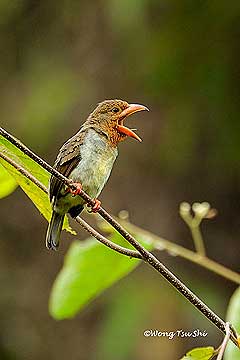 In fact, 20 of Borneo's 46 known endemic birds have been sighted around Sepilok and the rest around the Kinabalu Park.
Sepilok is not one eco-system but covers mangrove forests, heath forest, lowland dipterocarp forest and sandstone hill dipterocarp forest.
Patience is a virtue. Those in the trade swear that a bird-watcher must be prepared to spend at least 12 days in the wild before getting a chance to spot the Bornean Bristlehead, for example.
"Bird-watchers are very sensitive," said Johnnizam Bakar, a Sandakan-based bird watching guide.
"They want to feel the first light and they also want to be there at sundown before it gets dark because they want to see what's flying at that time. Everything from big to small."
"Non-endemic but prized birds like Diard's Trogon and the charismatic Serpent Eagle can also be found in Sepilok," said Cede Prudente, BBF Deputy Co-Organising Chair, who spoke on "Bird Watching in Sabah" during the event.
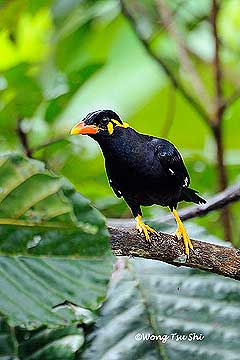 "The large birds, from canopy birds to mid under-storey birds to ground birds all exist here in Sepilok."
Prudente is also quick to point out that Sepilok is not the only spot for bird-watching in Sabah and refers to a spot on the map just 30 minutes away from the Kota Kinabalu International Airport.
Other noted spots in Sabah include Maliau Basin, Danum Valley, Imbak Canyon and the Tabin Wildlife Sanctuary.
Sabah offers opportunities for both day and night time bird watching, according to Prudente.
"Besides rare endemic and not so endemic birds from dawn to dusk, the night is also a show of active nocturnal creatures like the flying squirrels, owls, bugs and nocturnal mammals," said Prudente.
Prudente came to bird-watching only in the last two years. He has been in nature tourism since the 1980s, starting in Sukau.
He specialises in showing off the flora and fauna, filming and recently bird photography.
BBF happenings
The BBF witnessed a launch of two books, "A Field Guide to Birds of Borneo" by Susan Myers and "Phillipps' Field Guide to the Birds of Borneo" by Quetin Phillipps.
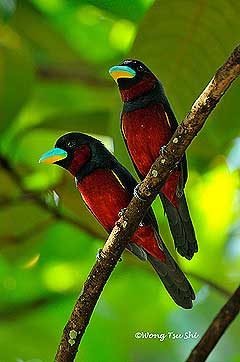 Phillipps is also presenting several papers at intervals during the BBF: "The Egrets of Borneo - Habits, Habitat and How to Tell Them Apart", "Frigate Birds of Borneo - Habits, Habitat and How to tell Them Apart" and "Attracting UK Bird Watchers to Borneo: Improving the Borneo Experience for Wildlife Enthusiasts".
Several other papers are also being presented at intervals for bird-watchers by several local speakers and their international counterparts from Singapore and Australia.
The topics include bird calls, bird ethics, conservation, important bird areas, exclusivity of the birds of Borneo, bird-watching tourism and linkages to nature-based tourism.
Nikon Vision of Japan is conducting several sessions on "Bird-watching equipment-Digiscoping" and "Optics Digiscoping" for bird watchers.
Workshops on nature art sketching by local expert The Kew Kiang was a dominant activity since last weekend along with bird walks, photography sessions, booth activities and exhibitions at the Rainforest Discovery Centre.
Photos courtesy of Kong Ket Leong (events) and Wong Tsu Shi (birds).


Are you sure you want to delete this comment?
This action cannot be undone.