




Kitingan: Special privileges in Sabah must go
PKR vice-president Jeffrey Kitingan has come forward to explain to Malaysiakini his three-month sabbatical leave which begins today and will end on Jan 15 next year.
PKR vice-president Jeffrey Kitingan has come forward to explain to Malaysiakini his three-month sabbatical leave which begins today and will end on Jan 15 next year.
He thinks that it would be better for all concerned if he ends speculation about his leave.
"My sabbatical leave doesn't involve any politics at all although, unfortunately, it does look that way. There's no hidden agenda," confessed Kitingan who, sceptics have noted, was absent from the party's political bureau meeting in Kuala Lumpur on Tuesday.
"Some people think that I am playing some sort of high stakes poker game, trying to hold the PKR leadership in Kuala Lumpur and Penang to ransom. That's not true at all."
Kitingan's name has been proposed as the Sabah PKR head by 16 divisional chiefs in Sabah.
They want him to replace Azmin Ali, the Gombak MP and state assemblyperson for Bukit Antarabangsa in Selangor.
 Azmin, reportedly, doesn't want to give way and "seems to be leading de facto party leader Anwar Ibrahim by the nose on the matter", according to critics.
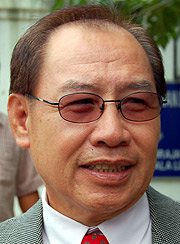
Kitingan ( left ) swears instead that he wants to spend the next three months reviving the People's Development Concept (PDC), which was allegedly brought to a halt in Sabah by former Prime Minister Mahathir Mohamad during his administration.
The PDC would be revived via the Yayasan Pembangunan Insan (Peoples Development Foundation) or YPI together with the KKRS Rural Economic Development Strategy.
Practical solutions for problems
KKRS stands for Kitingan Kedai Runcit System which follows up the PDC with practical solutions to everyday problems.
Kitingan is also seeking intellectual property rights for the PDC and the KKRS. Both programmes would be offered for use by the United Nations, international organisations and Third World countries battling the shackles of poverty.
The programmes are based on the premise that "poverty in all its forms is ultimately a reflection of the poverty of the spirit".
Kitingan explains the PDC as a self-awareness, self-realisation programme which works on the principle of the spirituality of man.
The objective is to build up the self-esteem of participants in the programme.
This would be done basically by convincing them that the answers to their problems lie within themselves. Participants in the programme, according to Kitingan, will realise that they have the "God-given" capacity to end their slave mentality and rise to the occasion.
In short, Kitingan wants to "undo through YPI the damage which has been singlehandedly wrought by Mahathir alone to the self-esteem of Sabahans".
"It's not surprising that Musa Hitam should say that the Malays still lack confidence," said Kitingan, referring to a statement yesterday by the former deputy prime minister.
"We in Sabah don't want the same thing to be said about us even after the next 50 years. We need to end the dependency syndrome."
‘Deprive the people'
Mahathir, according to Kitingan, first tried to persuade him not to continue with the PDC in the late 1980s.
Mahathir's thinking, claims Kitingan, was that "you don't have to tell the people what they don't know".
"Mahathir feared that it would be difficult to control and manipulate the people, especially when it came to the votes, if they were not dependent on the government," said Kitingan.
"I wanted to end the dependency syndrome among the people so that they will be free to develop in their own way without having to run to the government for everything."
In Kitingan's view, the dependency syndrome, which also includes the so-called Special Privileges - reservations in the civil service, intake into institutions of higher learning, government scholarships and opportunities to do business - is "part of the politics of corruption and moral depravity which has kept the ruling party in power since independence".
He cites the latest federal government programme of distributing free rice to the poor, as a case in point, "meant to deprive people of their self-esteem and keep them forever down so that they can continue to be exploited for political reasons".
He laments the fact that Mahathir had his People's Development Institute (PDI) closed down and turned it into the Kolej Yayasan Sabah, a community college, and his PDC replaced with Bakthi Insan (Human Faith), a programme with heavy Islamic overtones in a multi-religious state.
The PDI offered education within a non-formal setting and drew hundreds of university students who even abandoned their studies and the paper chase, according to Kitingan who holds a doctorate from the Fletcher School of Law and Diplomacy, a joint programme of Harvard and Tufts universities in the United States.
"When he thought I wouldn't listen to him, Mahathir had me incarcerated under the ISA (Internal Security Act) for three years," explained Kitingan.
‘Fermenting insurrection'
"Mahathir didn't mention the PDC as the reason for my detention but instead claimed that I was fomenting an insurrection among the people and planning to take Sabah out of Malaysia. He came to this conclusion by tying the PDC to my various talks about Sabah rights, the 20 Points and the Malaysia Agreement."
Explaining his interest in the PDC, Kitingan revealed that he used to visit ashrams in Rishikesh, in the Himalayas, for many years and drew much inspiration from that.
"Under the PDC, we don't go beyond self-awareness and self-realisation," stressed Kitingan.
"Spirituality is not religion but science. But spirituality is something that one must seek on one's own time when ready. We don't go there under the PDC concept."
He admits in a moment of unguarded candour that he sometimes feels that he's wasting his time in politics.
"It's the same old thing, the same old prejudices, pettiness and corruption," lashed out Kitingan.
"Nothing seems to have changed and nothing seems to be changing. Why should the people continue to be dependent on the politicians?"
Kitingan's PDC and KKRS seem to offer a way out, away from politics, for those interested.
The million ringgit question remains whether Kitingan will eventually abandon politics for good and respond to "a higher calling" in life.


Are you sure you want to delete this comment?
This action cannot be undone.