




Beyond the hype of 1Malaysia
Everyone can see that the race-based political parties in the BN are ironic when you aspire to be "1Malaysia". Where else will you find political parties that discriminate against other "races" such as we find in Umno, MCA and MIC? The floundering of these race-based parties since March 8th 2008 is an indication that the hour of their extinction is nigh.
Everyone can see that the race-based political parties in the BN are ironic when you aspire to be "1Malaysia".
Where else will you find political parties that discriminate against other "races" such as we find in Umno, MCA and MIC?
The floundering of these race-based parties since March 8th 2008 is an indication that the hour of their extinction is nigh.
Can a Chinese Malaysian join Umno? No. Can a Malay Malaysian join MCA? No. Can a non-Indian join MIC? No. Is this not racial discrimination?
 But can a Malay Malaysian enroll in a Chinese-language school? Can a Chinese Malaysian enroll in a Tamil school? Yes and yes. And there are more than 60,000 non-Chinese in Chinese primary schools of Malaysia today. The Chinese primary school at Fraser's Hill is almost all Indian! There is no racial discrimination in these schools.
Do you remember the Umno Minister of Higher Education who told the Umno general assembly a few years back that as long as he was the minister, he would not allow a single non-bumiputera to be admitted to UiTM? That's blatant racial discrimination in 21st century Malaysia. Has this policy changed at UiTM with 1Malaysia?
Stop racial discrimination
Having chaired the UN Human Rights Commission and now espousing 1Malaysia, the government should take a simple test. That test would be willingness to ratify the International Convention against all forms of Racial Discrimination (CERD).
Racism and racial discrimination have been part of Malaysian political, economic, social and cultural realities ever since colonial times. Practically every aspect of Malaysian life is permeated by the bumiputera policy based on Malay-centrism. This is unabashedly spelled out by political leaders in the daily mass media in Malaysia.
Racism is an integral part of the Malaysian socio-political system. The ruling coalition is still dominated by racially defined component parties such as those in BN. These parties compete for electoral support from their respective "racial" constituencies by pandering to "racial" interests. Invariably, their racist inclinations are exposed at their respective party congresses.
Some opportunistic opposition parties likewise pander to their constituencies using racialist propaganda to win electoral support and they have also contributed to the vicious circle of racial politics that has characterised Malaysian politics all these years.
Would the Umno leaders continue to use such racist concepts such as "Malay dominance" once we have ratified the CERD? Maybe that explains why Malaysia has still not ratified this basic international convention.
Consequently, we have witnessed the periodic controversies over the alleged "challenges to Malay special privileges" everytime sections of Malaysian society call for non-racist solutions to Malaysian problems.
Tainted affirmative action
The ruling party Umno prides itself on the supposedly "successful" affirmative action in favour of bumiputeras. This has been the cornerstone of development plans since the New Economic Policy that started in 1971.
It is time for Malaysians to reaffirm the non-discriminatory basis of the Federal Constitution and to uphold human rights principles that are strictly anti-racist.
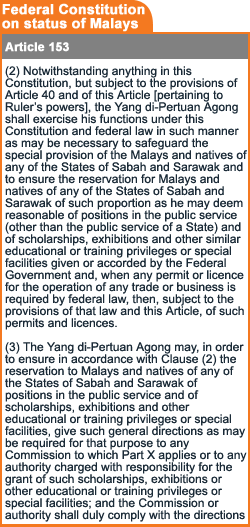 Article 8 (1) of the Malaysian Constitution clearly spells out the principle of equality of all Malaysians while Article 12 (1) allows no discrimination against any citizens on the grounds of religion, race, descent or place of birth.
Article 153 on the special position of Malays was inspired by the affirmative action provisions of the Indian Constitution to protect the minority under-privileged class of harijans.
Ours is fundamentally different from those provisions because the ethnic group in whose favour the discrimination operates in Malaysia happens to be the one in political control, the Malays.
At the time of independence in 1957, four matters in relation to which the special position of Malays were recognised and safeguarded were: land; admission to public services; issuing of permits or licences for operation of certain businesses; scholarships, bursaries or other forms of aid for educational purposes.
The Federal Constitution certainly does not adhere to any notion of "Ketuanan Melayu" (Malay Dominance), which is a totally racist concept.
When the Constitutional (Reid) Commission was considering whether such a provision should be included in the 1957 Constitution, it made the following comments:
"Our recommendations are made on the footing that the Malays should be assured that the present position will continue for a substantial period, but that in due course the present preferences should be reduced and should ultimately cease so that there should be no discrimination between races or communities." (Report of the Federation of Malaya Constitutional Commission 1957, Govt Press, paragraph 165, p.72)
The Umno leaders have often tried to accuse critics of the NEP of being against Malay special privileges. In fact, they are ignoring the fact that these racially discriminatory policies did not exist in pre-1971 Malaysian society even though Malay special privileges were in existence between 1957 and 1971.
Demanding accountability
After Tunku Abdul Rahman was deposed in 1971, the new Malay ruling elite felt that adequate opportunities had not been made available to them, especially in education and that there should be a larger proportion of Malays in the various sectors.
Thus, in 1971 and under Emergency conditions, Article 153 was duly amended to introduce the quota system for Malays in institutions of higher learning. Clause (8A) specifically provided for the reservation of places for bumiputeras in any University, College and other educational institutions.
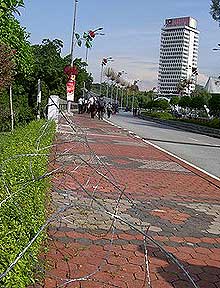 Nevertheless, the quota system was not intended to be the totally non-transparent and non-accountable and unfair system we know it today:
Firstly, Article (8A) makes it clear that the Yang di-Pertuan Agong can only order a reservation of a proportion of such places for the Malays. It would therefore mean that the quota system is applicable only on a faculty basis and more importantly every faculty or institution should reserve places for students of every race.
No faculty or institution under this provision could cater for the Malays alone to the exclusion of the other races. The existence of institutions such as UiTM and other junior colleges which have been practicing blatant racial exclusion is actually a wild aberration from Article 8A.
Visu Sinnadurai ("Rights in respect of education under the Malaysian Constitution" in Trindade & Lee-edited ‘The Constitution of Malaysia') has observed:
"Years after the implementation of this racial quota system, there was no trace of any such order being made by His Majesty nor was there evidence of any such order having been gazetted. Such a directive would thus seem to have been made by the officials of the Ministry of Education."
Thus, it is not clear whether the quota system is made applicable on an institutional basis or on the basis of the total number of places available in a particular course of study of all the universities in the country. To apply the quota system on the total number of places available in any particular university will again be a wrong interpretation of the provisions of the Constitution.
Article 153 (8A) does not authorise the administrators of any university to refuse admission to any student of a particular race.
It only allows a proportion of the places to be reserved for Malay students. On such reasoning, the constitutionality of institutions like UiTM, the Asasi Sains in the University of Malaya or Kursus Sains Matriculasi Sidang Akademik of the Universiti Sains Malaysia which cater only for Bumiputra students is doubtful.
From the above, it is clear that the question of the constitutionality of the quota system as it has been practised since 1971 especially in totally Bumiputera institutions has never been tested.
We know what the original intentions of the "Malay Special Privileges" provision in the Merdeka Constitution were, but to maintain that it is carte blanche for all manner of racial discrimination as we have witnessed since 1971 is a violation of the spirit of the Malaysian Constitution.
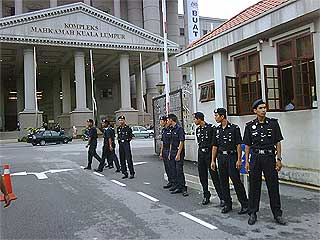 International law sets major limits on affirmative action measures. Notably, affirmative action policies must be carefully controlled and not be permitted to undermine the principle of non-discrimination itself nor violate human rights. Holding the equality principle uppermost, the raison detre and reasonableness for differential treatment must be proven.
Another important criterion to ensure successful affirmative action and synonymous with international law is that such special measures should be introduced for a limited duration as was suggested by the Reid Commission in its Report of the Federation of Malaya Constitutional Commission in 1957.
A consequence of the so-called affirmative action policies up to now is that for the poor of all ethnic communities, including the indigenous peoples in Malaysia, these objectives of wealth redistribution for their benefit have not been met. Worse, the poorest community remains the Orang Asli of Peninsula Malaysia, the original people of Malaysia who are not even considered bumiputera under the Federal Constitution.
Just 10 years after the NEP was implemented, the 1980 Census showed that more than 80 per cent of al government executive officers were Malay; Malays held 75 per cent of the publicly-funded tertiary education places; and 96 per cent of FELDA settlers were Malay. By 1990, it was widely held by observers that the wealth restructuring policy objective was very much on target if nominee companies listed under "other Malaysians" were analysed. It is also well known that the bumiputra elite formed many of these nominee companies.
Inequitable sharing of wealth
All the same, these figures showing ownership of equity capital, however distorted, also reveal that the rich non-Malay elite have done quite well under the NEP. This perhaps accounts for the elite cohesion that has held the Barisan Nasional coalition together for so long. The evidence further shows that the NEP's "wealth restructuring" has mainly resulted in increased wealth concentration and greater intra-ethnic inequality.
By the mid-Eighties, it was found that the top 40 shareholders in the country owned 63 per cent of the total number of shares in public companies; the top 4.4 per cent of investors in the Amanah Saham Nasional had savings amounting to more than 70 per cent of ASN's total investments.
By 1990, the realities of the racially discriminatory quota system in education were as follows: An average of 90 per cent of loans for polytechnic certificate courses, 90 per cent of scholarships for Diploma of Education courses, 90 per cent of scholarships/loans for degree courses taken in the country, almost all scholarships/loans for degree courses taken overseas were given to bumiputeras.
Regarding the enrolment of students in residential schools throughout the Eighties, 95 per cent of these were bumiputera. The enrolment in MARA's Lower Science College, Maktab Sains MARA was almost 100 per cent bumiputera throughout the Eighties.
Racial discrimination in the realm of culture is seen not only in education policy but also in the discrimination against Non-Malay cultures and religions in the National Cultural Policy. Non-Muslims face obstacles in their freedom to build places of worship and access to burial grounds, among other complaints.
Racism and racial discrimination have dominated Malaysian society for far too long. Now that the Malay ruling elite has clearly gained control of the Malaysian economy, it is high time for a new consensus based on non-racial factors such as class, sector or need to justify affirmative action.
It is time for all Malaysians who hunger for peace and freedom to outlaw racism and racial discrimination from Malaysian society once and for all and to build real unity based on adherence to human rights, equality and the interests of the Malaysian masses.
KUA KIA SOONG is the director of human rights movement Suaram. He was detained under ISA in 1987 and wrote about his experience in '445 Days Behind the Wire'.


Are you sure you want to delete this comment?
This action cannot be undone.