




Controversial AP to be scrapped by 2015
Foreign firms will be given manufacturing licenses to hold 100 percent equity in firms which produce luxury vehicles with an engine capacity of more than 1,800 cc and costing more than RM150,000 while the controversial Approved Permits (AP) system will be scrapped in 2015 under the review of the National Automotive Policy announced today.
Foreign firms will be given manufacturing licenses to hold 100 percent equity in firms which produce luxury vehicles with an engine capacity of more than 1,800 cc and costing more than RM150,000 while the controversial Approved Permits (AP) system will be scrapped in 2015 under the review of the National Automotive Policy announced today.
 Under the review announced by Minister of International Trade and Industry Mustapa Mohamed, the import duties of all completely-built-up (CBU) and completely-knocked-down (CKD) cars will be maintained.
Incentives and exemptions will be increased to develop local auto parts so that there would no longer be parts imports by 18 months' time, a move which help do away with imported and used spare parts outfits.
Vehicles which are 15 years and above would also have to go through mandatory testing to ensure their roadworthiness but provisions would be made for vintage cars, he told a media conference to announce the long-awaited review of the NAP.
He said that the review was undertaken after extensive discussions with industry players including manufacturers, assemblers, auto parts makers, non-governmental organisation as well as car associations.
New partner for Proton
Mustapa said that there were 18 new policies and measures covering licencing, duties, incentives, technology and environment, safety and standards and APs introduced under the NAP review.
New policies and measures would be effective from Jan 1, 2010.
Under the new measures new strategic partnership between Proton and a global established Original Equipment Manufacturer (OEM) will be established.
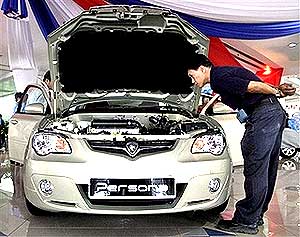 Currently, Proton is in talks to establish strategic partnership with international partners.
"Up to now, Proton has yet to find a strategic partner," he said.
Elaborating on APs, he said the AP system for imports of CBU vehicles will be terminated whereby open APs for used vehicles will be terminated by Dec 31, 2015, which means importation of used vehicles using the AP permit would no longer be allowed after 2015.
"No new applications for open APs will be considered and franchise APs will be terminated by Dec 31, 2020," he said.
Mustapa said as part of ongoing efforts to help bumiputera entrepreneurs in the automotive industry, a Fund for Bumiputera Development will also be established.
Besides this, he said that a charge of RM10,000 for each open AP will be introduced as announced in the 2010 budget last week whereby under current status, APs are issued for free.
A fund will be established to assist Bumiputera companies venturing into the automotive and other related businesses, he said.
Freeze on manufacturing licences
The government would also introduce a mechanism to prohibit the import of used parts and components effective June 2011, said Mustapa.
Currently, imports of new and used parts and components were allowed without any restrictions and might in some cases affect safety and environment, he said.
A new measure under the review of the NAP is the establishment of a gazetted price for imported used CBU motor vehicles by the Royal Customs, a move designed to stop the under-declaration of imported used-cars and abuse of the AP system.
Currently only prices for new imported CBU motor vehicles are gazetted for the purpose of duty compilation, he said.
Mustapa also said that the review would maintain the freeze on manufacturing licences (ML) for rebuilt activities.
"At the moment, new ML for rebuilt activities is frozen," he said.
He said that no equity condition is imposed for new ML under the revision of NAP.
However, the review maintains current policy on contract assembly to utilise existing excess capacity.
Mustapa said that the freeze on issuance of new ML will also be lifted for selected segments include hybrid and electric vehicles, pick-up trucks, commercial vehicles and motorcycles with engine capacity of 200cc and above.
Touching on the current rates of import duty and excise duties being maintained, he said that currently, the excise duty for CBU and CKD vehicles based on engine capacity was 75-105 percent for passenger cars, 60-105 percent for multi-purpose vehicles and vans, 65-105 percent for four-wheel drives and 20-30 percent for motorcycles.
- Bernama


Are you sure you want to delete this comment?
This action cannot be undone.