




Jeffrey hints at 2nd chance for PKR in Sabah
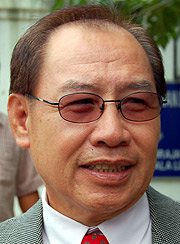
Jeffrey Kitingan, who yesterday quit his post as PKR vice-president, has hinted at the possibility of a second chance for opposition party in Sabah. However, he painted a ‘big if’ situation.
Jeffrey Kitingan, who yesterday quit his post as PKR vice-president, has hinted at the possibility of a second chance for opposition party in Sabah. However, he painted a ‘big if’ situation.
He urged party president Dr Wan Azizah Wan Ismail to move immediately to implement three steps that would stave off a total collapse of PKR in the state.
 Firstly, the PKR constitution should be changed to recognise the special position of Sabah and Sarawak (in Malaysia) by giving them autonomy to manage their political affairs and organisation.
Secondly, the leadership at the PKR headquarters based in Selangor should allow the divisional delegates to choose the state leadership line-up including the Sabah PKR chief, which will likely to be Jeffrey himself.
Thirdly, the party should create a special committee to review, manage and implement the requirements of the 20-points agreements when Sabah joined the federation.
The three recommendations are contained in Jeffrey’s resignation letter which he emailed late this afternoon to Wan Azizah.
The Sabah strongman also resigned as a member of the party’s supreme council and the political bureau, but remains as party member and Keningau division chief.
Views not respected
Jeffrey, when contacted in Kota Belud, confirmed that he had indeed emailed his letter of resignation to Wan Azizah and confirmed the gist of its contents.
“The three steps, if implemented, will allow PKR to address local issues and sentiments without having to set up a local political party,” writes Jeffrey in his resignation letter. “It will promote democracy in the state.”
Touching on his resignation, Jeffrey expressed regrets that he had to relinquish his position in the party as his “views are not respected”.
Jeffrey recalled that he joined the party because he “believed in its philosophy of democracy and struggle for justice, freedom and democracy and its recognition and acceptance of the Tambunan Declaration”.
The Tambunan Declaration incorporates Sabah rights and the 1963 Malaysia Agreement.
“I worked hard day and night in Sabah and Sarawak too, putting my life on the line sometimes, to promote the party,” writes Jeffrey. “It did not matter to me who was the state chief as long as we worked as a team.”
Jeffrey assured the party president that he had nothing against Ahmad Thamrin Jaini, the newly-appointed state chief, Azmin Ali who got the boot as the state chief and party advisor Anwar Ibrahim.
However, the Sabah division chiefs had to draw a line somewhere when “Anwar continued to look at Sabah the same way he did when he was in Umno”.
“Many now wonder what reformasi (reformation) is all about when it comes to Sabah and Sarawak,” pointed out Jeffrey.
“It had been our hope that PKR would be different from Umno as far as the handling and treatment of Sabah and Sarawak is concerned. But sadly, there’s no difference.”
Musical chairs
In support, Jeffrey cited the fact that the third state chief, Awang Tengah, was removed by Anwar despite the fact that he had the support of 90 percent of the divisions.
He attributed this to instigation of a certain division chief who has the ear of Anwar and is willing to be a proxy for people in Kuala Lumpur.
Awang Tengah’s removal, Jeffrey charged, was simply to facilitate the appointment of the unpopular Tuaran division chief Ansari Abdullah as the fourth state chief.
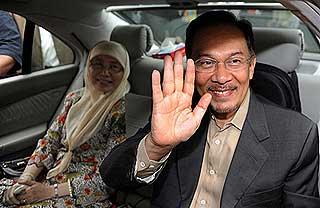 When Anwar found that almost the entire Sabah PKR was against Ansari, he took over as state chief for two months before relinquishing the post to Azmin, who sought advice only from Ansari on how to run the party in the state.
In Sarawak, Jeffrey complained, the unpopular Mustapha Kamil Ayub from Perak was thrust on party members in the state despite their protests.
In one of his parting shots, Jeffrey reminded the PKR president that the party lost the general election in the state last year simply because it was led by a state chief who did not have the support of the majority of the divisions.
“If the party doesn’t change its approach in Sabah and Sarawak, it will continue to get weaker and will no longer be cohesive as when it first started,” warned Jeffrey.
The Sept 20 memorandum, signed by 18 division chiefs, said Jeffrey, “is a manifestation of the same concern for better decision-making based on the principles of democracy which the party preaches.”
Whoever is appointed as the state chief in Sabah “will only bring disaster to the party” if he or she doesn’t have the support of the division chiefs, warned Jeffrey.


Are you sure you want to delete this comment?
This action cannot be undone.