




USM's world first gelatine detector
USM lecturer invents method to detect gelatine in medicinal capsules.
A lecturer from Universiti Sains Malaysia (USM) has invented the world's first protein-based biomarker method that would detect, analyse and differentiate the gelatine contents in medicinal capsules.
Associate Professor Dr Gam Lay Harn from the school of pharmaceutical sciences said her methodology would be able to detect contents of porcine (pig-based gelatine) and bovine (cow-based gelatine) in any medicinal capsules in the market.
"This is the world's first protein-based methodology to identify and differentiate gelatine contents in capsules.
"It can identify and differentiate gelatine in capsules containing 100 per cent porcine and even those with mixed contents of porcine and bovine," she told newsmen at USM today.
Also present at the press conference was the school of pharmaceutical sciences dean associate professor Syed Azhar Syed Sulaiman.
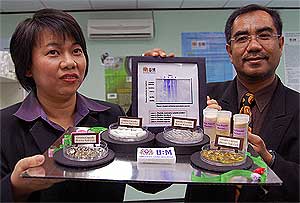 Dr Gam
(far left)
has already received an award at the International Exposition at Research and Invention Institutions of Higher Learning in KLCC last month for her scientific invention.
Dr Gam
(far left)
has already received an award at the International Exposition at Research and Invention Institutions of Higher Learning in KLCC last month for her scientific invention.
The expo was organised by the Higher Education Ministry, with Universiti Malaya as co-organiser.
Dr Gam said that the current research technical method using the polymerase chain reaction (PCR) to detect, analyse and differentiate was not accurate due the method's dependence on the presence of pig DNA in gelatine content in medicinal capsules.
Protein, not DNA
She said pig DNA was not the actual component of the gelatine because gelatine was protein, not a DNA.
Therefore, the researcher said PCR method could be relying on an unreliable source to detect porcine in gelatine.
Moreover, the pig DNA can be destroyed during the processing of gelatine and at times the pig DNA could be non-existent in gelatine.
"This would make it difficult to detect porcine.
"It may give a false negative reading," Dr Gam said.
However, she said her method would be 100 per cent accurate if a capsule contained 20 per cent porcine and 80 per cent bovine.
Dr Gam said the method would be 67 per cent accurate for capsules containing 10 per cent porcine.
According to her, USM was hopeful that the new method would resolve public dilemma over the ‘halal' capsules issue due to presence of porcine contents.
She said her research was funded under the research university grant provided by the ministry.
USM had filed for pattern rights over the method in Malaysia, she added, and would be filing the same under the Patent Cooperation Treaty for international patent rights and recognition.


Are you sure you want to delete this comment?
This action cannot be undone.