




Jeffrey takes 'epic battle' to Tambunan heartland
The Tambunan Valley Resort Centre (TVRC), nestled on a plateau in the high country, will be transformed tomorrow evening when the Common Interest Group (CIG) hits town.
The Tambunan Valley Resort Centre (TVRC), nestled on a plateau in the high country, will be transformed tomorrow evening when the Common Interest Group (CIG) hits town.
CIG is an ad hoc movement initiated by Parti Keadilan Rakyat (PKR) Keningau division chief Jeffrey Gapari Kitingan late last month.
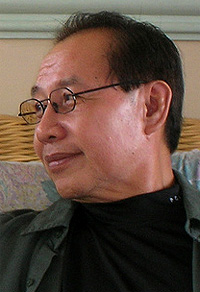 Tambunan is the historical battleground where the PBS (Parti Bersatu Sabah) began its struggle in 1985 to oust the ruling Barisan Nasional within 45 days of its formation.
The party went on to rule alone for an unprecedented four terms.
"This is a zone meet, not all-Sabah as many people initially thought," said Jeffrey who is a Dusun from Tambunan.
"We will have people from the Interior Division to discuss the political situation, especially in Sabah and Sarawak. There will also be observers from other zones."
He was speaking yesterday evening on the sidelines of a meeting of the Borneo Heritage Foundation, an NGO which he chairs.
He clarified - disingenuously according to his critics - that the CIG had nothing to do with PKR. Still, it's conceded that the emergence of the group was triggered by recent and on-going events in the Sabah chapter of the party.
Again, he does not want to be drawn into making comments any longer on the politics of Sabah PKR "since we have moved way past that stage".
Jeffrey did not dwell too much on the specifics of the Tambunan meet. He added that "it would be more to listen to the people and let them decide on the best way forward in the politics of the state".
However, it appears that there would be "a lot of nudging in the process of allowing the people to make their choices felt".
The Interior Division covers seven of the state's 25 districts and five parliamentary seats. Sabah has 25 parliamentary seats.
Apparently, the CIG is covering the state zone by zone, the others being seven districts in the west coast, three in Kudat, four in Sandakan and four in Tawau.
Sabah politics back to square one
The zones refer to the divisions in the administration of the state and not the parliamentary constituencies on which the PKR divisions or ‘cabang' are based.
The CIG's emergence came in the wake of the PKR supreme council meet in Kuala Lumpur on Oct 25.
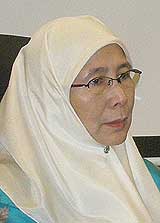 During the meet, ostensibly chaired by party president Wan Azizah Wan Ismail
(left)
, party advisor Anwar Ibrahim over-turned the decision by a majority of the Sabah divisions to propose Jeffrey as the state PKR chief.
During the meet, ostensibly chaired by party president Wan Azizah Wan Ismail
(left)
, party advisor Anwar Ibrahim over-turned the decision by a majority of the Sabah divisions to propose Jeffrey as the state PKR chief.
Libaran division chief Ahmad Thamrin Jaini, a Bajau, was appointed instead.
As best as it can be gleaned from Jeffrey's inner circle, "the politics of Sabah is back to square one".
There's renewed emphasis on Sabah and Sarawak rights. The window of opportunity opened up by the political tsunami last year in Peninsular Malaysia, it is said, favours the consensus that issues in Malaysian Borneo must be addressed by local parties.
Jeffrey has so far denied that he would be forming a new political party.
"Political parties just divide us and make it easier for Kuala Lumpur to continue with their divide-and-rule tactics," said Jeffrey.
"Kuala Lumpur has no shortage of local proxies, stooges and traitors in Sabah and Sarawak."
He has also denied, for the umpteenth time, that he would be returning to PBS, helmed by his elder brother Joseph Pairin Kitingan, also a deputy chief minister.
Pairin is also huguan siou (paramount chief) of the KadazanDusunMurut. He also heads the KadazanDusunMurut Association (KDCA) where Jeffrey is the deputy president.
"There is no point for me to join any of the BN components parties including the PBS. They too, have failed to give voice to the people in Sabah and Sarawak," said Jeffrey.
"I'm willing to work with Sabah People's Progressive Party (SAPP). I don't see myself joining the party."
The Keningau division chief has yet to state whether he will stay with PKR or quit. There's a growing consensus among a majority of division chiefs that "his position in the party has become untenable".
BN component parties in trouble
His arch critics do not rule out the possibility of him getting the sack in the near future - "for undermining the party in Sabah and Sarawak" - in the event he does not quit in time.
Jeffrey has already since resigned as vice-president from the Supreme Council and from the National Political Bureau.
Tawau division chief Kong Hong Ming, the only critic willing to be named, had this to say: "Thamrin is here to stay and working very well".
 Kota Kinabalu division chief Christina Liew
(right)
has a wait-and-see attitude.
Kota Kinabalu division chief Christina Liew
(right)
has a wait-and-see attitude.
"Just wait till you see the mass resignations. And the new faces in the new party. Unbelievable!" said Liew adding that Wan Azizah is keen to catch up with her.
Wan Azizah, as best as can be gathered, wants to stop Liew from leaving PKR. Liew seems to be Wan Azizah's passport to other rebel division chiefs like Jeffrey in the party.
In the absence of a new party, the initial CIG game plan seems to be to reverse the gains made by PKR in Sabah over the last five years or so through the powerful KadazanDusunMurut Task Force.
The Task Force also covers seats dominated by Muslim tribes within the community.
This includes the Orang Sungei in Kinabatangan in the east coast, the Bisayas of Beaufort along the west coast and the Dusuns in Ranau in the high country.
Former PKR state secretary Kanul Gindul has the most candid take on the political situation in Sabah and Sarawak.
"The CIG will undermine support for all the BN component parties in Sabah that are from Peninsular Malaysia. The first victim will be PKR," said Kanul who agreed that many Sabah PKR rebel division chiefs were sworn to needless secrecy.
"If PKR has no place in Sabah, it will have no place in Sarawak either. But that doesn't mean we (Sabahans) can't work together with PKR at the federal level."
Tuaran Division chief Ansari Abdullah alleged that Kanul was in fact sacked by PKR -denied by the latter - "but his DNA seems to be all over the place."


Are you sure you want to delete this comment?
This action cannot be undone.