




Section 498: Out of date, out with it!
Several NGOs have renewed calls for the abolition of Section 498 of the Penal Code which restricts a woman's right to decide on matters over her own body.
Several NGOs have renewed calls for the abolition of Section 498 of the Penal Code which restricts a woman's right to decide on matters over her own body.
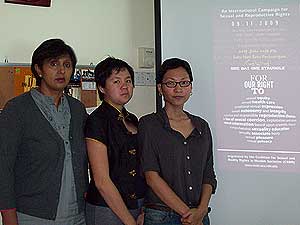 The All Women's Action Society (Awam), Pusat Kesedaran Komuniti Selangor (or Empower), Sisters in Islam and Women's Aid Organisation (WAO) said section 498 contravenes the provision of equality between men and women, as stated in Article 8 of the federal constitution.
Their initiative is part of an international campaign by the Coalition for Sexual and Bodily Rights in Muslim Societies. Details were revealed at a press conference in Petaling Jaya this morning.
Over 20 organisations in 11 countries are holding simultaneous events and public demonstrations to promote human rights that relate to women.
Honour killings, discriminatory and life-threatening laws like stoning and lashing of women, and female genital mutilation are among the issues in focus.
 Section 498 came under public scrutiny in a recent case, when local celebrity Daphne Iking's (
right
) husband, Ryan Chong, used it against managing director Choy Khin Ming.
Section 498 came under public scrutiny in a recent case, when local celebrity Daphne Iking's (
right
) husband, Ryan Chong, used it against managing director Choy Khin Ming.
The clause reads: Whoever takes or entices away any woman who is and whom he knows or has reason to believe, to be the wife of any other man from that man, or from any person having the care of her on behalf of that man, with intent that she may have illicit intercourse with any person, or conceals, or detains with that intent any such woman, shall be punished with imprisonment for a term which may extend to two years or with fine or with both.
Awam committee member Ng Tze Yeng said the provision has been in existence since the 19th century. It was adopted from the Indian Penal Code, which was enacted 200 years ago by the British colonial government.
"This law was made at a time when married women had to submit to their husband and did not have any power over themselves," she explained.
 WAO president Meera Samanther (
right
) pointed out that times have changed and that women are now accorded equal rights by law.
WAO president Meera Samanther (
right
) pointed out that times have changed and that women are now accorded equal rights by law.
She said the clause portrays women as the property of their husband and implies that they are not capable of making decisions.
"Women today hold key positions in the government and corporate sector, so why they are still not allowed to make decisions about their own body?" she asked.
She further questioned the need to retain ‘colonial chauvinism', asking whose interests are served by the provision.
Ambiguous interpretation
In addition, there appears to be no consensus among the judiciary as to what is deemed ‘enticement'.
Meera said that, whenever the clause has been invoked to date, the verdict has been vague.
 Seputeh parliamentarian Teresa Kok (
left
), who raised the issue in the Dewan Rakyat, received a written reply from the home minister. He said the Penal Code would not be amended as only one case has been reported in relation to section 498.
Seputeh parliamentarian Teresa Kok (
left
), who raised the issue in the Dewan Rakyat, received a written reply from the home minister. He said the Penal Code would not be amended as only one case has been reported in relation to section 498.
The NGOs disputed this claim, saying six cases had been tried between the 1930s and the 1970s, prior to the most recent one.
"The number of cases tried under this law does not matter - it is an archaic and irrelevant law in this day and age," noted Meera.
The NGOs are also of the view that a consensual relationship between two adults should not be the state's concern and that it should not criminalise ‘acts deemed to break up marriages'.
Meera also said the clause does not address the issue of consent.
"If we are concerned about the lack of the women's consent or that she may be taken against her will, we have other applicable (provisions of) the Penal Code," she said, citing clauses against kidnap and wrongful confinement.
"We sent a memorandum to the government in 2005, calling for the abolition of all laws that are discriminatory to women. This includes section 498."
The NGOs reminded the authorities that, under the Convention on the Elimination of Discrimination Against Women, the state is obligated to remove all laws that impede women's equality.


Are you sure you want to delete this comment?
This action cannot be undone.