




Chinese president Hu arrives for two-day visit
Chinese President Hu Jintao arrived in Malaysia this afternoon, in his first round of regional diplomacy before heading to the Asia-Pacific Economic Cooperation summit in neighbouring Singapore.
In Malaysia, Hu will receive a formal welcome in parliament before an evening audience with the country's king, followed by a state banquet, according to officials in Kuala Lumpur.
China's President Hu Jintao was greeted in Malaysia with a 21-gun salute today as he began his first round of regional diplomacy ahead of the Apec summit in neighbouring Singapore.
Hu, the first Chinese leader to visit Malaysia in 15 years, was given a state welcome at Parliament Square by King Tuanku Mizan Zainal Abidin, Prime Minister Najib Razak, and an honour guard from the elite Royal Malay regiment.
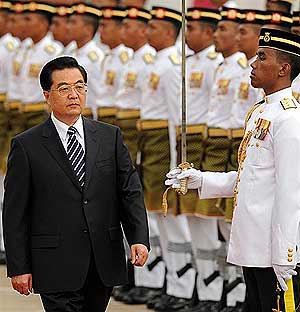 The official trip marks the 35th anniversary of Malaysia-China diplomatic ties, which were established in 1974 by Najib's father, former premier Abdul Razak Hussein.
"Malaysia is a friendly neighbour of China and people of the two countries enjoy a time-honoured friendship," Hu said in a statement after his arrival.
"To deepen China-Malaysia strategic cooperation under the new circumstances serves the fundamental interests of the two countries and peoples and contributes to peace, stability and prosperity of the region."
Najib visited China in June and signed a joint action plan on strategic cooperation. On Wednesday the two leaders will hold talks and sign several undisclosed agreements.
A senior finance ministry official told AFP that one of the agreements involves the sale of a stake in leading Malaysian palm oil producer Sime Darby and another would see a major transport project awarded to a Chinese company.
On Thursday Hu will travel to Singapore to attend the Asia-Pacific Economic Cooperation (Apec) summit with US President Barack Obama, Russian President Dmitry Medvedev and other regional leaders.
Chia Oai Peng, from Universiti Tunku Abdul Rahman, said the visit reflected an ongoing shift towards China by the 10-member Association of Southeast Asian Nations (Asean).
"China is coming to the region to make friends and it wants to get Malaysia as a close ally," she said.
"For China, it means having a key friend in Asean and the region, which will rely less on the US and Japan from now on."
"Greater cooperation also means a bigger market for Chinese goods in Southeast Asia and also a realignment of regional loyalties, with China competing with the US and Japan for greater trade and political influence."
Irritants remain
KS Balakrishnan, senior lecturer at Universiti Malaya, said Hu's visit provided Malaysia with an opportunity to cement close ties with the region's rising economic power.
He said multicultural Malaysia can also capitalise on its large ethnic Chinese population, which plays a prominent role in business here.
However, Balakrishnan said that irritants remain, including the disputed Spratlys, a group of islands and atolls in the South China Sea claimed in whole or in part by Brunei, China, Malaysia, Philippines, Taiwan and Vietnam.
"Militarily, we fear China due to the Spratlys problem," he said, referring to deadly armed confrontations over the islands in the past.
Before departing for Singapore, Hu will travel south to tour the historic enclave of Malacca.
China's influence over Malacca dates back to the 15th century when it was an important stopping point for the trading fleet of the great Chinese admiral and explorer Zheng He.
The Chinese who settled in Malacca at that time intermarried with the local Malay people. Their descendents created their own culture and are known as "peranakan".
China became Malaysia's biggest trading partner this year, surpassing Singapore, the United States and Japan.
Between January and September, bilateral trade reached RM89 billion, accounting for nearly 13 percent of Malaysia's total trade during the period.


Are you sure you want to delete this comment?
This action cannot be undone.