




Damming report calls for fair treatment of Penans
The national Human Rights Commission (Suhakam) has found serious flaws in the Sarawak government's plans to evict thousands of Penans to make way for the ongoing construction of the RM3 billion Murum Dam in the heart of Sarawak.
The national Human Rights Commission (Suhakam) has found serious flaws in the Sarawak government's plans to evict thousands of Penans to make way for the ongoing construction of the RM3 billion Murum Dam in the heart of Sarawak.
In a new 93-page report published on its website, Suhakam noted that the recent furore over the Sarawak government's plan to proceed with the Murum Hydroelectric Project (MHP) raised concerns over its effects towards human rights, in particular, the economic, social and cultural rights of indigenous communities."
On Sept 16, Malaysia Day, 15 indigenous activists were arrested in Kuching for illegal assembly when they tried to present a memorandum to Chief Minister Abdul Taib Mahmud.
Suhakam reported that the internal displacement of eight Penan communities is raising fears that they will suffer the same grim fate as 10,000 indigenous people relocated to the dilapidated Sungai Asap Resettlement Scheme in the 1990s, from the Bakun Hydroelectric Dam site, 60km downriver.
According to Suhakam, "there is a shortfall in the extent of free, prior and informed consultation with the affected communities".
The report stopped short, however, of acknowledging that the government had failed to seek prior consent of indigenous communities before removing them from their homes.
 This consent is required by the United Nations Declaration on the Rights of Indigenous Peoples, which Malaysia's government signed up to in 2007.
Suhakam said the views, concerns and expectations of local communities had been "noted" by government agencies, but appeared to have been discounted.
Civil society and environmental groups were denied access to information during the planning of the Murum Dam, and were not allowed to give "relevant views" before its implementation.
The report also called it "paradoxical" that the Environmental Impact Assessment (EIA) on the Murum Dam remains unfinished and shrouded in secrecy, even though construction has already begun.
The EIAs of 11 other proposed mammoth hydroelectric dams announced by the Sarawak government have also been kept from the public, although the EIAs hold information crucial to native communities who will lose their land to these mega-projects.
Ironically, news about the Murum Dam, and the other 11 dams planned, only leaked out inadvertently, thanks to Abdul Aziz Husain, Group Managing Director of Sarawak Energy Berhad.
Sarawak Energy is an electricity consortium closely linked to chief minister Taib's family. Abdul Aziz, Taib's brother-in-law, displayed the details during a slide presentation at a China-Asean Power Cooperation and Development Forum in Guangxi, China, in October 2007.
Urge to splurge
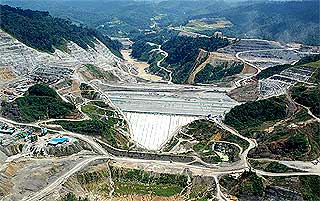
Construction has already begun on the Murum Dam. The contract was awarded to the China Three Gorges Project Corporation (CTGPC). The dam is slated to generate 944 megawatts of electricity upon completion in 2013.
An environmentalist NGO source told Malaysiakini that Sarawak already enjoys a surplus of electricity, and that proper energy planning has given way to the "urge to splurge" on mega-projects.
The Sarawak government has said excess electricity generated by Bakun and Murum will be used by a controversial aluminium smelter in Bintulu, or transmitted to Peninsular Malaysia.
The local partner of the aluminium mega-project is Cahaya Mata Sarawak (CMS), a consortium dominated by members of Taib's family.
Local NGO sources have warned the aluminium smelter would cause devastating environmental pollution. NGOs have also ridiculed Sarawak Energy's proposal to export electricity to Peninsular Malaysia, via untested, and immensely expensive, underwater cables laid on the bed of the South China Sea.
 The NGOs argue the cable would face daunting risks from earthquakes, sabotage and equipment failure.
Suhakam met leaders and representatives from eight Penan communities facing eviction, Long Singu, Long Tangau, Long Luar, Long Menapah, Long Wat, Long Malim, Long Jaik and Long Peran, during its investigation in August.
These were the same communities highlighted by Suhakam in its 2007 report on Penan in Ulu Belaga: Right to Land and Socio-Economic Development .
The Penan communities had been affected in 2007 by a takeover of their land by plantation company Shin Yang Forestry . Shin Yang is a logging company with close ties to the state government.
During Suhakam's return visit this year to gauge the effects of the Murum Dam on these Penan communities, Suhakam discovered by chance, to their horror, that one of the "consultants" who had written the Shin Yang plantation EIA was actually a Shin Yang employee.
The villagers' previous trauma in 2007, in losing what they claimed as Native Customary Rights (NCR) land to Shin Yang, has now been compounded by the government's instructions to resettle because of the Murum Dam.
The Suhakam report described the local villagers as "once bitten twice shy." It pointed out that the communities felt that they would lose more of their land if they were to relocate, and would be given unfair compensation in return.
Suhakam: Amend the state land laws
Natives of different ethnic groups told Suhakam they had been cheated when they were relocated to the Sungai Asap Resettlement following the construction of the nearby Bakun Dam.
According to Suhakam, the villagers were only compensated with three acres of land for each entitled family. Those lands were, however, later found to be unsuitable for cultivation as some were swamps and rubble. Some others were too far away from the Sungai Asap Resettlement.
Suhakam also found there was widespread poverty among the resettled villagers at Sungai Asap. It said the villagers had insufficient access to clean piped water and electricity, as well as problems in accessing land for cultivation.
"In addition, extremely limited access to employment and other income-generating activities had further compounded their hardship," it said.
The report stressed that the neglected local communities had voiced their appeals for access to education, healthcare, registration and other vital public services.
"Their concerns were based on their previous experience in which they were promised development but ended up being deprived of their land and lost their main source of sustenance as well as being left without proper assistance to cope with change," said the report.
Suhakam urged the Sarawak government to amend the state land laws to recognise the customary claims to NCR land by the Penan.
 "The Sarawak Land Code 1958 as it stands presently does not provide provisions for the Penan community to establish ownership of land which they have traditionally lived in for generations. This can lead to non compensation and under-compensation for the internally displaced and affected communities."
Suhakam was told that whenever there was a big project, they would be the victims...asked to sacrifice whatever they had, in the name of the country's development.
However, in return, they did not see the benefits that were promised and at the same time, they lost their native land, in addition to their other rights.
Suhakam said they felt that it was unfair for the government to request them to sacrifice, when the government itself was unwilling to sacrifice or help its own citizens, especially communities such as the Penan who were clearly disadvantaged.
The report emphasised that Suhakam strongly recommends that the government ensures that local legislations are in line with international standards and are not interpreted in ways that could result in the infringement of human rights.


Are you sure you want to delete this comment?
This action cannot be undone.