




Hasan ticks off imans and mosque committees
Imams and mosque committee members in the state have been taken to task for taking the Selangor Islamic Religious Department rules lightly.
Imams and mosque committee members in the state have been taken to task for taking the Selangor Islamic Religious Department rules lightly.
State Islamic Affairs, Malay Culture, Infrastructure and Public Amenities Committee chairperson Dr Hasan Mohamed Ali said some imams and committee members were indifferent to the rules by labelling them either as Umno rules or the state government rules.
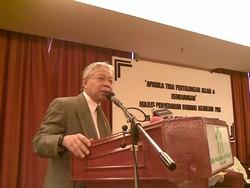 "Why should you be indifferent to the rules? Imams are required deliver prepared sermons. Can you write better ones?
"If we keep rejecting rules, there will be anarchy in the society. The society that does not respect rules will be destroyed," he said when opening the Sermon Enhancement Seminar in Shah Alam today.
Hasan also reprimanded certain mosque committees for inviting unauthorised imams to deliver sermons as some of them had touched on irrelevant issues like the murder of Mongolian model Altantuya Shaariibuu.
"It will be more apt for imams to talk about Muslims in their midst, who are not praying, strained husband-wife relationship, poor exam results among their children and the sluggish religious propagation in the villages," he added.
Dr M: Politicians should get permits
Meanwhile, former prime minister Dr Mahathir Mohamad has suggested that politicians get commissioned as religious preachers if they want to conduct "ceramah" (talks) on Islam so as to avert disunity and confusion among Muslims in the country.
"I notice that many politicians conduct religious lectures without having been commissioned to do so. Religious lectures with a political motive cannot be trusted.
"The commissioning is to ensure that the lectures adhere to the true Islamic teachings propagated by Prophet Muhammad," he told reporters after opening the annual general meeting of the United Sabah Islamic Association (USIA) in Kota Kinabalu.
Mahathir, who is president of the Malaysian Muslim Welfare Organisation (Perkim), said it was feared that the differences of opinion among certain Muslim personalities would be misinterpreted by Muslims and lead to disunity and factions.
He also said that the commissioning of the religious preachers would also ensure that true Islamic teachings were disseminated in all the states.
"We find that some people can preach, while some cannot. Some states can accept a certain preacher, while others cannot," he said.
He said differences of opinion among Muslims could occur but this should not necessarily lead to enmity.
He also said that Muslims should not neglect other knowledge in their quest for religious excellence.
"We should not confine ourselves to preaching only. If we want to tell others about the distinction of Islam, but are seen as poor, weak and dependent, then how can we convince them about Islam?" he asked.
- Bernama


