




Women caught in 'gender trap'
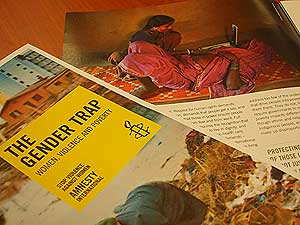
An Amnesty International report stated that women are caught in a 'gender trap', whereby interlinked violence and poverty prevent them from improving their lives.
An Amnesty International report stated that women are caught in a 'gender trap', whereby interlinked violence and poverty prevent them from improving their lives.
Launched at the Annexe Gallery in Kuala Lumpur today, the global report noted that economic dependency exposed women and girls to dangerous and violent situations.
Many women in low-paid jobs work in deplorable conditions, while female migrant workers are often exploited by employers or criminal networks.
While the paper did not specifically cite cases from Malaysia, it is not hard to find examples within our borders.
Abuse of Indonesian domestic workers in Malaysia had been widely reported while many female sex workers claim to reach our shores after falling prey to human traffickers.
 According to Tenaganita programme coordinator Aegile Fernandez, many domestic workers in Malaysia, often women, have their wages withheld for years. Often, they are sent back with only RM1,000 after being told they had damaged or stolen their employers' properties.
Many women are also trafficked from as far as Russia to work as sex workers in Malaysia.
Most, however, originate from Southeast Asia due to looser immigration regulations for Asean citizens and cheaper flights.
'Poverty drives women into sex trade'
Poverty remains the reason for these foreign women to come to Malaysia, as most were promised "exaggerated high incomes" as factory workers or waitresses.
"When they reach Malaysia, the agents will tell them that they have been 'bought' and these women are forced into prostitution in a form of debt-bondage," said Fernandez.
Tenaganita has rescued many such women with the help of the authorities. The women claim that their supposed debts are often not recorded, with the figures often changing according to agents' whims and fancies.
 Ho Yock Lin, founding member of All Women's Action Society Malaysia (Awam) said that violence against women has been an issue here and has always been on the forefront of the local women's movement.
"Today, in the cities, women are afraid to walk on the streets because there are many cases of snatch-theft. Women are also self-imposing curfews and are afraid to go out at night because we keep hearing of rape cases," she said.
If this continues, Ho added, there will soon be a time when women will be too afraid to leave their homes, leading to a "self-imposed house arrest".
Penan issue evidence of 'gender trap'
Violence and poverty remain facts of life for many rural women in Malaysia, as evidenced by the Penan rapes in the interiors of Sarawak.
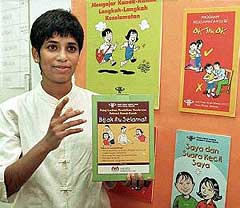 Programme Director of Women's Centre for Change (WCC), Dr Prema Devaraj, who was also part of the task force investigating the Penan issue, said that poverty acerbates the problem as it forces heavy reliance on the logging companies.
"There is an issue of enticement because (the Penans) are very poor… and when the companies move away from the area, the men who marry these women move too leaving their wives," she said.
Like other indigenous women highlighted in the Amnesty report, the Penans suffer multiple discrimination as they are seen as a minority group who have no ability to sway votes.
In Batang Berjuntai, Paul Seenapan of People's Service Organisation has found that rural women, especially educated ones, are trapped in violent relationships that are based on patriarchal values.
"Men are finding that they cannot have power over their wives economically or mentally anymore so they are resorting to physical force, leading to cases of wife-battery," he said.
'Public more sensitive to domestic violence'
Fortunately, Ho noted, public attitudes about domestic violence have shifted since the 1980s when it was mostly seen as a private issue.
 "Having the Domestic Violence Act means that the police are more ready to intervene," she said.
However, the Amnesty report noted that poverty is not just lack of income but also a "lack of security, voice and choice."
As it stands, women the world over are prevented from making choices for themselves due to regulation, religion, culture and social customs.
According to Ho, this is evident in Malaysia through the rise of conservatism, which infringes on a woman's freedom to choose how to practice religion, her attire, her behaviour and speech.
Amnesty also highlighted the issue of abortion, whereby many countries still regulate a woman's choice whether or not they will become mothers, forcing many to seek unsafe alternatives.
In Malaysia, abortion can only be legally undertaken if the pregnancy endangers the life of the mother.
While some may argue that violence against women is not as prevalent within our borders, it is apparent that poverty remains a large problem.
With poverty being "both a consequence and cause of violence" against women, the gender trap is indeed one that continues to keep women in Malaysia in this vicious cycle.


