




Woman scores legal first in High Court of Sabah/S'wak
Sabah-born Wendy Chan Poh Lau, 27, made legal history yesterday when she was admitted as an advocate of the High Court of Sabah and Sarawak, despite not having lived in the state for most of her life.
Sabah-born Wendy Chan Poh Lau, 27, made legal history yesterday when she was admitted as an advocate of the High Court of Sabah and Sarawak, despite not having lived in the state for most of her life.
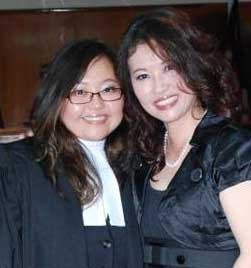 Senior lawyer Christina Liew, who objected to Chan's (
left in photo
) admission, argued that the latter left the state when she was in Primary 5 and never returned until she began her chambering.
Senior lawyer Christina Liew, who objected to Chan's (
left in photo
) admission, argued that the latter left the state when she was in Primary 5 and never returned until she began her chambering.
Justice Clement Skinner, in dismissing Liew's objections, ruled that Chan was qualified to practice in the state "by virtue of her birth".
"She is deemed to have Sabah connections which is the sole criteria for admission as advocate to the High Court in Sabah and Sarawak," said Skinner in Kota Kinabalu.
Chan's mother ( right in photo ) is from Peninsular Malaysia and her father, who is also a Malaysian, is said to have Brunei connections.
There was no objection by the Sabah Law Association (SLA), represented by its president John Sikayun, to Chan's admission.
Senior State Counsel Dayangku Fazidah Hatun Pengiran Bagul from the State Attorney-General's Chambers also raised no objection.
Liew was represented by senior counsel Marina Tiu as the former was not attired in a robe as convention demands.
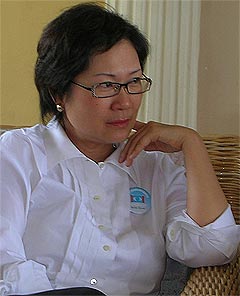 Liew (
left)
moved in her preliminary objections that the petitioner's (Chan's) father was a Bruneian, not a Malaysian, while the mother is a Peninsular Malaysian.
Liew (
left)
moved in her preliminary objections that the petitioner's (Chan's) father was a Bruneian, not a Malaysian, while the mother is a Peninsular Malaysian.
"Therefore, under immigration laws the petitioner is not a Malaysian citizen, in general, and she is not a Sabahan in particular," said Tiu.
"Under the Advocates Ordinance, a person must have Sabah connections in order to qualify for admission to the Bar in the High Court of Sabah and Sarawak."
Tiu argued that the constitution provides for those who can stay and work in Sabah and the fact of the person being born in the state alone should not qualify the person under sub-section (2)(a) of the Advocates Ordinance.
"If this petition were allowed, it would create a dangerous precedent which would allow non-citizens to apply and be admitted to the Bar," said Tiu.
"In theory, even the children of the holders of IMM13 (refugee status) immigration document, which gives the holder the right to stay and work, can apply and be admitted to the Bar."
Tiu reiterated that the application by the petitioner was a matter of public concern when it would seem that even someone born in Sabah of illegal immigrants can qualify under para (2)(a) provided he or she also satisfies the other requirements in the Ordinance.
Advocates Ordinance outdated
The SLA took the position that Chan was qualified "on paper" because she was born in Sabah, held a Sabah IC and although she had been away from the state it could be deemed that it was for the purpose of studying.
Hence, she never lost her Sabah connections by virtue of domicile. Sikayun also pointed out that under existing legislation one doesn't have to be a Malaysian citizen to be admitted as an advocate of the High Court of Sabah and Sarawak.
"Under Section 2 of the Ordinance, a person can only have Sabah connections if the person is born in Sabah, has been ordinarily resident in Sabah for a continuous period of five years or satisfies the Chief Judge that he or she is at the time of the application domiciled in Sabah," said Sikayun.
The SLA president acknowledged that the Advocates Ordinance is outdated and needs to be amended to be brought in line with the Legal Practices Act, 1967.
"It is my (SLA) view that the remedy does not lie in this court but in the legislative process," said Sikayun. "As the law stands at the moment, I see no further requirement that a person must go on further to prove that he or she is entitled to Malaysian citizenship."
Sinner, in responding to Sikayun's submission, noted that the Sabah Advocates Ordinance was enacted in 1953 during a short period of British colonial rule after World War II to 1963 "when the problems which have been highlighted during the hearing of the present objection (to Chan) could not have been foreseen".
The objections to Chan's admission delayed proceedings in court until after lunch. It also took media attention away from Rachel Jane Ongkili who was also admitted to the Bar along with Chan and 10 others.
 Rachel is the daughter of Federal Minister for Science, Technology and Environment Maximus Jonity Ongkili (
left
) who was also present in court with family members.
Rachel is the daughter of Federal Minister for Science, Technology and Environment Maximus Jonity Ongkili (
left
) who was also present in court with family members.
There were no objections from the SLA and the State Attorney-General to the applications by the 11 others for admission to the Bar.
Sikayun said that the decision on Wendy Chan must be read together with that of Justice Ian Chin in the case of Perak-born Mursyida Abdul Halim who was denied her application to be admitted to the Bar in 2003.
Mursyida is now a deputy registrar of the High Court in Selangor.
In a landmark decision, Ian Chin held that Mursyida did not satisfy the court that she had abandoned her Perak domicile or taken up domicile in Sabah.
He pointed out that she did not have a Sabah address in her MyKad and was not registered as a voter in the state. Her purchase of an apartment in Sabah just before her application was made was not proof enough, ruled Chin.
Mursyida visited the state for the first time on June 14, 2001 to be briefly with her family before coming back on Jan 7, 2002 to do her chambering in Kota Kinabalu for 12 months.
Chin discovered that Mursyida did her chambering without the necessary Visit Pass (Professional) as required by Regulation 11(1)(i) of the Immigration Regulations,1963.


Are you sure you want to delete this comment?
This action cannot be undone.