




The trouble with Dubai
A Reuters photograph on November 27 showed a signage by Dubai property conglomerate Nakheel. It was planted behind a small hill of rocks and boulders. Emblazoned on it were the words "Dubai gets built".
A Reuters photograph on November 27 showed a signage by Dubai property conglomerate Nakheel. It was planted behind a small hill of rocks and boulders. Emblazoned on it were the words "Dubai gets built".
The rocks and boulders may as well have been sand. Smash them and they turn into sand anyway. Whatever the United Arab Emirates has said and may say about the Dubai financial crisis, it is Dubai where the fan that is whirring and wobbling manically.
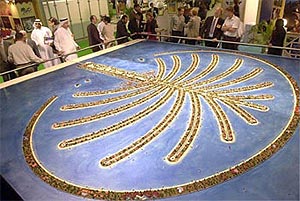 Dubai is only a part of the UAE, which consists of seven city-states. Each has separate ruling families and budgets. But they share immigration, security and foreign policies.
The richest among them is Abu Dhabi, potentially the savior of the Dubai goose that is being roasted. Abu Dhabi has nearly all the UAE's oil reserves. Since the 1950s Dubai has relied on diversifying its economy, service orienteering it from ports and trade to services and finance.
In the last decade, however, its liquidity-fuelled real estate and tourism bender is now showing that, like Southeast and East Asia of the 1990s, Dubai's phenomenal economic emergence has been built on sand.
"They do not understand anything", cried Sheikh Mohammed bin Rashid Al Maktoum, the ruler of Dubai. He was responding to the global fallout from Dubai World, which controls 49 ports, and Nakheel. Both are in debt. Serious debt.
Billions small potatoes for some
On the eve of Eid, they announced that they were seeking from their creditors a six-month debt moratorium. The Sheikh says the debt is comparatively small - US$60 billion. Ratings agency Moody's puts the figure closer to US$100 billion. But other market analysts are now saying the debt could be double Moody's "conservative estimate".
"This company [Dubai World] is independent of the government. This exaggerated media uproar will not affect our determination," Sheikh Mohammed ranted. What a crybaby. His claim is utter nonsense.
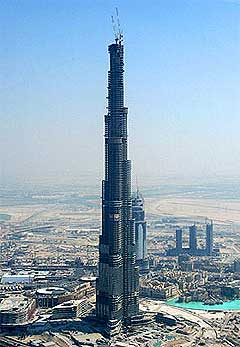 None of these conglomerates are independent of his regime. In the cloistered world of sheikhdoms, mad mullahs and kleptocractic regimes that stretch the Arab-Moslem arc from northwest Africa through the Middle East to Southeast Asia, all these regimes have nurtured and supported corrupt patronage networks of cronies and nepotists. Dubai World and Nakheel are very much state-owned or state bankrolled and protected.
Besides, it's too late: the region's bourses were hammered before re-stabilizing - somewhat. What is clear, though, is that Dubai's tinpot dictatorship of royal despots, despite their wealth, does not have the cash to save their own gander. And that gander was built on illusions of self-grandeur and absurd folly.
Unless Abu Dhabi comes to its rescue, the Sheikh and his entourage of business cronies and nepotists may be forced to offload their personal assets and worldwide business holdings, including investments.
Nevertheless western leaders have rallied behind Dubai's woes. They have said it is just a glitch and that Dubai wouldn't have to run to the International Monetary Fund cap-in-hand to bail it out of its self-made mess.
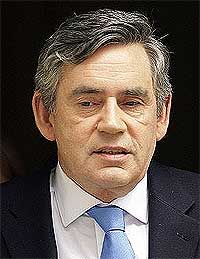 British prime minister Gordon Brown (
right
), known for his own economic folly as Chancellor of the Exchequer in Tony Blair's government, and these days constantly afflicted by his self-administered foot-in-mouth disease, weighed in behind the Sheikh like a trooper.
British prime minister Gordon Brown (
right
), known for his own economic folly as Chancellor of the Exchequer in Tony Blair's government, and these days constantly afflicted by his self-administered foot-in-mouth disease, weighed in behind the Sheikh like a trooper.
His advisers have warned him that British economic interests in Dubai and the UAE could face grief too if help does not come to Dubai's dictator - soon.
Because reports are filtering out (as I write this) that the Sheikh's personal investment vehicle, Dubai Holding, could well be the next state-owned Dubai company to default.
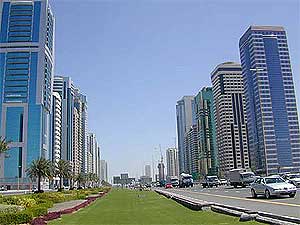 Research shows that Dubai Holding and Dubai World together hold 60%-70% of Dubai's debt, conservatively estimated at 180% of Dubai's gross domestic product. Bank of America Merrill Lynch thinks Dubai Holding has $1.8 billion due for repayment next year.
And Barclays Capital said at the start of December that Dubai Holding was most at risk of defaulting on its debts after Dubai World.
That's because it has extensive property assets, over-inflated in value, with property values having been halved in the last year. It remains highly leveraged. More, it faced problems last year.
Bye-bye Dubai?
The litmus test was the $US3.5bn loan due for repayment on December 14 2009 by Nakheel, Dubai World's property arm, and which triggered Dubai's debt crisis. Dubai's international creditors have the jitters growing by the day, including the Royal Bank of Scotland and HSBC, and local lenders.
Analysts close to the goings-on in Dubai's murky business world, say Mohammed Gergawi, Dubai Holding's CEO, hasn't a clue about the mess he has helped to create.
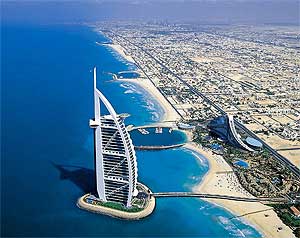 Some restructuring has been taking place at a frenetic pace. The vast conglomerate is being hived off into separate businesses. What's unclear, however, is if any of the restructuring will lead to business and financial transparency.
That's the problem. There hasn't been any transparency of the murky world of business and finance in the Middle East, let alone in the UAE, much less Dubai.
It's the tinpot dictatorships in the region that own and run business and finance in ways that, at minimum, would have raised heckles by international banks like RBS, HSBC and others.
But after West's own appalling banking standards, the manic greed of its executives and their pathetic and criminal financial practices, to raise heckles of the Middle East now would be tantamount to their being labeled hypocrites. And rightly so.
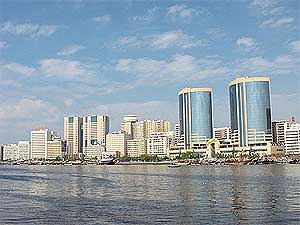 Still, two questions emerge from Dubai's self-made carnage. One is whether its image has been irreparably damaged and if it can win the confidence of foreign lenders and investors to previous levels going forward. Probably not.
Relatedly, who will lead the charge for good governance and transparency in Dubai and the rest of the Middle East? Certainly not the royal despots with their self-serving interests. Second, if this has happened in Dubai, what kind of financial disasters lurk in the rest of the UAE and the Middle East?
If you want to see the worse of the worst of these kinds of monolithic, lunatic, despotic dictatorships that have festooned massive corruption in business and politics and at all levels of Middle Eastern society, take a close look at Saudi Arabia.
And if there is a third question, when is the next global financial crisis, and what is its source? Not hard to guess, really. Is it? Give it about ten years - or less.
MANJIT BHATIA, an academician and writer, is also research director of AsiaRisk, a political, economic and risk analysis consultancy in Australia. He specialises in international economics and politics, with a focus on the Asia-Pacific.


