




SIS book ban: Decision on Jan 25
Can the Home Ministry intervene in banning a book on Islam, when the power to do so rests with state religious councils?
And can the home minister act based on the 'Guidelines on Censoring Islamic Publications', which are drawn up by the Department for the Advancement of Islam (Jakim)?
Can the Home Ministry intervene in banning a book on Islam, when the power to do so rests with state religious councils?
And can the home minister act based on the 'Guidelines on Censoring Islamic Publications', which are drawn up by the Department for the Advancement of Islam (Jakim)?
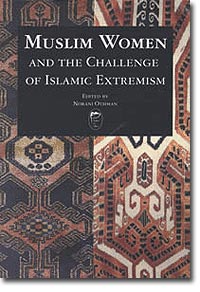
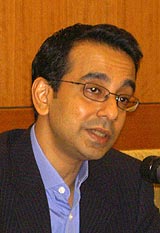 Lawyer Malik Imtiaz Sarwar posed these questions in relation to the ban on the book 'Muslim Women and the Challenge of Islamic Extremism - Building bridges between South East Asia and the Middle East'.
Malik is representing Sisters in Islam (SIS) which published the book, but which was banned on July 31 last year on the ground that it is prejudicial to public order.
The ministry's secretary-general had rejected an appeal on Nov 5, describing the book as “inclined towards confusing the Muslim community especially women” and “attempting to interpret statements about Islam according to the opinion of the authors”, thus confusing those who have “shallow religious beliefs”.
However, SIS is challenging the ban in the Kuala Lumpur High Court, with Malik telling today that the guidelines should not be deemed to be law.
The court, which heard submissions, will deliver its decision on Jan 25.
“There is no fatwa (decree) by the state religious councils to call for its ban. (In the case of the) Al-Arqam movement, state councils issued a fatwa that (members of) the group are deviants. It was only then that the federal government banned the movement,” Malik argued.
“What if the state councils find nothing wrong with the book or decide not to ban it? The ministry’s action is unlawful as it was based on Jakim guidelines The guidelines can never be taken as law as it is not part of any statute or Act.”
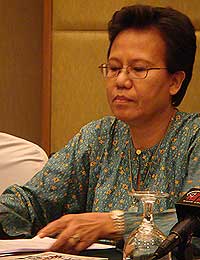 The book is a collection of essays by activists and international intellectuals, edited by sociologist Prof Norani Othman
(right)
of the Malaysian and International Studies Institute, Universiti Kebangsaan Malaysia.
The book is a collection of essays by activists and international intellectuals, edited by sociologist Prof Norani Othman
(right)
of the Malaysian and International Studies Institute, Universiti Kebangsaan Malaysia.
In it, academicians, scholars and activists give contemporary accounts of how the Islamic religion is being abused in various countries. It has been used as a resource and teaching material in universities.
Malik further submitted that the book merely raises concern about the administration of Islam in Malaysia, and does not question the precepts (principles) of the religion.
“The home minister has acted as a grand wazir (arbitrator) in bypassing the state governments in issuing the directive to ban the book. There is a possibility that he may not have read the book, which he should have before coming to the decision.
“This leads to the contention that the country is a police state or an autocratic state, where the minister can ban the book for fear of public security, whereas there is no evidence to suggest (any such basis).”
SIS has claimed that the ban on the book is outside the ambit of the Printing Presses and Publications Act 1984 and that it contravenes Articles 8(2), 10(1)(a) and 11(4) of the federal constitution.
Basis of action
Senior Federal Council Noor Hisham Ismail countered that the minister had banned the book by virtue of the fact that the King is the guardian of Islam at the federal level.
“The minister (then looked) at the Jakim guidelines and (considered) the problems that may be caused to public order,” he said.
Justice Mohamad Ariff Md Yusof asked the federal counsel if the book should be treated as an academic publication, rather than as religious text.
“If it is an academic text, it will be open to criticism,” he pointed out.
 Noor Hisham concurred that the publication comprises academic writing, but maintained that the ban should not be lifted as it would lead to deviant teaching of Islam.
“Jakim has found that the book may affect the religious beliefs of individuals. Furthermore, the ministry’s Publications Control and Al-Quran Text division has supported and recommended the action,” he said.
Jakim, however, has not stated the grounds or produced a report in assisting the ministry to arrive at its decision.
Noor Hisham said the court cannot intervene with the minister's decision so long as he exercises his discretion without mala fide (bad intention) or without improper motive.
“If it can be proven there was no ill intention by the minister in banning the book, then the court should not interfere with the decision,” he said.
Last Thursday, Noor Hisham read seven passages as the bone of contention, in supporting the government’s claim that the book would affect public order.
However, the judge commented that he did not find the passages to be offensive and that he does not see how the book would affect public order.


Are you sure you want to delete this comment?
This action cannot be undone.