




We've a growing rubbish problem
The bustling economic growth experienced by a developing country like Malaysia demanded the effective disposal of its domestic solid wastes.
But only seven of the 289 garbage disposal sites in the country were environmental-friendly sanitary sites.
This means less than 2.5 percent of the existing garbage disposal sites in the country were being well-managed, while the rest were operated on the 'open-dumping' basis...
The bustling economic growth experienced by a developing country like Malaysia demanded the effective disposal of its domestic solid wastes.
But only seven of the 289 garbage disposal sites in the country were environmental-friendly sanitary sites.
This means less than 2.5 percent of the existing garbage disposal sites in the country were being well-managed, while the rest were operated on the 'open-dumping' basis.
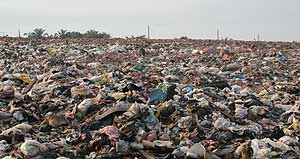 For Universiti Kebangsaan Malaysia (UKM)'s Prof Ir Dr Hassan Basri, this scenario reflected that solid wastes disposal system in the country was still inefficient.
"It is critical in the long run," said the professor in environmental engineering.
Hassan's statement was based on the environmental pollution risks posed by the open-dumping garbage disposal sites.
The implication of using open-dumping garbage disposal sites were the permeation (seepage) of 'leachate' into the underground water resources and the release of methane gas (CH4) caused by decomposition of the garbage.
The open-dumping sites also required high maintenance costs apart from causing depreciation in the value of the surrounding real estate.
"There are also constraints facing the opening of new open-dumping garbage disposal sites posed by the infrastructure requirements due to the limited land available," said Dr Latifah Abdul Manaf, a lecturer on environment from Universiti Putra Malaysia (UPM).
A visit to the sanitary garbage disposal site at Bukit Tagar found the facility to have several 'pleasant' features.
The site has a 'liner' to prevent seepage of the leachate into underground water sources apart from a system of underground pipes that pool the leachate and channelled the substance into a treatment plant.
The site was also equipped with the 'daily cover' made up of clay and plastic used to cover the garbage to prevent it from being accessible to pests like rodents and crows.
Hence, Bukit Tagar sanitary garbage disposal dump was a much welcomed garbage disposal facility as compared to the open-dumping sites that discharged foul odour that can be smelled kilometres away.
Sanitary garbage disposal sites also have a pipe system that absorb the methane gas released from decomposition of garbage that can be used for power generation.
In the case of the Bukit Tagar garbage disposal site, its 'advance cell' that was closed in November 2007 after operating for two years, now generated 1.0 megawatt of electricity used for operations at the site.
The existence of the pipes prevented accidental combustion of greenhouse gases.
The latest example on this was the fire at the 300 feet high garbage pile-up at the illegal dump at Kampung Sungai Kertas, Gombak early last September.
Few dumps are properly managed
The problems related to disposal of solid wastes was not only faced by Malaysia but also in other countries due to rapid economic development, population boom and limited land.
In Malaysia, with the population jump forecast at 2.4 percent or 600,000 a year (since 1994) more solid wastes was expected to be produced, reducing the life span of the garbage disposal dumps.
The scenario was further worsened with the statistics that showed 113 of the 289 garbage disposal sites in the country were no longer operating. Most of them were waiting for 'decomissioning'.
However the operations of several of theze sites had to be extended, like the garbage dumps at Sungai Sedu, Banting that received garbage flow from Sepang and Putrajaya. The site was supposed to be closed last June.
And, most of these 113 dumps were not sanitary garbage disposal facilities. Another interesting fact was that these garbage disposal sites were managed by the local authorities or their appointed firms.
According to the National Solid Waste Department and Solid Waste and Public Cleansing Management Corporation (PPSPPA), 114 garbage disposal sites were under the management of the local authorities with 58 in the Peninsula and Labuan Federal Territory, 41 in Sarawak and 15 in Sabah.
Gov't action plan not working
For Prof Hassan, this issue was rather complex coupled with factors like the shortage of funds and expertise, lack of public awareness apart from the 'grey' legal aspects.
Parliament passed the Solid Waste and Public Cleansing Act 2007 two years ago but due to certain reasons, it had yet to be implemented.
According to industry sources, the delay was due to the privatisation of solid waste management which was yet to be finalised despite the fact that the management of solid waste was being handled by Alam Flora, SWM Environment and Idaman Bersih Sdn Bhd according to their respective zones since 1996.
Presently, the 'employers' of these garbage disposal firms were the respective local authorities.
Back to the garbage disposal dumps issue. The government had implemented the Action Plan 1988 that was aimed at boosting the efficiency of the garbage disposal sites in stages.
The stages - controlled disposal (phase one), sanitary fill-up with daily covers (phase two), sanitary fill-up with leachate circulation system (phase three) and sanitary fill-up with leachate treatment (phase four).
However, it appeared that this action plan was not working well as proven by the fact that only seven garbage disposal dumps in the country were sanitary facilities and they were operated by the private sector.
Three of these sanitary garbage disposal dumps were in Selangor and one each in Kedah, Pahang, Melaka and Johor.
Only 5% of garbage recycled
The situation was further compounded by the society's lackadaisical attitude on the recycling campaign launched in 1993 and 2000. This was proven by the percentage of recycling being a mere five percent.
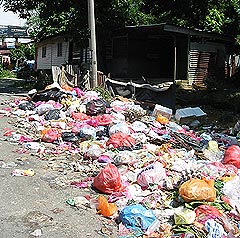 This was a great distance away from the government's target of 22 percent by the year 2020. What more when compared to a developed nation like Japan where the recycling percentage was at more than 50 percent.
The time has arrived for the government to come out with a more effective measure apart from conducting campaigns and advertisements.
Problems associated with garbage disposal such as the irregular collection of garbage should be dealt with in a transparent and wholesome manner as the amount of solid wastes was continuing to pile up everyday and expected to reach 30,000 tonnes within the next 11 years.
Hence, the society does not really have much choice except to recycle, and this can begin right in the home.
- Bernama


Are you sure you want to delete this comment?
This action cannot be undone.