




Campus polls: UM student group balks at e-voting
The Student Coalition Movement of Universiti Malaya (UM) has protested the introduction of the e-voting system in the campus elections, expressing fear that this will allow the polls to be rigged.
The Student Coalition Movement of Universiti Malaya (UM) has protested the introduction of the e-voting system in the campus elections, expressing fear that this will allow the polls to be rigged.
Student Coalition Movement president Muhammad Aizat Mohamad handed over a memorandum to Deputy Higher Education Minister Sharifuddin Abdullah after the latter officiated the revival of the speaker’s corner at the university late yesterday.
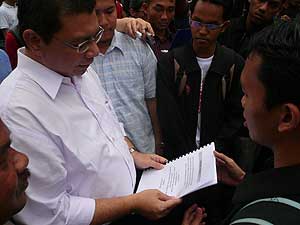 As Shariffudin was leaving, Muhammad Aizat stopped him and handed over a bound folio, briefly explaining that the movement is concerned over the “lack of transparency” in the new voting system.
The deputy minister accepted the document, saying he would look into the matter.
Vice-chancellor Azarae Haji Idris then told reporters that the majority of students are not against the implementation of e-voting.
“It is only a small group that does not believe in the transparency of the system,” he claimed.
The campus elections will be held tomorrow, with the two-day campaign to end today.
The e-voting system is being implemented for the first time at UM, following its introduction in Universiti Islam Antarabangsa and University Putra Malaysia in recent years.
Earlier yesterday, the UM pro-mahasiswa group contesting the election showed its dissatisfaction over the elections by submitting a blank manifesto to the Student Affairs’ Department.
The group had, in its original manifesto, pledged to work towards abolition of the Internal Security Act and Biro Tata Negara (National Civics Bureau) programmes.
However, the department directed this pledge be removed, leading to the protest action.
Speaker’s corner revived
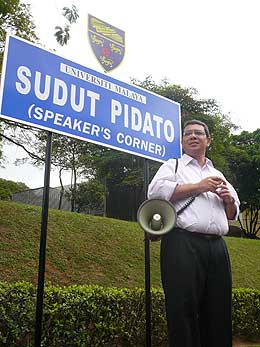 Sharifuddin, in launching the speaker’s corner, said its use should not be bound by rules or the need for registration.
“This a place for students to voice their opinions, thoughts and dissatisfaction. Speakers have immunity so long as the content doesn't trigger racial tension or contravene the laws,” he said.
While the Higher Education Ministry has not set guidelines for the speaker’s corner, he said the campus authorities have the jurisdiction to do so.
As he was speaking, the deputy minister spotted a student wearing a Che Guevara t-shirt in the crowd of about 100.
Pointing to the t-shirt, he said he wants students to be as intellectual as the Cuban revolutionary, so that their portraits will be similarly featured on local t-shirts in future.
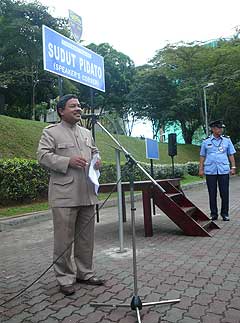 UM’s current speaker’s corner is located at the concourse near the cafeteria.
The university had been the first in the country to provide a speaker’s corner, but the lively venue was shut down due to stringent enforcement of the Universities and University Colleges Act 1971, which bars students from engaging in political activism and participation in political parties.
While it was amended in 2008 to allow participation in off-campus associations, it still prohibits affiliation with political parties unless for academic research. Students are also not allowed to express support for, or opposition to, any political party.
Last November, the Higher Education Ministry gave the green light for a speaker’s corner on all campuses. Universiti Kebangsaan Malaysia was the first to establish one, launching it on Jan 15.


Are you sure you want to delete this comment?
This action cannot be undone.