




Tough going for majority of Sabah single mums
The majority of single mums in Sabah - as elsewhere in Malaysia - generally lack proper education and live below the poverty line.
The majority of single mums in Sabah - as elsewhere in Malaysia - generally lack proper education and live below the poverty line.
In fact Sabah has the highest incidence of poverty in Malaysia, with over a quarter of the population living in poverty.
 According to Sabah State Minister for Development and Consumer Affairs, Azizah Mohd Dun (
left
), “The poorest of the poor are the rural poor.”
According to Sabah State Minister for Development and Consumer Affairs, Azizah Mohd Dun (
left
), “The poorest of the poor are the rural poor.”
She also said there was a trend towards the feminisation of poverty. “Most single mothers face financial problems. In this category, 65.6 percent face difficulties sending their children to school. Over a quarter had problems sustaining their daily needs due to the absence of a source of income.”
Poverty study
Azizah gave further details from a poverty study done by Universiti Putra Malaysia which indicated that most single mothers were either labourers or factory workers, dispelling the notion that poverty was confined mostly to rural areas.
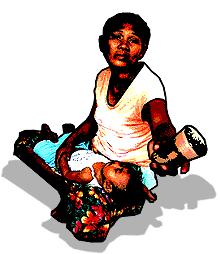 Azizah noted that men compounded the situation by not providing for their families after divorce, and single mothers had to somehow cope with housing, housework, and the expenses of raising the children.
To make things worse, single mothers often had poor communication and relationships with their children who also often displayed a lack of interest in studies. The mothers also faced health and work-related problems if they were employed.
At the social level, single mothers had problems relating to and communicating with others, said Azizah. This is because there is a prevailing attitude in society that looks down on divorcees and widows. “The woman is often blamed for the divorce, creating emotional stress among single mothers and eroding their self-confidence."
Special needs
She added that improving the lives of single mothers took a long time and needed a special approach beginning with data input at every level on matters involving the family.
This could come from government agencies, schools, voluntary associations and leaders at the community level.
State assemblypersons, district officers and village security and development committees could identify the poverty groups in their areas and take action to help and provide the government with the data.
New initiatives planned by the government to tackle poverty include recruiting the help of voluntary associations, enlisting contributions, embarking on adoption projects and continuing poverty studies to update the picture and come up with new strategies.
“Sometimes, we help or adopt underprivileged people who we don’t even know, living in other countries. But if our neighbours are in difficultiies, we don’t help them,” said Azizah. “There are underprivileged people around us who need help but we don’t seem to be aware of them.”
The state government hopes that members of the public would contact its agencies and voluntary associations for details on children they can sponsor under an adoption scheme.
 “My ministry can provide assistance to those interested in sponsoring a child,” said Azizah in urging well-off families to come forward. “They can help by taking care of their schooling needs. The children don’t have to live with them.”
Political interference
Meanwhile, Dusun activist Raymond Tombung charged that political interference was a source of trouble in channeling aid under anti-poverty economic assistance programmes.
He cited the Hardcore Poor Housing Programme and other government-funded housing schemes for the poor as an example. “Many undeserving people are collecting the benefits,” alleged Tombung. “As a result, the benefits do not reach the intended targets.”
The government’s Tekun loan programme for the poor is another case of abuse, according to Tombung. “Applicants for Tekun loans are required to state their voting constituency, as well as their race and religion before getting the recommendation of their elected representative.”
This means, Tombung said, that those who don’t support the ruling party are often excluded from the Tekun loan scheme.


Are you sure you want to delete this comment?
This action cannot be undone.